Vanderbilt University Medical Center, Department of Pediatrics, Division of Neonatology, Monroe Carell Jr. Children's Hospital at Vanderbilt, Nashville, TN 37232–9544, USA.
J Perinatol. 2011 Jan;31(1):51-7. doi: 10.1038/jp.2010.71. Epub 2010 Jun 10.
The aim of this study is to characterize baseline regional oxygen saturations (rSO(2)) in stable preterm infants during the first weeks of life.
Cerebral, renal and abdominal rSO(2) were continuously monitored from the time of birth to 21 days in twelve preterm infants of 29-34 weeks gestation. Regional saturations were evaluated for trends over time, variability and differences between gestational ages (GAs) and reported pediatric values.
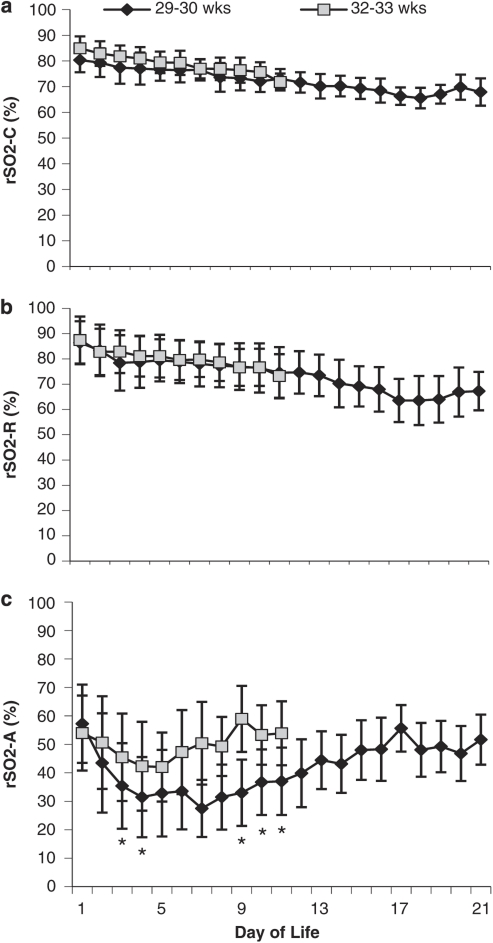
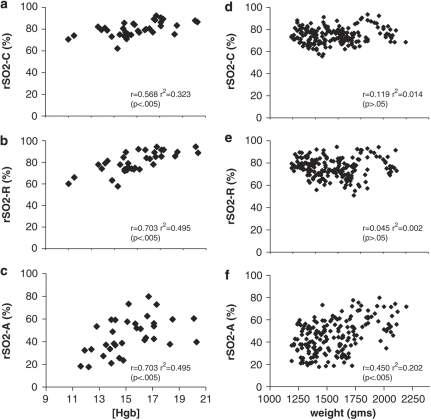
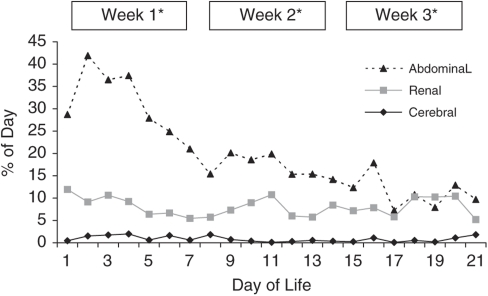
Both cerebral (66-83%) and renal (64-87%) rSO(2) baselines were within the range of reported neonatal values but consistently decreased over the first weeks of life (P<0.01). The baseline abdominal rSO(2) was 32-66% and increased with GA (P=0.05). The rSO(2) variability was lowest for cerebral measurements and highest at the abdomen. Abdominal rSO(2) variability decreased over time (P≤0.05).
Daily baseline rSO(2) in preterm infants changes over the first weeks of life, especially at the abdomen. Evolution in baseline rSO2 over time may indicate regional developmental maturation of physiological oxygen balance.
本研究旨在描述稳定早产儿出生后最初数周的基线局部氧饱和度(rSO₂)。
对 12 名 29-34 周胎龄的早产儿从出生到 21 天进行连续监测,监测大脑、肾脏和腹部 rSO₂。评估局部饱和度随时间的趋势、变异性以及不同胎龄之间的差异,并与已发表的儿科正常值进行比较。
大脑(66-83%)和肾脏(64-87%)的 rSO₂基线均在已报道的新生儿正常值范围内,但在出生后最初数周内持续下降(P<0.01)。腹部 rSO₂的基线值为 32-66%,并随胎龄增加(P=0.05)。大脑测量的 rSO₂变异性最低,腹部的 rSO₂变异性最高。腹部 rSO₂变异性随时间减少(P≤0.05)。
早产儿出生后最初数周的每日 rSO₂基线值发生变化,尤其是在腹部。rSO₂随时间的演变可能表明局部生理氧平衡的发育成熟。