Division of Infectious Diseases, The Children's Hospital of Philadelphia, University of Pennsylvania School of Medicine, Philadelphia, PA, USA.
BMC Pediatr. 2010 Jun 11;10:40. doi: 10.1186/1471-2431-10-40.
The highest incidence of rotavirus gastroenteritis has generally been reported in children 6-24 months of age. Young infants are thought to be partially protected by maternal antibodies acquired transplacentally or via breast milk. The purpose of our study was to assess the age distribution of children with confirmed community-acquired rotavirus gastroenteritis presenting to an urban referral hospital.
Children presenting to The Children's Hospital of Philadelphia with acute gastroenteritis have been monitored for the presence of rotavirus antigen in the stool by ELISA (followed by genotyping if ELISA-positive) since the 1994-95 epidemic season.
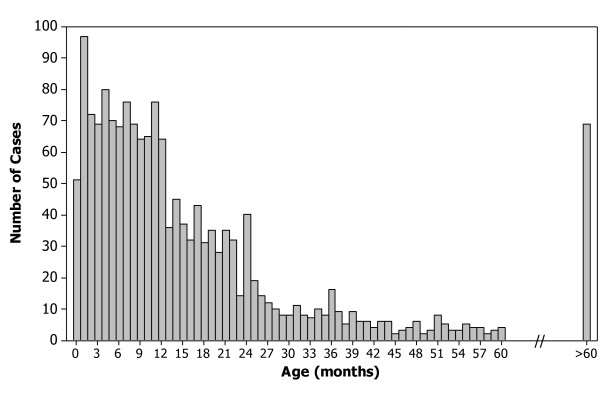
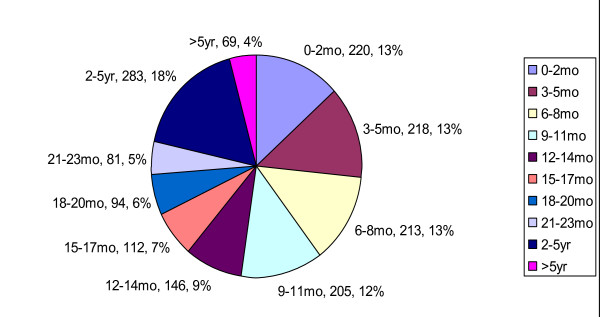
Over the last 12 rotavirus seasons prior to the introduction of the pentavalent rotavirus vaccine in 2006, stool specimens from 1646 patients tested positive for community-acquired rotavirus infection. Gender or age was not recorded in 6 and 5 cases, respectively. Overall, 58% of the cases occurred in boys. G1 was the predominant VP7 serotype, accounting for 72% of cases. The median (IQR) age was 11 (5-21) months. A total of 790 (48%) cases occurred in children outside the commonly quoted peak age range, with 27% in infants <6 months of age and 21% in children >24 months of age. A total of 220 (13%) cases occurred during the first 3 months of life, and the highest number of episodes per month of age [97 (6%)] was observed during the second month of life.
The incidence of community-acquired rotavirus gastroenteritis monitored over 12 seasons in the prevaccine era at a major university hospital was nearly constant for each month of age during the first year of life, revealing an unexpectedly high incidence of symptomatic rotavirus disease in infants <3 months old. A sizeable fraction of cases occurred in children too young to have been vaccinated according to current recommendations.
轮状病毒胃肠炎的最高发病率通常见于 6-24 月龄儿童。人们认为,年幼婴儿通过胎盘或母乳获得的母传抗体而得到部分保护。本研究旨在评估在一家城市转诊医院就诊的确诊社区获得性轮状病毒胃肠炎患儿的年龄分布。
自 1994-1995 年流行季以来,费城儿童医院通过 ELISA(如果 ELISA 阳性则进一步进行基因分型)监测急性胃肠炎患儿粪便中轮状病毒抗原的存在情况。
在 2006 年五价轮状病毒疫苗引入之前的过去 12 个轮状病毒流行季中,1646 例粪便标本检测出社区获得性轮状病毒感染阳性。分别有 6 例和 5 例患儿未记录性别或年龄。总体而言,58%的病例发生在男孩。G1 是最常见的 VP7 血清型,占 72%的病例。中位(IQR)年龄为 11(5-21)月龄。共有 790(48%)例病例发生在通常引用的高峰年龄范围之外,其中 27%的患儿年龄小于 6 个月,21%的患儿年龄大于 24 个月。共有 220(13%)例病例发生在出生后的前 3 个月,每个月的发病例数[97(6%)]在出生后第 2 个月最高。
在主要大学医院,在疫苗前时代的 12 个流行季监测到的社区获得性轮状病毒胃肠炎的发病率在生命的第一年每个月龄段几乎保持不变,揭示了令人惊讶的高发症状性轮状病毒疾病在 3 个月龄以下婴儿中。相当一部分病例发生在根据当前建议接种疫苗年龄太小的儿童中。