Clare Hall Laboratories, Cancer Research UK London Research Institute, Blanche Lane, South Mimms EN6 3LD, UK.
Mol Cell. 2010 Jun 11;38(5):637-48. doi: 10.1016/j.molcel.2010.04.017.
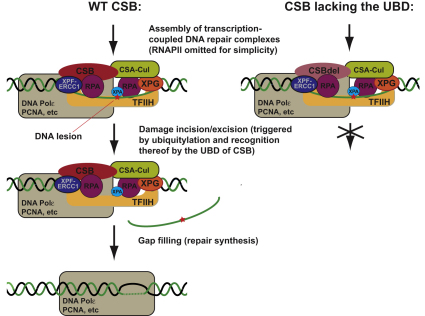
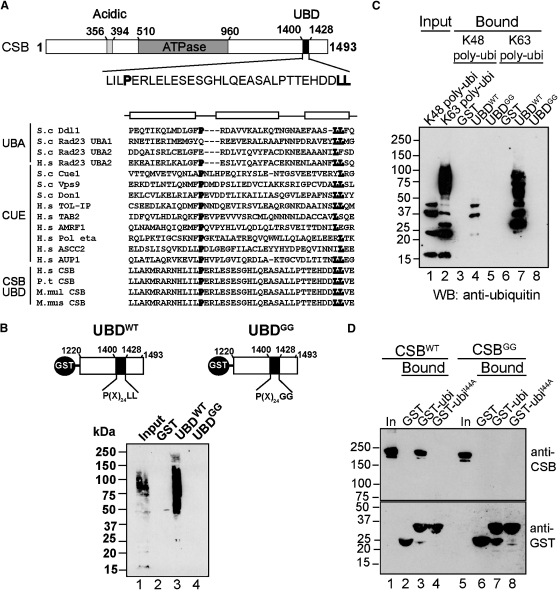
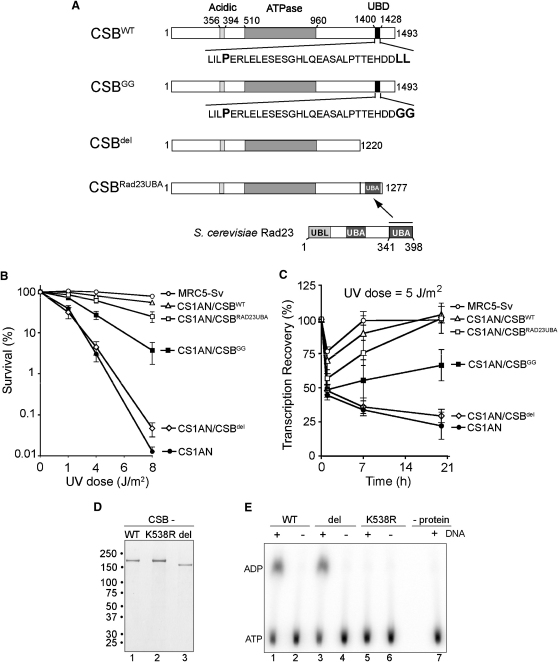
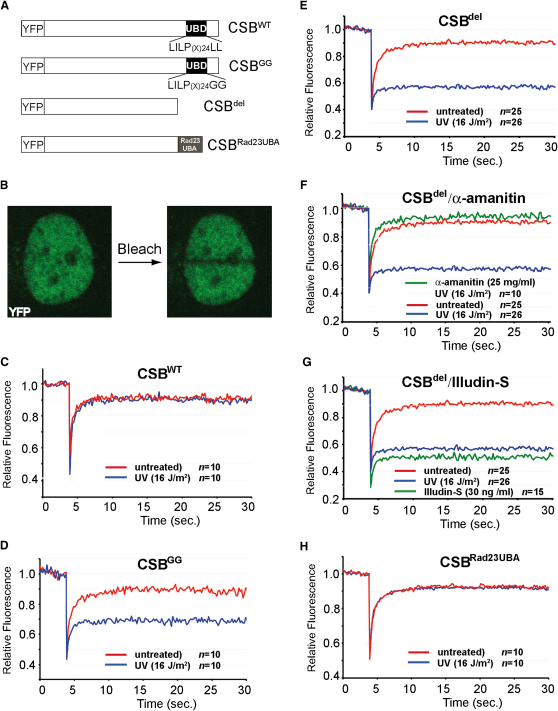
Transcription-coupled nucleotide excision repair (TC-NER) allows RNA polymerase II (RNAPII)-blocking lesions to be rapidly removed from the transcribed strand of active genes. Defective TCR in humans is associated with Cockayne syndrome (CS), typically caused by defects in either CSA or CSB. Here, we show that CSB contains a ubiquitin-binding domain (UBD). Cells expressing UBD-less CSB (CSB(del)) have phenotypes similar to those of cells lacking CSB, but these can be suppressed by appending a heterologous UBD, so ubiquitin binding is essential for CSB function. Surprisingly, CSB(del) remains capable of assembling nucleotide excision repair factors and repair synthesis proteins around damage-stalled RNAPII, but such repair complexes fail to excise the lesion. Together, our results indicate an essential role for protein ubiquitylation and CSB's UBD in triggering damage incision during TC-NER and allow us to integrate the function of CSA and CSB in a model for the process.
转录偶联核苷酸切除修复(TC-NER)可使 RNA 聚合酶 II(RNAPII)阻断的损伤迅速从活跃基因的转录链中移除。人类 TCR 的缺陷与 Cockayne 综合征(CS)有关,通常由 CSA 或 CSB 的缺陷引起。在这里,我们表明 CSB 含有一个泛素结合结构域(UBD)。表达无 UBD 的 CSB(CSB(del))的细胞具有类似于缺乏 CSB 的细胞的表型,但通过添加异源 UBD 可以抑制这些表型,因此泛素结合对 CSB 功能至关重要。令人惊讶的是,CSB(del)仍然能够在损伤停滞的 RNAPII 周围组装核苷酸切除修复因子和修复合成蛋白,但这些修复复合物无法切除损伤。总之,我们的结果表明蛋白质泛素化和 CSB 的 UBD 在 TC-NER 过程中触发损伤切口至关重要,并使我们能够在该过程的模型中整合 CSA 和 CSB 的功能。