Faculty of Life Sciences, University of Manchester, Manchester, UK.
Neuroscience. 2010 Sep 15;169(4):1630-9. doi: 10.1016/j.neuroscience.2010.06.015. Epub 2010 Jun 12.
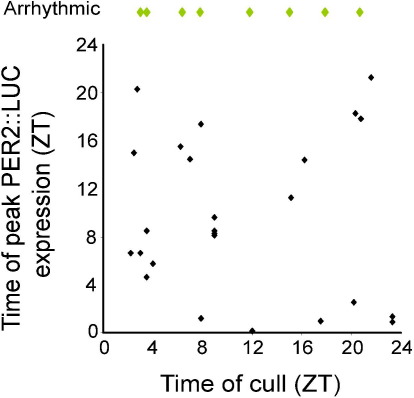
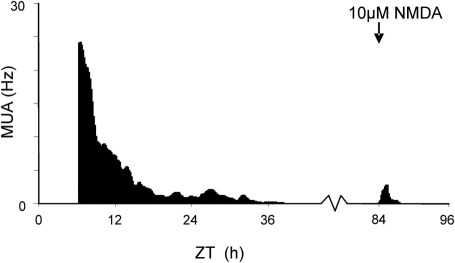
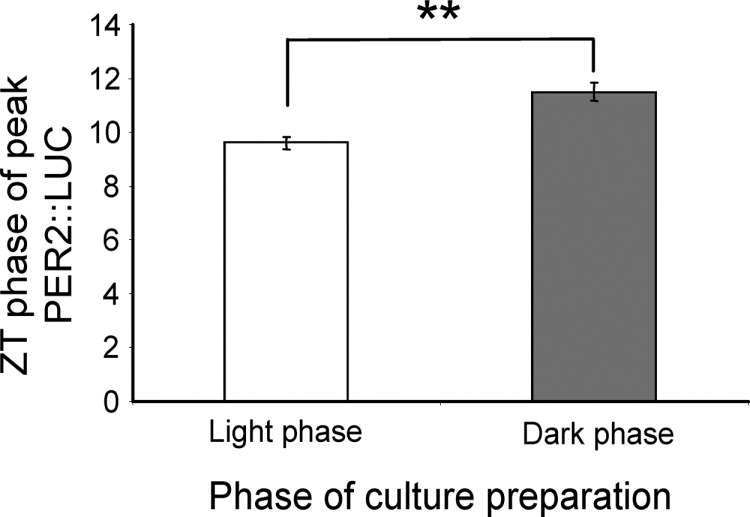
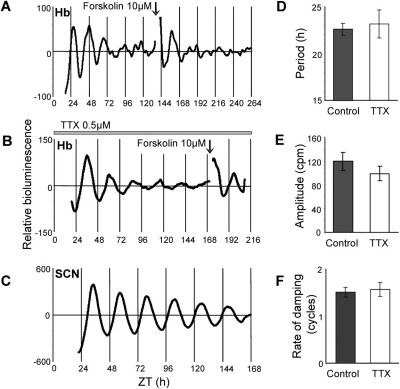
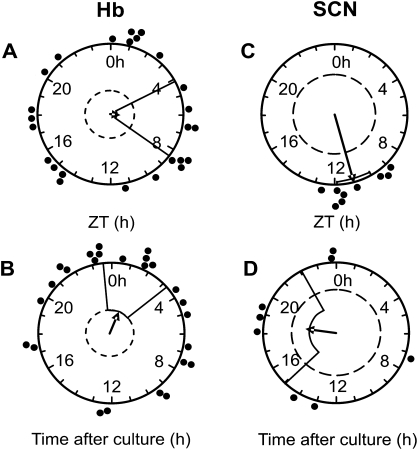
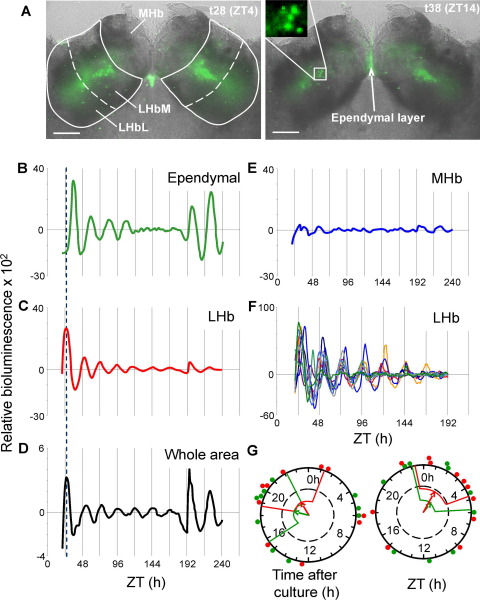
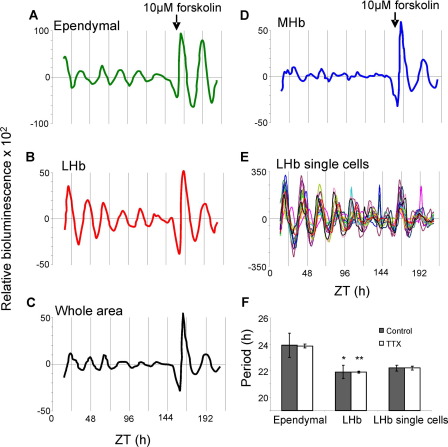
The habenula complex is implicated in a range of cognitive, emotional and reproductive behaviors, and recently this epithalamic structure was suggested to be a component of the brain's circadian system. Circadian timekeeping is driven in cells by the cyclical activity of core clock genes and proteins such as per2/PER2. There are currently no reports of rhythmic clock gene/protein expression in the habenula and therefore the question of whether this structure has an intrinsic molecular clock remains unresolved. Here, using videomicroscopy imaging and photon-counting of a PER2::luciferase (LUC) fusion protein together with multiunit electrophysiological recordings, we tested the endogenous circadian properties of the mouse habenula in vitro. We show that a circadian oscillator is localized primarily to the medial portion of the lateral habenula. Rhythms in PER2:: LUC bioluminescence here are visualized in single cells and oscillations continue in the presence of the sodium channel blocker, tetrodotoxin, indicating that individual cells have intrinsic timekeeping properties. Ependymal cells lining the dorsal third ventricle also express circadian oscillations of PER2. These findings establish that neurons and non-neuronal cells in the epithalamus express rhythms in cellular and molecular activities, indicating a role for circadian oscillators in the temporal regulation of habenula controlled processes and behavior.
缰核复合体参与了一系列认知、情感和生殖行为,最近这个丘脑下结构被认为是大脑昼夜节律系统的一个组成部分。昼夜节律的计时是由核心时钟基因和蛋白质(如 per2/PER2)的周期性活动驱动的。目前还没有缰核中时钟基因/蛋白表达呈节律性的报告,因此这个结构是否具有内在的分子时钟仍然没有解决。在这里,我们使用视频显微镜成像和 PER2::荧光素酶(LUC)融合蛋白的光子计数以及多单位电生理记录,在体外测试了小鼠缰核的内源性昼夜节律特性。我们表明,一个昼夜振荡器主要定位于外侧缰核的中间部分。在这里,PER2::LUC 生物发光的节律可以在单个细胞中可视化,并且在钠离子通道阻断剂河豚毒素存在的情况下,振荡仍在继续,这表明单个细胞具有内在的计时特性。排列在第三脑室背侧的室管膜细胞也表达 PER2 的昼夜振荡。这些发现表明,丘脑中的神经元和非神经元细胞表达细胞和分子活动的节律,表明昼夜振荡器在缰核控制的过程和行为的时间调节中发挥作用。