Oxford Centre for Diabetes Endocrinology and Metabolism, University of Oxford, Churchill Hospital, Oxford, UK.
Diabetes. 2010 Sep;59(9):2198-208. doi: 10.2337/db09-1505. Epub 2010 Jun 14.
To document the properties of the voltage-gated ion channels in human pancreatic alpha-cells and their role in glucagon release.
Glucagon release was measured from intact islets. Ca(2+) was recorded in cells showing spontaneous activity at 1 mmol/l glucose. Membrane currents and potential were measured by whole-cell patch-clamping in isolated alpha-cells identified by immunocytochemistry.
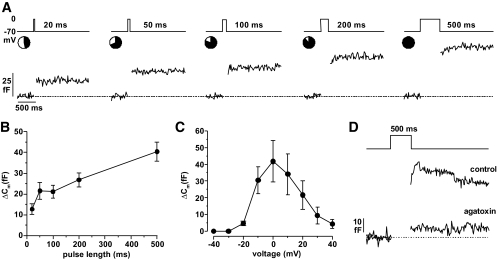
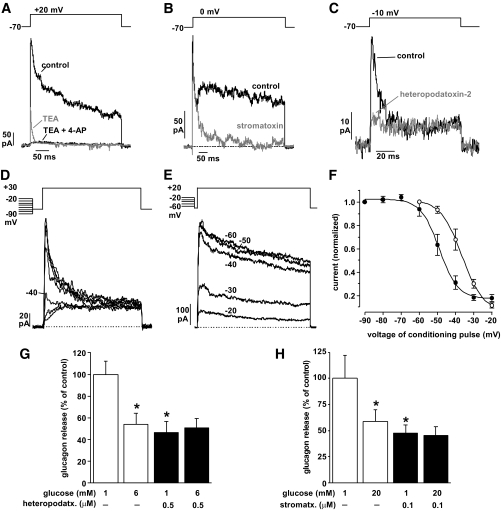
Glucose inhibited glucagon secretion from human islets; maximal inhibition was observed at 6 mmol/l glucose. Glucagon secretion at 1 mmol/l glucose was inhibited by insulin but not by ZnCl(2). Glucose remained inhibitory in the presence of ZnCl(2) and after blockade of type-2 somatostatin receptors. Human alpha-cells are electrically active at 1 mmol/l glucose. Inhibition of K(ATP)-channels with tolbutamide depolarized alpha-cells by 10 mV and reduced the action potential amplitude. Human alpha-cells contain heteropodatoxin-sensitive A-type K(+)-channels, stromatoxin-sensitive delayed rectifying K(+)-channels, tetrodotoxin-sensitive Na(+)-currents, and low-threshold T-type, isradipine-sensitive L-type, and omega-agatoxin-sensitive P/Q-type Ca(2+)-channels. Glucagon secretion at 1 mmol/l glucose was inhibited by 40-70% by tetrodotoxin, heteropodatoxin-2, stromatoxin, omega-agatoxin, and isradipine. The Ca(2+) oscillations depend principally on Ca(2+)-influx via L-type Ca(2+)-channels. Capacitance measurements revealed a rapid (<50 ms) component of exocytosis. Exocytosis was negligible at voltages below -20 mV and peaked at 0 mV. Blocking P/Q-type Ca(2+)-currents abolished depolarization-evoked exocytosis.
Human alpha-cells are electrically excitable, and blockade of any ion channel involved in action potential depolarization or repolarization results in inhibition of glucagon secretion. We propose that voltage-dependent inactivation of these channels underlies the inhibition of glucagon secretion by tolbutamide and glucose.
记录人胰腺α细胞电压门控离子通道的特性及其在胰高血糖素分泌中的作用。
从完整胰岛中测量胰高血糖素的释放。在 1mmol/l 葡萄糖条件下记录显示自发性活动的细胞中的 Ca(2+)。通过免疫细胞化学鉴定的分离的α细胞进行全细胞膜片钳测量,记录膜电流和电位。
葡萄糖抑制人胰岛中胰高血糖素的分泌;在 6mmol/l 葡萄糖时观察到最大抑制。1mmol/l 葡萄糖条件下的胰高血糖素分泌被胰岛素抑制,但不受 ZnCl(2)影响。在 ZnCl(2)存在下和阻断 2 型生长抑素受体后,葡萄糖仍具有抑制作用。人α细胞在 1mmol/l 葡萄糖条件下具有电活性。用甲苯磺丁脲抑制 K(ATP)通道使α细胞去极化 10mV,并降低动作电位幅度。人α细胞含有异钩藤碱敏感 A 型 K(+)通道、慢钙激活钾通道、河豚毒素敏感的 Na(+)电流以及低阈值 T 型、异搏定敏感的 L 型和ω-芋螺毒素敏感的 P/Q 型 Ca(2+)通道。1mmol/l 葡萄糖条件下的胰高血糖素分泌被 40-70%的河豚毒素、异钩藤碱-2、慢钙激活钾通道、ω-芋螺毒素和异搏定抑制。Ca(2+) 振荡主要依赖于 L 型 Ca(2+)通道的钙内流。电容测量揭示了快速(<50ms)的胞吐作用组成部分。在低于-20mV 的电压下,胞吐作用可以忽略不计,在 0mV 时达到峰值。阻断 P/Q 型 Ca(2+)电流消除了去极化诱发的胞吐作用。
人胰腺α细胞具有电兴奋性,阻断任何参与动作电位去极化或复极化的离子通道都会导致胰高血糖素分泌抑制。我们提出,这些通道的电压依赖性失活是甲苯磺丁脲和葡萄糖抑制胰高血糖素分泌的基础。