San Francisco Department of Public Health, San Francisco, California, USA.
PLoS One. 2010 Jun 10;5(6):e11068. doi: 10.1371/journal.pone.0011068.
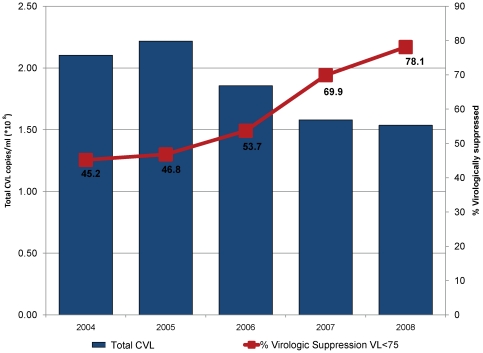
At the individual level, higher HIV viral load predicts sexual transmission risk. We evaluated San Francisco's community viral load (CVL) as a population level marker of HIV transmission risk. We hypothesized that the decrease in CVL in San Francisco from 2004-2008, corresponding with increased rates of HIV testing, antiretroviral therapy (ART) coverage and effectiveness, and population-level virologic suppression, would be associated with a reduction in new HIV infections.
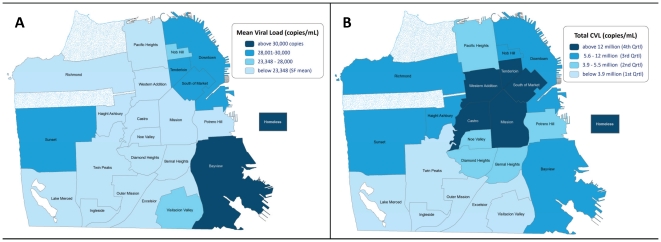
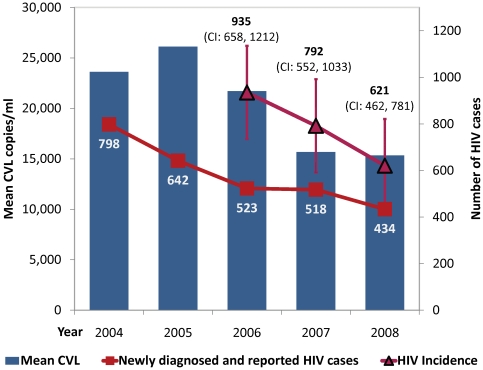
METHODOLOGY/PRINCIPAL FINDINGS: We used San Francisco's HIV/AIDS surveillance system to examine the trends in CVL. Mean CVL was calculated as the mean of the most recent viral load of all reported HIV-positive individuals in a particular community. Total CVL was defined as the sum of the most recent viral loads of all HIV-positive individuals in a particular community. We used Poisson models with robust standard errors to assess the relationships between the mean and total CVL and the primary outcome: annual numbers of newly diagnosed HIV cases. Both mean and total CVL decreased from 2004-2008 and were accompanied by decreases in new HIV diagnoses from 798 (2004) to 434 (2008). The mean (p = 0.003) and total CVL (p = 0.002) were significantly associated with new HIV cases from 2004-2008.
CONCLUSIONS/SIGNIFICANCE: Reductions in CVL are associated with decreased HIV infections. Results suggest that wide-scale ART could reduce HIV transmission at the population level. Because CVL is temporally upstream of new HIV infections, jurisdictions should consider adding CVL to routine HIV surveillance to track the epidemic, allocate resources, and to evaluate the effectiveness of HIV prevention and treatment efforts.
在个体层面上,较高的 HIV 病毒载量预示着性传播风险。我们评估了旧金山的社区病毒载量(CVL),将其作为 HIV 传播风险的人群水平标志物。我们假设,旧金山的 CVL 从 2004 年至 2008 年下降,与 HIV 检测、抗逆转录病毒治疗(ART)覆盖率和有效性的增加以及人群水平的病毒学抑制率的增加有关,这将与新的 HIV 感染减少相关。
方法/主要发现:我们使用旧金山的 HIV/AIDS 监测系统来研究 CVL 的趋势。平均 CVL 是通过计算特定社区中所有报告 HIV 阳性个体的最近一次病毒载量的平均值来计算的。总 CVL 是通过计算特定社区中所有 HIV 阳性个体的最近一次病毒载量的总和来定义的。我们使用具有稳健标准误差的泊松模型来评估平均 CVL 和总 CVL 与主要结局(每年新诊断的 HIV 病例数)之间的关系。平均 CVL 和总 CVL 均从 2004 年至 2008 年下降,并且伴随着新的 HIV 诊断从 2004 年的 798 例下降到 2008 年的 434 例。从 2004 年至 2008 年,平均 CVL(p=0.003)和总 CVL(p=0.002)与新的 HIV 病例显著相关。
结论/意义:CVL 的降低与 HIV 感染的减少有关。结果表明,广泛的 ART 可以降低人群层面的 HIV 传播。由于 CVL 是新的 HIV 感染的时间上游,因此司法管辖区应考虑将 CVL 添加到常规 HIV 监测中,以跟踪疫情,分配资源,并评估 HIV 预防和治疗工作的效果。