Department of Neurology, University of Texas Medical Branch, Galveston, Texas, USA.
PLoS Genet. 2010 Jun 10;6(6):e1000984. doi: 10.1371/journal.pgen.1000984.
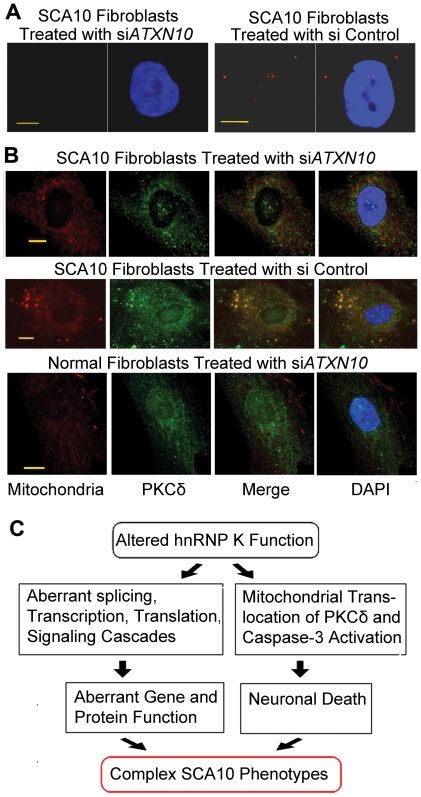
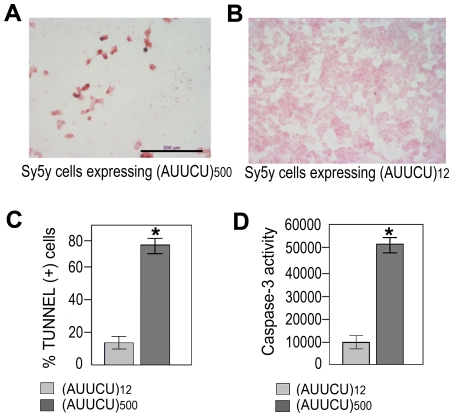
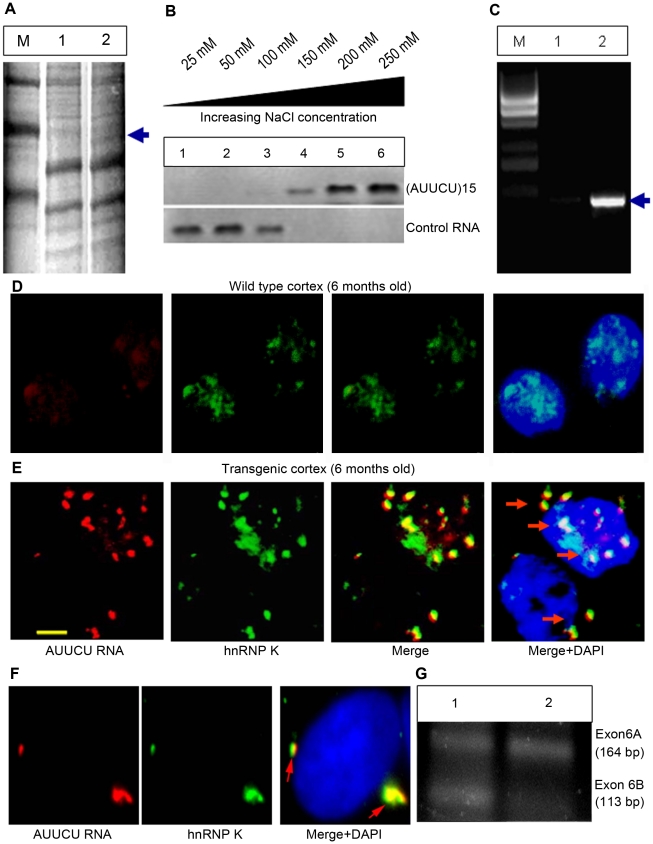
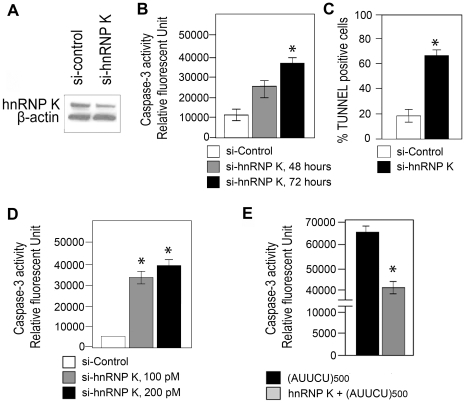
We have identified a large expansion of an ATTCT repeat within intron 9 of ATXN10 on chromosome 22q13.31 as the genetic mutation of spinocerebellar ataxia type 10 (SCA10). Our subsequent studies indicated that neither a gain nor a loss of function of ataxin 10 is likely the major pathogenic mechanism of SCA10. Here, using SCA10 cells, and transfected cells and transgenic mouse brain expressing expanded intronic AUUCU repeats as disease models, we show evidence for a key pathogenic molecular mechanism of SCA10. First, we studied the fate of the mutant repeat RNA by in situ hybridization. A Cy3-(AGAAU)(10) riboprobe detected expanded AUUCU repeats aggregated in foci in SCA10 cells. Pull-down and co-immunoprecipitation data suggested that expanded AUUCU repeats within the spliced intronic sequence strongly bind to hnRNP K. Co-localization of hnRNP K and the AUUCU repeat aggregates in the transgenic mouse brain and transfected cells confirmed this interaction. To examine the impact of this interaction on hnRNP K function, we performed RT-PCR analysis of a splicing-regulatory target of hnRNP K, and found diminished hnRNP K activity in SCA10 cells. Cells expressing expanded AUUCU repeats underwent apoptosis, which accompanied massive translocation of PKCdelta to mitochondria and activation of caspase 3. Importantly, siRNA-mediated hnRNP K deficiency also caused the same apoptotic event in otherwise normal cells, and over-expression of hnRNP K rescued cells expressing expanded AUUCU repeats from apoptosis, suggesting that the loss of function of hnRNP K plays a key role in cell death of SCA10. These results suggest that the expanded AUUCU-repeat in the intronic RNA undergoes normal transcription and splicing, but causes apoptosis via an activation cascade involving a loss of hnRNP K activities, massive translocation of PKCdelta to mitochondria, and caspase 3 activation.
我们已经确定,22q13.31 号染色体上 ATXN10 内含子 9 中的 ATTCT 重复序列的大量扩增是脊髓小脑性共济失调 10 型(SCA10)的基因突变。我们随后的研究表明,ataxin 10 的功能获得或缺失都不太可能是 SCA10 的主要致病机制。在这里,我们使用 SCA10 细胞、转染细胞和表达扩增内含子 AUUCU 重复的转基因鼠脑作为疾病模型,展示了 SCA10 的一个关键致病分子机制的证据。首先,我们通过原位杂交研究了突变重复 RNA 的命运。Cy3-(AGAAU)(10)核糖探针检测到 SCA10 细胞中扩增的 AUUCU 重复序列聚集在焦点中。拉下和共免疫沉淀数据表明,剪接内含子序列中的扩增 AUUCU 重复序列强烈结合到 hnRNP K。hnRNP K 和 AUUCU 重复聚集体在转基因鼠脑和转染细胞中的共定位证实了这种相互作用。为了研究这种相互作用对 hnRNP K 功能的影响,我们对 hnRNP K 的一个剪接调节靶标进行了 RT-PCR 分析,发现 SCA10 细胞中的 hnRNP K 活性降低。表达扩增 AUUCU 重复序列的细胞发生凋亡,同时 PKCdelta 大量转移到线粒体并激活 caspase 3。重要的是,siRNA 介导的 hnRNP K 缺陷也会导致正常细胞发生相同的凋亡事件,而过表达 hnRNP K 可使表达扩增 AUUCU 重复序列的细胞免于凋亡,表明 hnRNP K 的功能丧失在 SCA10 的细胞死亡中起着关键作用。这些结果表明,内含子 RNA 中的扩增 AUUCU 重复序列经历正常的转录和剪接,但通过涉及 hnRNP K 活性丧失、PKCdelta 大量转移到线粒体和 caspase 3 激活的激活级联反应引起细胞凋亡。