Department of Horticultural Science, North Carolina State University, Raleigh, North Carolina, USA.
PLoS Genet. 2010 Jun 10;6(6):e1000982. doi: 10.1371/journal.pgen.1000982.
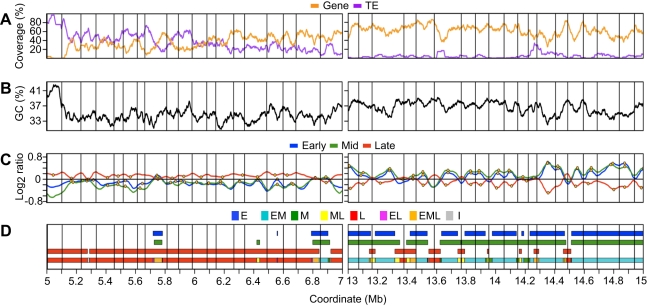
DNA replication programs have been studied extensively in yeast and animal systems, where they have been shown to correlate with gene expression and certain epigenetic modifications. Despite the conservation of core DNA replication proteins, little is known about replication programs in plants. We used flow cytometry and tiling microarrays to profile DNA replication of Arabidopsis thaliana chromosome 4 (chr4) during early, mid, and late S phase. Replication profiles for early and mid S phase were similar and encompassed the majority of the euchromatin. Late S phase exhibited a distinctly different profile that includes the remaining euchromatin and essentially all of the heterochromatin. Termination zones were consistent between experiments, allowing us to define 163 putative replicons on chr4 that clustered into larger domains of predominately early or late replication. Early-replicating sequences, especially the initiation zones of early replicons, displayed a pattern of epigenetic modifications specifying an open chromatin conformation. Late replicons, and the termination zones of early replicons, showed an opposite pattern. Histone H3 acetylated on lysine 56 (H3K56ac) was enriched in early replicons, as well as the initiation zones of both early and late replicons. H3K56ac was also associated with expressed genes, but this effect was local whereas replication time correlated with H3K56ac over broad regions. The similarity of the replication profiles for early and mid S phase cells indicates that replication origin activation in euchromatin is stochastic. Replicon organization in Arabidopsis is strongly influenced by epigenetic modifications to histones and DNA. The domain organization of Arabidopsis is more similar to that in Drosophila than that in mammals, which may reflect genome size and complexity. The distinct patterns of association of H3K56ac with gene expression and early replication provide evidence that H3K56ac may be associated with initiation zones and replication origins.
DNA 复制程序在酵母和动物系统中得到了广泛研究,这些研究表明它们与基因表达和某些表观遗传修饰相关。尽管核心 DNA 复制蛋白具有保守性,但人们对植物中的复制程序知之甚少。我们使用流式细胞术和平铺微阵列来分析拟南芥第 4 号染色体(chr4)在早期、中期和晚期 S 期的 DNA 复制情况。早期和中期 S 期的复制图谱相似,涵盖了大部分常染色质。晚期 S 期表现出明显不同的图谱,包括其余的常染色质和几乎所有的异染色质。实验之间的终止区是一致的,这使我们能够在 chr4 上定义 163 个假定的复制子,这些复制子聚类成主要是早期或晚期复制的较大区域。早期复制序列,尤其是早期复制子的起始区,显示出一种指定开放染色质构象的表观遗传修饰模式。晚期复制子和早期复制子的终止区则表现出相反的模式。赖氨酸 56 乙酰化的组蛋白 H3(H3K56ac)在早期复制子中富集,以及早期和晚期复制子的起始区中也富集。H3K56ac 还与表达基因相关,但这种效应是局部的,而复制时间与 H3K56ac 在广泛区域上的相关性。早期和中期 S 期细胞的复制图谱相似,表明常染色质中复制起点的激活是随机的。拟南芥复制子的组织受到组蛋白和 DNA 的表观遗传修饰的强烈影响。拟南芥的结构域组织与果蝇的更为相似,而与哺乳动物的差异较大,这可能反映了基因组的大小和复杂性。H3K56ac 与基因表达和早期复制的明显关联提供了证据,表明 H3K56ac 可能与起始区和复制起点有关。