Department of Orthopaedic, Laboratory of Biomaterials and Biomechanics, Medical School Hannover, Germany.
Biomed Eng Online. 2010 Jun 15;9:24. doi: 10.1186/1475-925X-9-24.
Material wear testing is an important technique in the development and evaluation of materials for use in implant for total knee arthroplasty. Since a knee joint induces a complex rolling-gliding movement, standardised material wear testing devices such as Pin-on-Disc or Ring-on-Disc testers are suitable to only a limited extent because they generate pure gliding motion only.
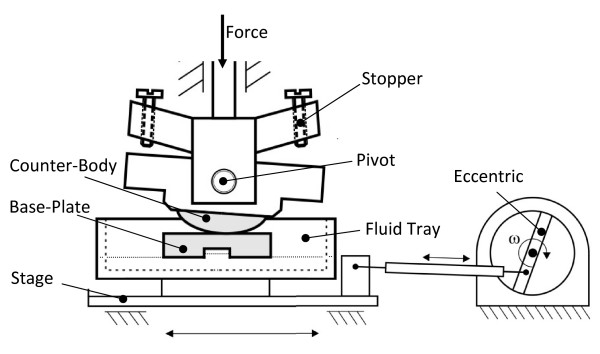
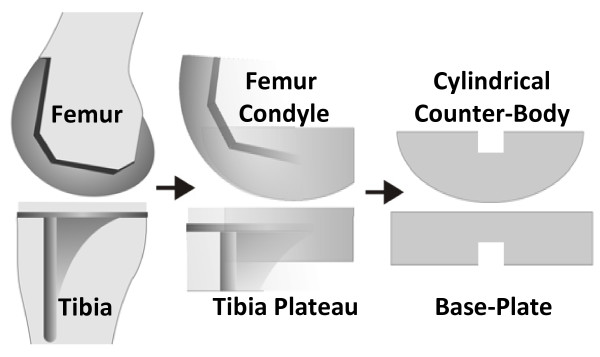
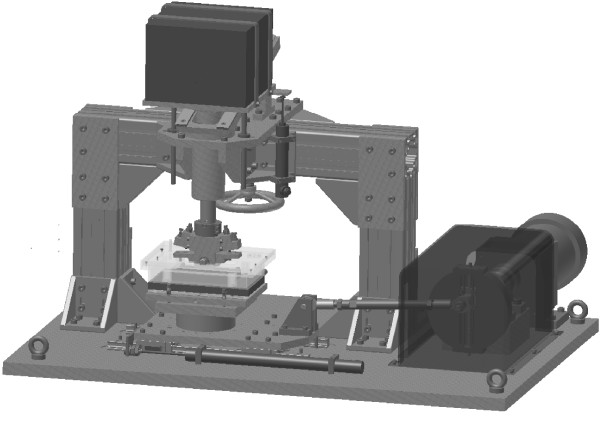
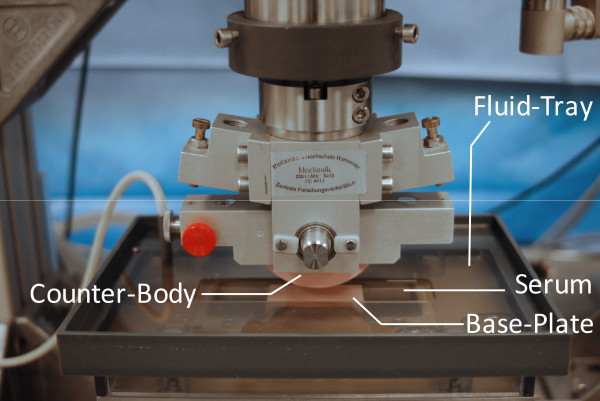
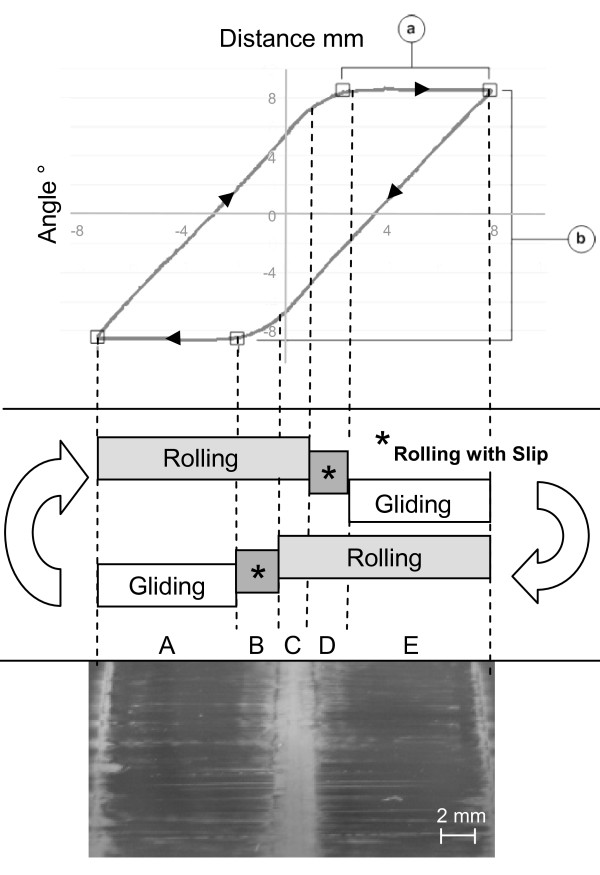
A rolling-gliding wear simulator was thus designed, constructed and implemented, which simulates and reproduces the rolling-gliding movement and loading of the knee joint on specimens of simplified geometry. The technical concept was to run a base-plate, representing the tibia plateau, against a pivoted cylindrical counter-body, representing one femur condyle under an axial load. A rolling movement occurs as a result of the friction and pure gliding is induced by limiting the rotation of the cylindrical counter-body. The set up also enables simplified specimens handling and removal for gravimetrical wear measurements. Long-term wear tests and gravimetrical wear measurements were carried out on the well known material pairings: cobalt chrome-polyethylene, ceramic-polyethylene and ceramic-ceramic, over three million motion cycles to allow material comparisons to be made.
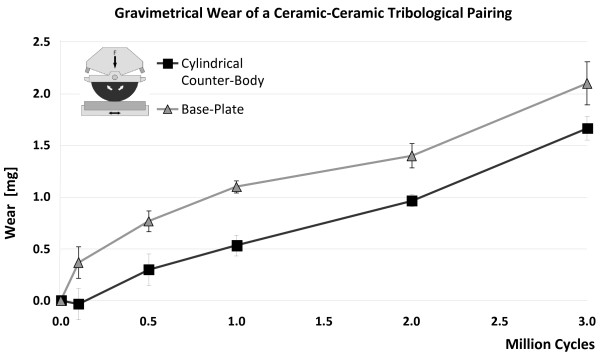
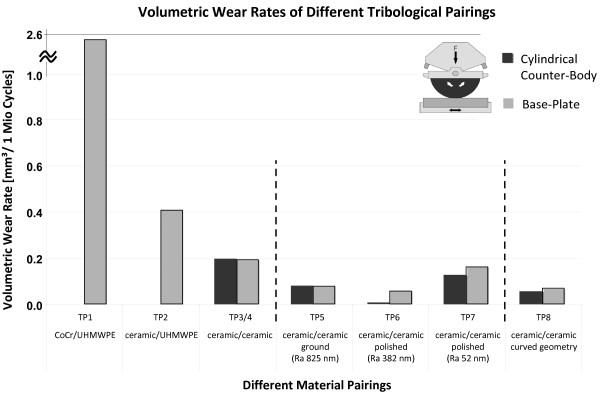
The observed differences in wear rates between cobalt-chrome on polyethylene and ceramic on polyethylene pairings were similar to the differences of published data for existing material-pairings. Test results on ceramic-ceramic pairings of different frontal-plane geometry and surface roughness displayed low wear rates and no fracture failures.
The presented set up is able to simulate the rolling-gliding movement of the knee joint, is easy to use, and requires a minimum of user intervention or monitoring. It is suitable for long-term testing, and therefore a useful tool for the investigation of new and promising materials which are of interest for application in knee joint replacement implants.
材料磨损测试是开发和评估用于全膝关节置换植入物的材料的重要技术。由于膝关节会产生复杂的滚动-滑动运动,因此类似于销盘或环盘试验机的标准化材料磨损测试设备仅在一定程度上适用,因为它们仅产生纯滑动运动。
因此,设计、构建并实施了一种滚动-滑动磨损模拟器,该模拟器模拟并再现了膝关节对简化几何形状试件的滚动-滑动运动和加载。其技术概念是使代表胫骨平台的基板与代表一个股骨髁的枢轴圆柱形对置体在轴向负载下相对运行。由于摩擦的作用会产生滚动运动,通过限制圆柱形对置体的旋转来产生纯滑动。该设置还可简化试件的处理和去除,以便进行重力磨损测量。对众所周知的材料配对(钴铬-聚乙烯、陶瓷-聚乙烯和陶瓷-陶瓷)进行了长达三百万次运动循环的长期磨损测试和重力磨损测量,以进行材料比较。
钴铬对聚乙烯和陶瓷对聚乙烯配对的观察到的磨损率差异与现有材料配对的已发表数据的差异相似。不同前平面几何形状和表面粗糙度的陶瓷-陶瓷配对的测试结果显示出低磨损率和无断裂失效。
所提出的设置能够模拟膝关节的滚动-滑动运动,易于使用,并且需要最少的用户干预或监测。它适用于长期测试,因此是研究新的有前途的材料的有用工具,这些材料有望应用于膝关节置换植入物。