Alzheimer's and Parkinson's Disease Laboratory, Brain and Mind Research Institute, University of Sydney, Sydney, New South Wales, Australia.
PLoS One. 2010 Jun 11;5(6):e11070. doi: 10.1371/journal.pone.0011070.
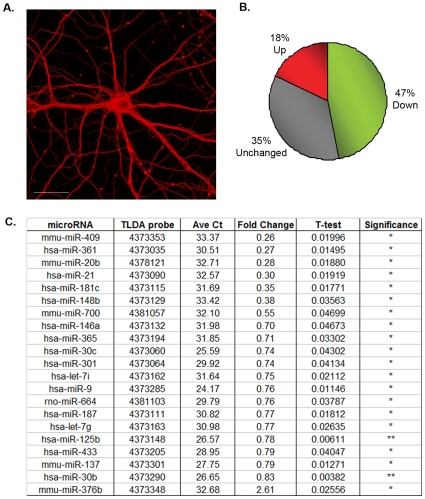
Normal brain development and function depends on microRNA (miRNA) networks to fine tune the balance between the transcriptome and proteome of the cell. These small non-coding RNA regulators are highly enriched in brain where they play key roles in neuronal development, plasticity and disease. In neurodegenerative disorders such as Alzheimer's disease (AD), brain miRNA profiles are altered; thus miRNA dysfunction could be both a cause and a consequence of disease. Our study dissects the complexity of human AD pathology, and addresses the hypothesis that amyloid-beta (Abeta) itself, a known causative factor of AD, causes neuronal miRNA deregulation, which could contribute to the pathomechanisms of AD. We used sensitive TaqMan low density miRNA arrays (TLDA) on murine primary hippocampal cultures to show that about half of all miRNAs tested were down-regulated in response to Abeta peptides. Time-course assays of neuronal Abeta treatments show that Abeta is in fact a powerful regulator of miRNA levels as the response of certain mature miRNAs is extremely rapid. Bioinformatic analysis predicts that the deregulated miRNAs are likely to affect target genes present in prominent neuronal pathways known to be disrupted in AD. Remarkably, we also found that the miRNA deregulation in hippocampal cultures was paralleled in vivo by a deregulation in the hippocampus of Abeta42-depositing APP23 mice, at the onset of Abeta plaque formation. In addition, the miRNA deregulation in hippocampal cultures and APP23 hippocampus overlaps with those obtained in human AD studies. Taken together, our findings suggest that neuronal miRNA deregulation in response to an insult by Abeta may be an important factor contributing to the cascade of events leading to AD.
正常的大脑发育和功能依赖于 microRNA(miRNA)网络来微调细胞转录组和蛋白质组之间的平衡。这些小的非编码 RNA 调节剂在大脑中高度富集,在神经元发育、可塑性和疾病中发挥关键作用。在阿尔茨海默病(AD)等神经退行性疾病中,大脑 miRNA 谱发生改变;因此,miRNA 功能障碍既可能是疾病的原因,也可能是疾病的结果。我们的研究剖析了人类 AD 病理学的复杂性,并提出了这样一个假设,即淀粉样β(Abeta)本身是 AD 的已知致病因素,会导致神经元 miRNA 失调,这可能有助于 AD 的病理机制。我们使用小鼠原代海马培养物上的敏感 TaqMan 低密度 miRNA 阵列(TLDA)进行检测,结果表明,在测试的所有 miRNA 中,约有一半在 Abeta 肽的作用下下调。神经元 Abeta 处理的时间过程测定显示,事实上,Abeta 是 miRNA 水平的强大调节因子,因为某些成熟 miRNA 的反应非常迅速。生物信息学分析预测,失调的 miRNA 可能会影响 AD 中已知被破坏的突出神经元通路中的靶基因。值得注意的是,我们还发现,在 Abeta 斑块形成开始时,APP23 小鼠海马中 Abeta42 沉积导致的 miRNA 失调与海马培养物中的 miRNA 失调相平行。此外,海马培养物和 APP23 海马中的 miRNA 失调与人类 AD 研究中获得的结果重叠。总之,我们的研究结果表明,Abeta 对神经元的刺激导致的 miRNA 失调可能是导致 AD 的一系列事件的一个重要因素。