Huang Xiao-Lei, Qiao Ge-Xia, Lei Fu-Min
Key Laboratory of Zoological Systematics and Evolution, Institute of Zoology, Chinese Academy of Sciences, Beijing 100101, China; E-Mails:
Int J Mol Sci. 2010 May 10;11(5):2097-108. doi: 10.3390/ijms11052097.
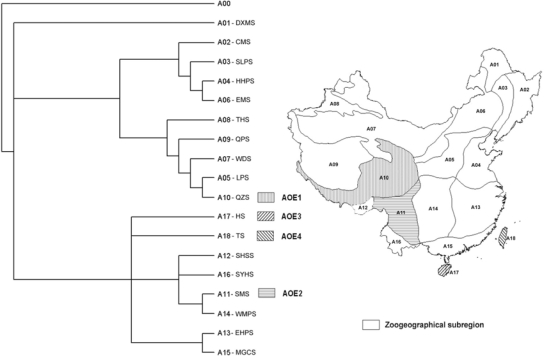
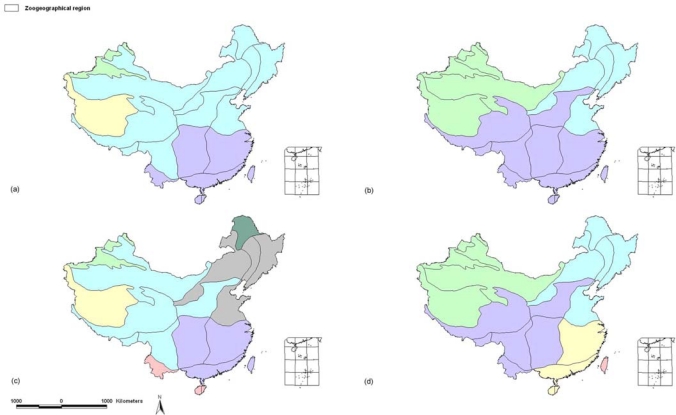
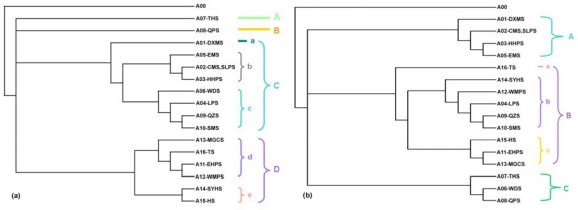
Parsimony analysis of endemicity (PAE) was used to identify areas of endemism (AOEs) for Chinese birds at the subregional level. Four AOEs were identified based on a distribution database of 105 endemic species and using 18 avifaunal subregions as the operating geographical units (OGUs). The four AOEs are the Qinghai-Zangnan Subregion, the Southwest Mountainous Subregion, the Hainan Subregion and the Taiwan Subregion. Cladistic analysis of subregions generally supports the division of China's avifauna into Palaearctic and Oriental realms. Two PAE area trees were produced from two different distribution datasets (year 1976 and 2007). The 1976 topology has four distinct subregional branches; however, the 2007 topology has three distinct branches. Moreover, three Palaearctic subregions in the 1976 tree clustered together with the Oriental subregions in the 2007 tree. Such topological differences may reflect changes in the distribution of bird species through circa three decades.
简约性特有性分析(PAE)被用于在次区域层面识别中国鸟类的特有区域(AOEs)。基于105种特有物种的分布数据库,并将18个鸟类亚区域作为操作地理单元(OGUs),确定了四个特有区域。这四个特有区域是青藏南亚区域、西南山地亚区域、海南亚区域和台湾亚区域。对亚区域的分支系统发育分析总体上支持将中国鸟类区系划分为古北界和东洋界。从两个不同的分布数据集(1976年和2007年)生成了两个PAE区域树。1976年的拓扑结构有四个不同的亚区域分支;然而,2007年的拓扑结构有三个不同的分支。此外,1976年树中的三个古北亚区域与2007年树中的东洋亚区域聚集在一起。这种拓扑差异可能反映了大约三十年间鸟类物种分布的变化。