Department of Leukemia, The University of Texas M. D. Anderson Cancer Center, Houston, Texas 77030, USA.
Cancer. 2010 Aug 15;116(16):3830-4. doi: 10.1002/cncr.25247.
The prognosis of patients with myelodysplastic syndrome (MDS) after decitabine failure is not known.
Data from 87 patients with MDS (n=67) and chronic myelomonocytic leukemia (n=.20) after failure of decitabine regimens were reviewed.
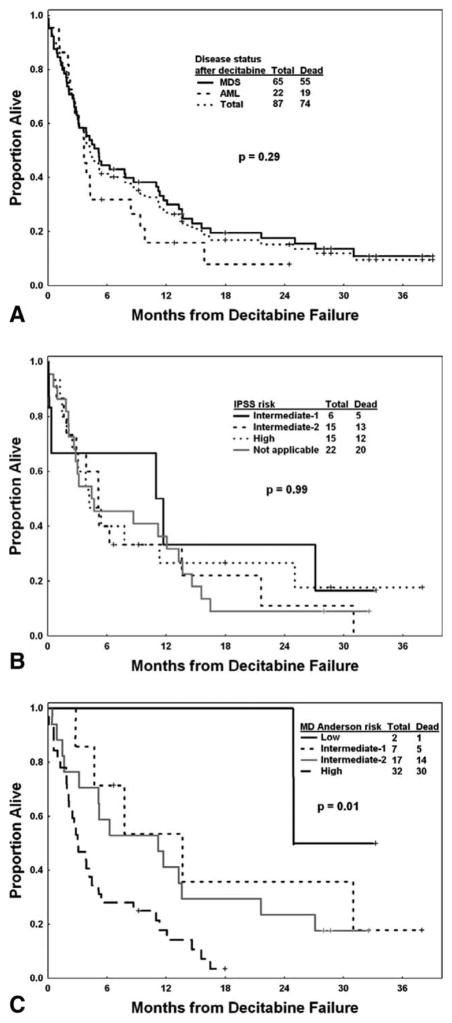
After a median follow-up of 21 months from decitabine failure, 13 (15%) patients remained alive; the median survival was 4.3 months, and the estimated 12-month survival rate was 28%. The estimated 12-month survival rates were 27%, 33%, and 33%, respectively, for patients with high-risk, intermediate-2-risk, and intermediate-1-risk disease (P=.99) by the International Prognostic Scoring System. The estimated 12-month survival rates were 100%, 54%, 41%, and 18%, respectively, for patients with low-risk, intermediate-1-risk, intermediate-2-risk, and high-risk disease according to The University of Texas M. D. Anderson Cancer Center risk model (P=.01).
The outcome of patients after decitabine failure is poor and appears to be predictable after decitabine failure.
地西他滨治疗失败后骨髓增生异常综合征(MDS)患者的预后尚不清楚。
回顾了 87 例地西他滨治疗失败后(n=67)的 MDS 患者和慢性粒单核细胞白血病(n=20)的数据。
从地西他滨失败到中位随访 21 个月,13 例(15%)患者仍然存活;中位生存期为 4.3 个月,估计 12 个月生存率为 28%。国际预后评分系统(IPSS)显示,高危、中危-2 级和中危-1 级疾病患者的估计 12 个月生存率分别为 27%、33%和 33%(P=.99)。根据德克萨斯大学 MD 安德森癌症中心风险模型(UT-MDACC),低危、中危-1 级、中危-2 级和高危疾病患者的估计 12 个月生存率分别为 100%、54%、41%和 18%(P=.01)。
地西他滨治疗失败后患者的预后较差,而且似乎在地西他滨治疗失败后可以预测。