Salbaum J Michael, Kappen Claudia
Laboratory of Regulation of Gene Expression, 6400 Perkins Road, Baton Rouge, Louisiana 70808, USA.
Birth Defects Res A Clin Mol Teratol. 2010 Aug;88(8):601-11. doi: 10.1002/bdra.20680.
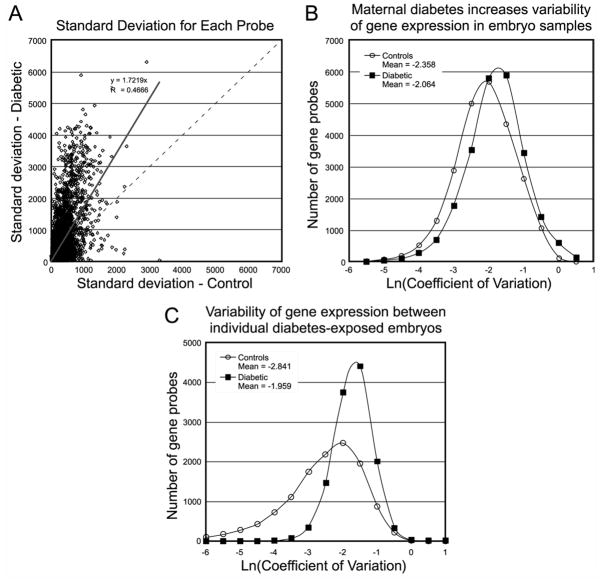
Maternal diabetes during pregnancy is a well-known teratogen that increases the risk for birth defects, such as neural tube defects (NTDs). We have previously shown that maternal diabetes profoundly affects gene expression in the developing embryo, in particular a suite of known NTD genes. In rodent experimental systems, NTDs present as phenotypes of incomplete penetrance in diabetic pregnancies. This property is difficult to reconcile with observations of consistently altered gene expression in exposed embryos. We here show that maternal diabetes increases the overall variability of gene expression levels in embryos.
Altered gene expression and increased variability of gene expression together may constitute the molecular correlates for incomplete phenotype penetrance.
Based on this model, we suggest that maternal diabetes reduces the precision of gene regulation in exposed individuals. Loss of precision in embryonic gene regulation may include changes to the epigenome via deregulated expression of chromatin-modifying factors. Unraveling the mechanisms underlying such epigenetic modifications in diabetic pregnancies will help to understand how teratogenic insults compromise embryonic development and possibly provide avenues for therapeutic intervention.
孕期母体糖尿病是一种众所周知的致畸剂,会增加出生缺陷的风险,如神经管缺陷(NTDs)。我们之前已经表明,母体糖尿病会深刻影响发育中胚胎的基因表达,尤其是一组已知的NTD基因。在啮齿动物实验系统中,NTDs在糖尿病妊娠中表现为不完全显性的表型。这一特性难以与暴露胚胎中基因表达持续改变的观察结果相协调。我们在此表明,母体糖尿病会增加胚胎中基因表达水平的总体变异性。
基因表达改变和基因表达变异性增加共同可能构成不完全表型显性的分子关联。
基于此模型,我们认为母体糖尿病会降低暴露个体中基因调控的精确性。胚胎基因调控精确性的丧失可能包括通过染色质修饰因子的失调表达导致表观基因组的变化。阐明糖尿病妊娠中此类表观遗传修饰的潜在机制将有助于理解致畸性损伤如何损害胚胎发育,并可能为治疗干预提供途径。