Center for Human Genetics, Marshfield Clinic Research Foundation, WI, USA.
BMC Genet. 2010 Jun 17;11:51. doi: 10.1186/1471-2156-11-51.
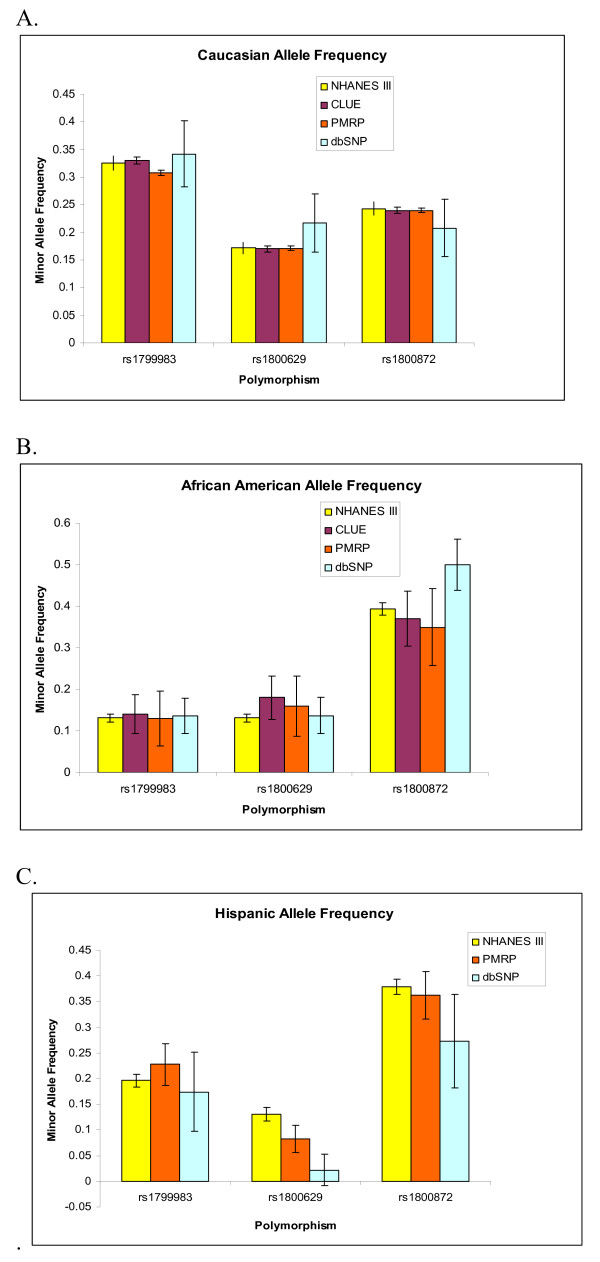
There is a lack of knowledge regarding the frequency of disease associated polymorphisms in populations and population attributable risk for many populations remains unknown. Factors that could affect the association of the allele with disease, either positively or negatively, such as race, ethnicity, and gender, may not be possible to determine without population based allele frequencies.Here we used a panel of 51 polymorphisms previously associated with at least one disease and determined the allele frequencies within the entire Personalized Medicine Research Project population based cohort. We compared these allele frequencies to those in dbSNP and other data sources stratified by race. Differences in allele frequencies between self reported race, region of origin, and sex were determined.
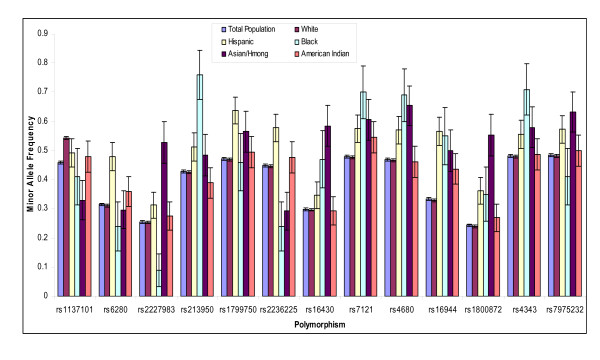
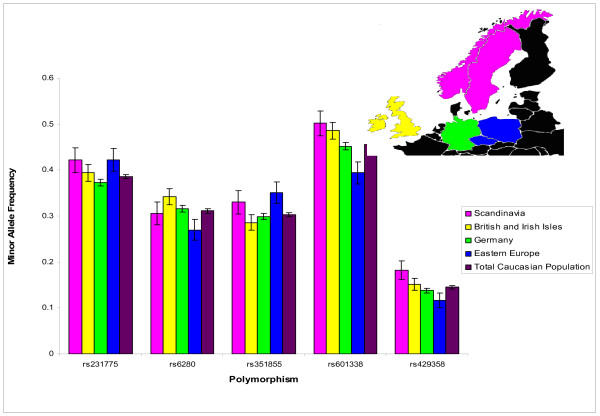
There were 19544 individuals who self reported a single racial category, 19027 or (97.4%) self reported white Caucasian, and 11205 (57.3%) individuals were female. Of the 11,208 (57%) individuals with an identifiable region of origin 8337 or (74.4%) were German.41 polymorphisms were significantly different between self reported race at the 0.05 level. Stratification of our Caucasian population by self reported region of origin revealed 19 polymorphisms that were significantly different (p = 0.05) between individuals of different origins. Further stratification of the population by gender revealed few significant differences in allele frequencies between the genders.
This represents one of the largest population based allele frequency studies to date. Stratification by self reported race and region of origin revealed wide differences in allele frequencies not only by race but also by region of origin within a single racial group. We report allele frequencies for our Asian/Hmong and American Indian populations; these two minority groups are not typically selected for population allele frequency detection. Population wide allele frequencies are important for the design and implementation of studies and for determining the relevance of a disease associated polymorphism for a given population.
对于许多人群,与疾病相关的多态性的频率以及人群归因风险知之甚少。如果没有基于人群的等位基因频率,就无法确定种族、民族和性别等可能对等位基因与疾病的关联产生积极或消极影响的因素。在这里,我们使用了先前与至少一种疾病相关的 51 个多态性的面板,并确定了基于整个个性化医学研究项目人群队列的所有等位基因频率。我们将这些等位基因频率与种族分层的 dbSNP 和其他数据源进行了比较。确定了自我报告的种族、原籍地区和性别之间等位基因频率的差异。
有 19544 名个体自我报告了单一的种族类别,19027 名或(97.4%)自我报告为白种高加索人,11205 名(57.3%)个体为女性。在 11208 名(57%)可识别原籍地区的个体中,有 8337 名或(74.4%)是德国裔。41 个多态性在 0.05 水平上与自我报告的种族存在显著差异。按自我报告的原籍地区对我们的白种人群进行分层,发现有 19 个多态性在不同来源的个体之间存在显著差异(p = 0.05)。进一步按性别对人群进行分层,发现性别之间的等位基因频率差异很小。
这是迄今为止最大的基于人群的等位基因频率研究之一。按自我报告的种族和原籍地区分层,不仅在种族之间,而且在单一种族群体的原籍地区之间,等位基因频率存在广泛差异。我们报告了我们的亚洲/苗族和美洲印第安人群体的等位基因频率;这两个少数群体通常不会被选为人群等位基因频率检测。人群等位基因频率对于研究的设计和实施以及确定与疾病相关的多态性对特定人群的相关性非常重要。