Park Dae Woo, Richards Michael S, Rubin Jonathan M, Hamilton James, Kruger Grant H, Weitzel William F
Department of Internal Medicine, University of Michigan, Ann Arbor, Michigan, USA.
Cardiovasc Ultrasound. 2010 Jun 18;8:22. doi: 10.1186/1476-7120-8-22.
The nonlinear mechanical properties of internal organs and tissues may be measured with unparalleled precision using ultrasound imaging with phase-sensitive speckle tracking. The many potential applications of this important noninvasive diagnostic approach include measurement of arterial stiffness, which is associated with numerous major disease processes. The accuracy of previous ultrasound measurements of arterial stiffness and vascular elasticity has been limited by the relatively low strain of nonlinear structures under normal physiologic pressure and the measurement assumption that the effect of the surrounding tissue modulus might be ignored in both physiologic and pressure equalized conditions.
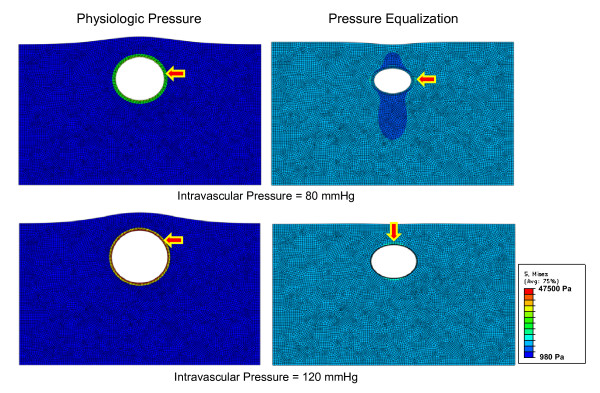
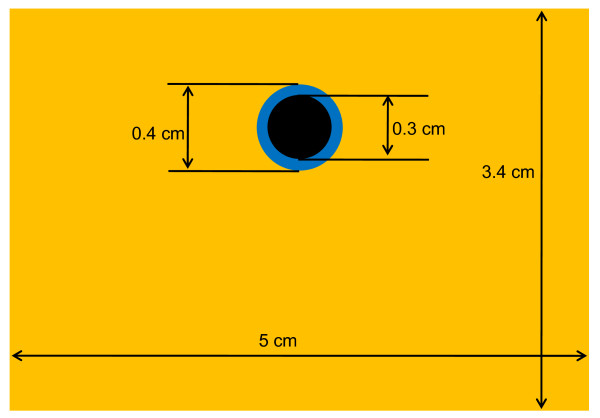
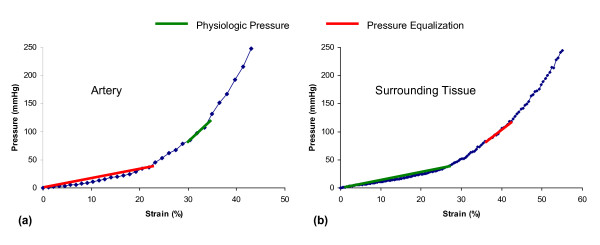
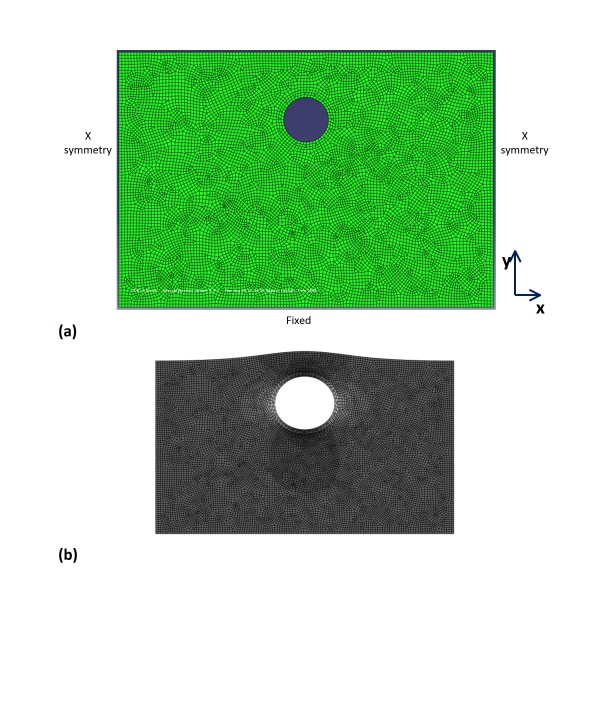
This study performed high-resolution ultrasound imaging of the brachial artery in a healthy adult subject under normal physiologic pressure and the use of external pressure (pressure equalization) to increase strain. These ultrasound results were compared to measurements of arterial strain as determined by finite-element analysis models with and without a surrounding tissue, which was represented by homogenous material with fixed elastic modulus.
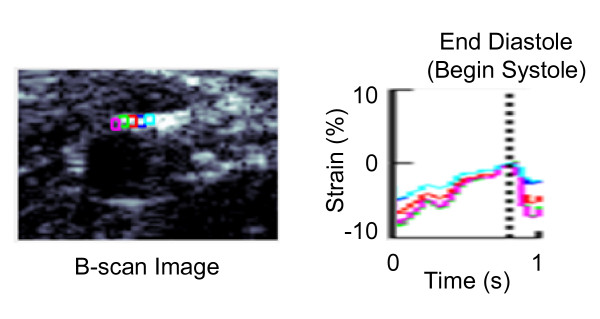
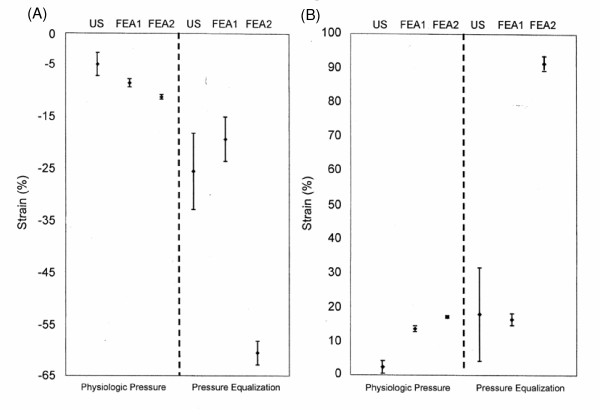
Use of the pressure equalization technique during imaging resulted in average strain values of 26% and 18% at the top and sides, respectively, compared to 5% and 2%, at the top and sides, respectively, under physiologic pressure. In the artery model that included surrounding tissue, strain was 19% and 16% under pressure equalization versus 9% and 13% at the top and sides, respectively, under physiologic pressure. The model without surrounding tissue had slightly higher levels of strain under physiologic pressure compared to the other model, but the resulting strain values under pressure equalization were > 60% and did not correspond to experimental values.
Since pressure equalization may increase the dynamic range of strain imaging, the effect of the surrounding tissue on strain should be incorporated into models of arterial strain, particularly when the pressure equalization technique is used.
使用具有相位敏感散斑跟踪的超声成像可以以前所未有的精度测量内部器官和组织的非线性力学特性。这种重要的非侵入性诊断方法有许多潜在应用,包括测量与众多主要疾病过程相关的动脉僵硬度。以往超声测量动脉僵硬度和血管弹性的准确性受到正常生理压力下非线性结构相对较低应变以及测量假设的限制,该假设认为在生理和压力均衡条件下周围组织模量的影响可能被忽略。
本研究对一名健康成年受试者的肱动脉在正常生理压力下进行了高分辨率超声成像,并使用外部压力(压力均衡)来增加应变。将这些超声结果与通过有限元分析模型确定的动脉应变测量值进行比较,该模型有或没有周围组织,周围组织由具有固定弹性模量的均匀材料表示。
成像过程中使用压力均衡技术时,顶部和侧面的平均应变值分别为26%和18%,而在生理压力下,顶部和侧面的平均应变值分别为5%和2%。在包含周围组织的动脉模型中,压力均衡下的应变分别为19%和16%,而在生理压力下,顶部和侧面的应变分别为9%和13%。与另一个模型相比,没有周围组织的模型在生理压力下的应变水平略高,但在压力均衡下得到的应变值>60%,且与实验值不相符。
由于压力均衡可能增加应变成像的动态范围,因此在动脉应变模型中应纳入周围组织对应变的影响,特别是在使用压力均衡技术时。