Research Center for Genetic Medicine, Children's National Medical Center, George Washington University, Washington, DC 20010, USA.
Pediatrics. 2010 Jul;126(1):e208-14. doi: 10.1542/peds.2010-0008. Epub 2010 Jun 21.
The objective of this study was to determine whether N-carbamylglutamate (NCG) reduces plasma levels of ammonia and glutamine and increases the rate of ureagenesis in patients with propionic acidemia (PA).
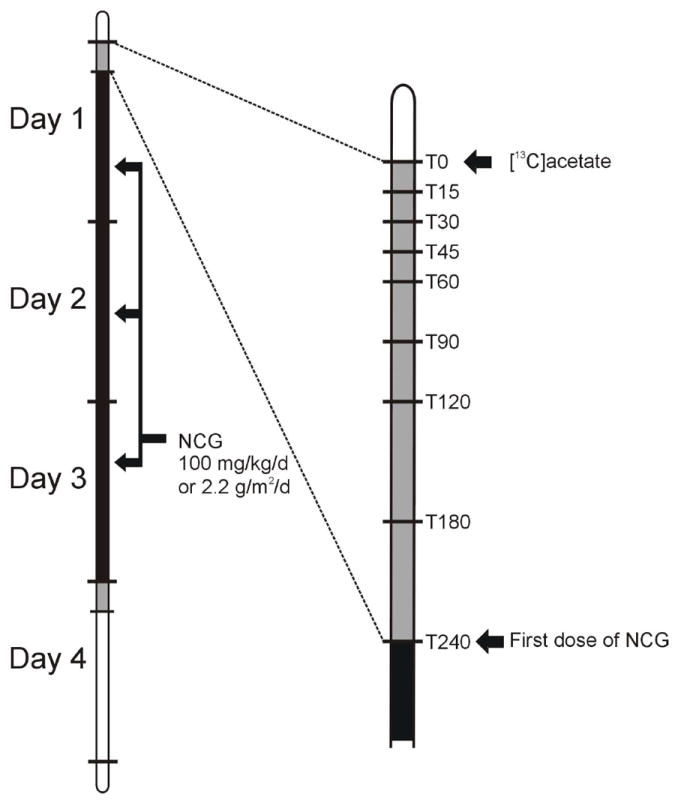
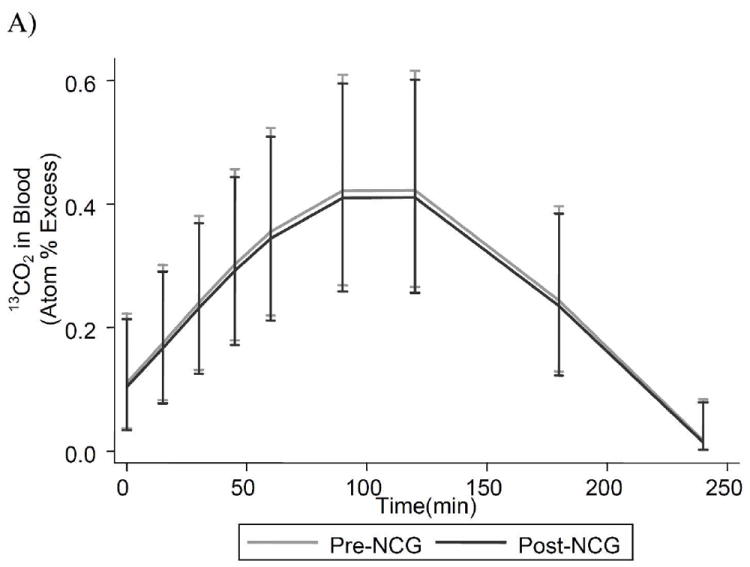
Identical 4-hour studies were performed before and immediately after a 3-day trial of oral NCG in 7 patients with PA. An oral bolus of [(13)C]sodium acetate was administered at the start of each study, and sequential blood samples were obtained to measure [(13)C]urea, ammonia, urea, and amino acids.
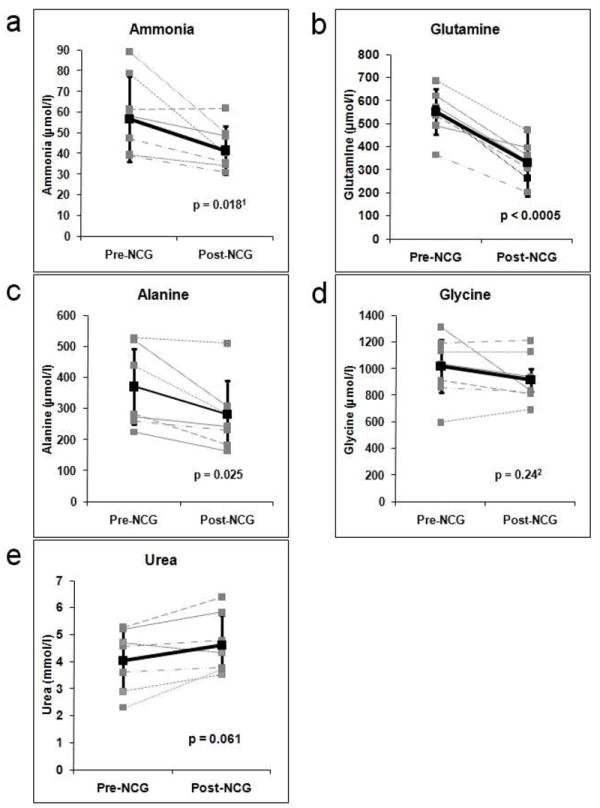
With longitudinal mixed-effects linear regression, peak [(13)C]urea increased after treatment with NCG (from 2.2 to 3.8 microM; P < .0005). There were concomitant decreases in mean plasma ammonia (59-43 microM; P < .018) and glutamine (552-331 microM; P < .0005).
NCG augments ureagenesis and decreases plasma ammonia and glutamine in patients with PA. The drug may serve as an important therapeutic adjunct in the treatment of acute hyperammonemia in this disorder.
本研究旨在确定 N-氨甲酰谷氨酸(NCG)是否能降低丙酸血症(PA)患者的血氨和谷氨酰胺水平,并增加尿素生成率。
7 例 PA 患者在接受 3 天口服 NCG 治疗前后分别进行了相同的 4 小时研究。在每个研究的开始时给予口服 [(13)C]醋酸钠脉冲,然后连续采集血样以测量 [(13)C]尿素、氨、尿素和氨基酸。
采用纵向混合效应线性回归分析,NCG 治疗后 [(13)C]尿素峰值增加(从 2.2 增至 3.8 μM;P<.0005)。同时,平均血浆氨(59-43 μM;P<.018)和谷氨酰胺(552-331 μM;P<.0005)降低。
NCG 可增强 PA 患者的尿素生成,并降低血氨和谷氨酰胺水平。该药可能是治疗该疾病急性高氨血症的重要辅助治疗药物。