Department of Physical Chemistry and Institut de Química Teòrica i Computacional (IQTCUB), Universitat de Barcelona, Barcelona, Spain.
PLoS One. 2010 Jun 17;5(6):e11162. doi: 10.1371/journal.pone.0011162.
In lipid bilayers, cholesterol facilitates the formation of the liquid-ordered phase and enables the formation of laterally ordered structures such as lipid rafts. While these domains have an important role in a variety of cellular processes, the precise atomic-level mechanisms responsible for cholesterol's specific ordering and packing capability have remained unresolved.
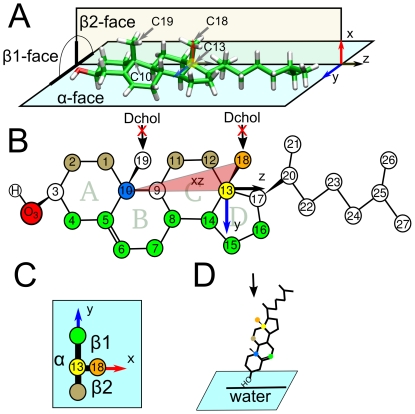
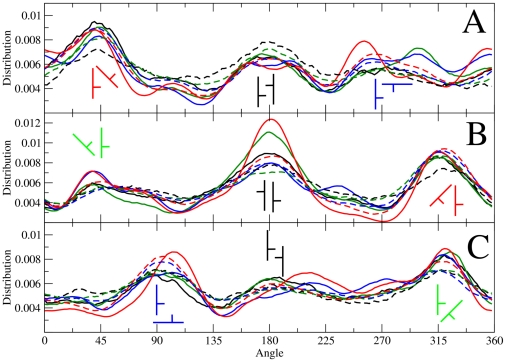
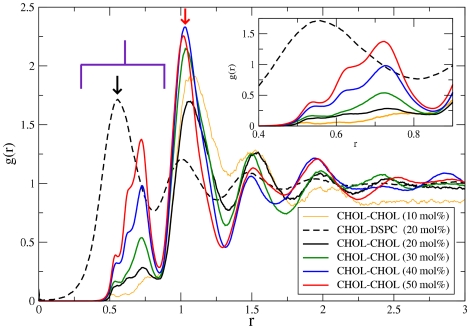
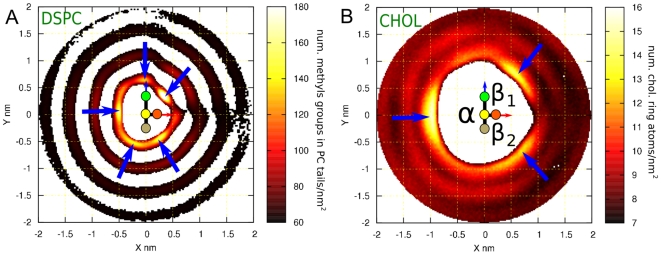
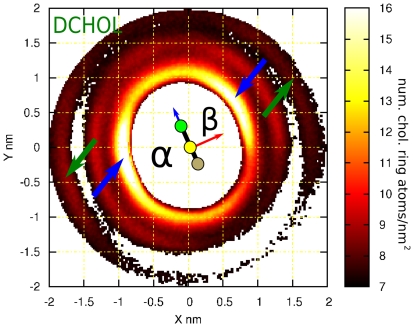
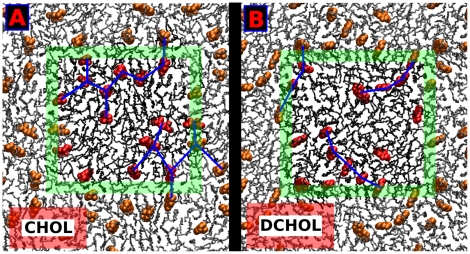
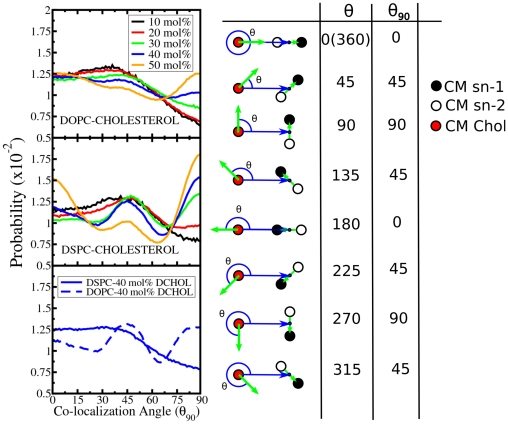
METHODOLOGY/PRINCIPAL FINDINGS: Our atomic-scale molecular dynamics simulations reveal that this ordering and the associated packing effects in membranes largely result from cholesterol's molecular structure, which differentiates cholesterol from other sterols. We find that cholesterol molecules prefer to be located in the second coordination shell, avoiding direct cholesterol-cholesterol contacts, and form a three-fold symmetric arrangement with proximal cholesterol molecules. At larger distances, the lateral three-fold organization is broken by thermal fluctuations. For other sterols having less structural asymmetry, the three-fold arrangement is considerably lost.
CONCLUSIONS/SIGNIFICANCE: We conclude that cholesterol molecules act collectively in lipid membranes. This is the main reason why the liquid-ordered phase only emerges for Chol concentrations well above 10 mol% where the collective self-organization of Chol molecules emerges spontaneously. The collective ordering process requires specific molecular-scale features that explain why different sterols have very different membrane ordering properties: the three-fold symmetry in the Chol-Chol organization arises from the cholesterol off-plane methyl groups allowing the identification of raft-promoting sterols from those that do not promote rafts.
在脂质双层中,胆固醇有助于形成液体有序相,并能够形成侧向有序结构,如脂筏。虽然这些区域在各种细胞过程中起着重要作用,但负责胆固醇特定有序性和堆积能力的精确原子级机制仍未解决。
方法/主要发现:我们的原子尺度分子动力学模拟表明,这种有序性和相关的膜堆积效应在很大程度上是由胆固醇的分子结构引起的,这使胆固醇有别于其他固醇。我们发现胆固醇分子更喜欢位于第二配位壳中,避免直接的胆固醇-胆固醇接触,并与邻近的胆固醇分子形成三重对称排列。在较大的距离上,侧向的三重组织被热波动打破。对于其他结构对称性较小的固醇,三重排列会大大丢失。
结论/意义:我们得出结论,胆固醇分子在脂质膜中集体作用。这就是为什么只有在胆固醇浓度远远高于 10mol%时,才会出现液体有序相,因为胆固醇分子的集体自组织会自发出现。集体有序过程需要特定的分子尺度特征,这解释了为什么不同的固醇具有非常不同的膜有序性:胆固醇-胆固醇组织中的三重对称性源于胆固醇非平面甲基基团,从而可以从不促进筏的固醇中识别出促进筏的固醇。