Department of Bioengineering, University of California, San Diego, La Jolla, CA 92093-0412, USA.
J Biomech. 2010 Sep 17;43(13):2501-7. doi: 10.1016/j.jbiomech.2010.05.022. Epub 2010 Jun 8.
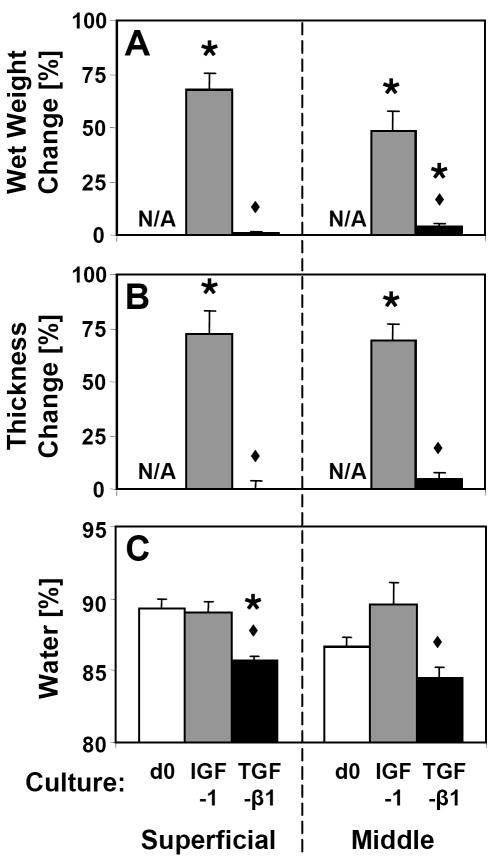
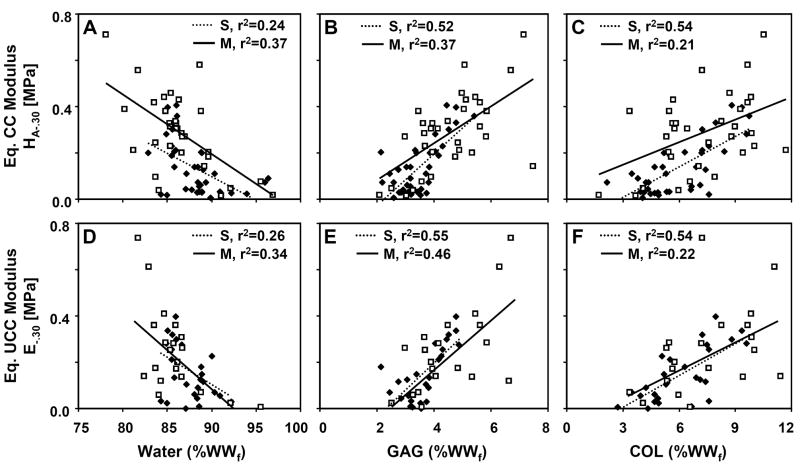
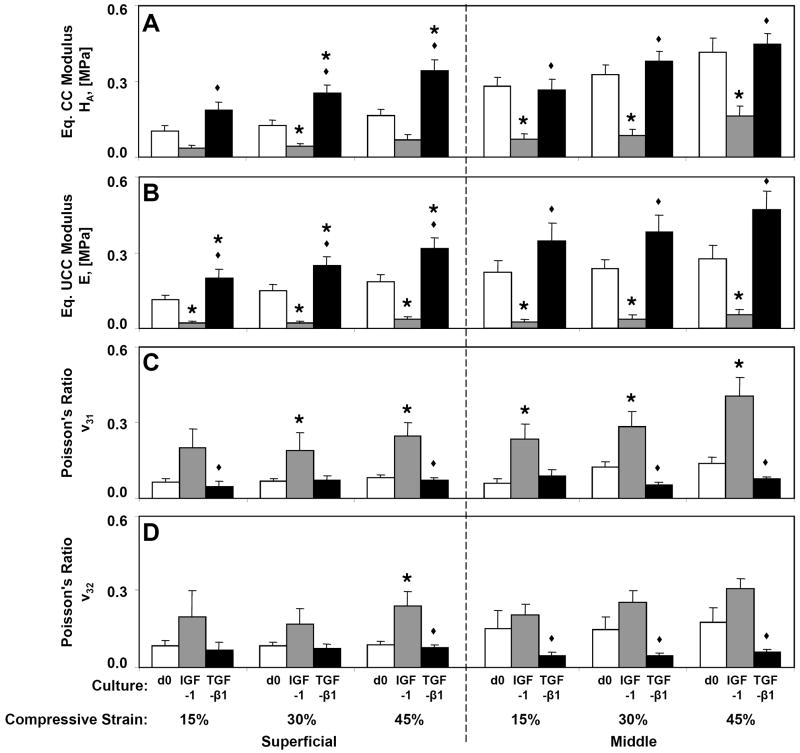
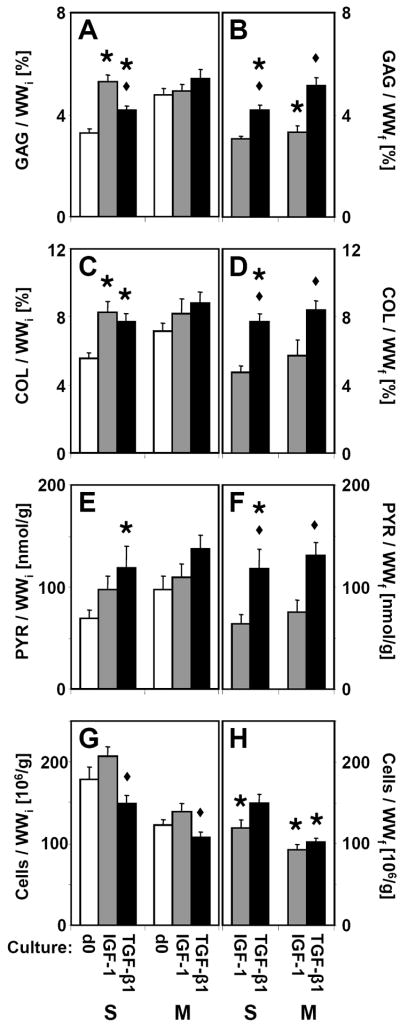
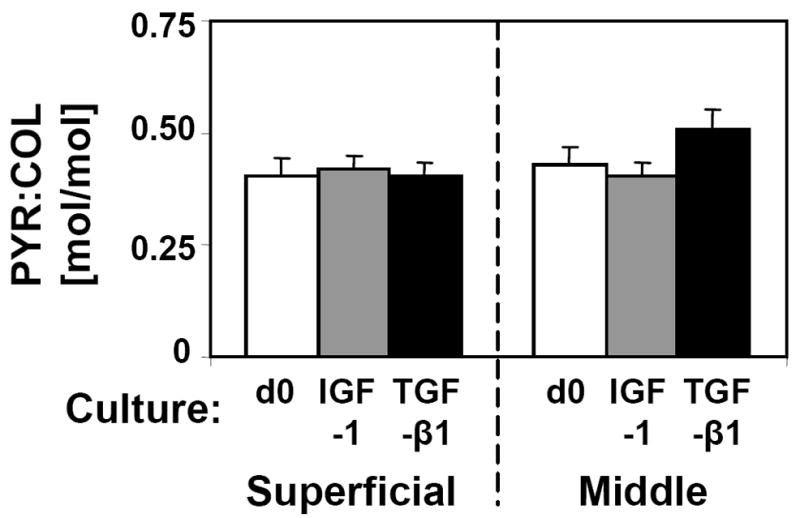
Mechanisms of articular cartilage growth and maturation have been elucidated by studying composition-function dynamics during in vivo development and in vitro culture with stimuli such as insulin-like growth factor-1 (IGF-1) and transforming growth factor-beta 1 (TGF-beta1). This study tested the hypothesis that IGF-1 and TGF-beta1 regulate immature cartilage compressive moduli and Poisson's ratios in a manner consistent with known effects on tensile properties. Bovine calf articular cartilage from superficial-articular (S) and middle-growth (M) regions were analyzed fresh or following culture in medium with IGF-1 or TGF-beta1. Mechanical properties in confined (CC) and unconfined (UCC) compression, cartilage matrix composition, and explant size were assessed. Culture with IGF-1 resulted in softening in CC and UCC, increased Poisson's ratios, substantially increased tissue volume, and accumulation of glycosaminoglycan (GAG) and collagen (COL). Culture with TGF-beta1 promoted maturational changes in the S layer, including stiffening in CC and UCC and increased concentrations of GAG, COL, and pyridinoline crosslinks (PYR), but little growth. Culture of M layer explants with TGF-beta1 was nearly homeostatic. Across treatment groups, compressive moduli in CC and UCC were positively related to GAG, COL, and PYR concentrations, while Poisson's ratios were negatively related to concentrations of these matrix components. Thus, IGF-1 and TGF-beta1 differentially regulate the compressive mechanical properties and size of immature articular cartilage in vitro. Prescribing tissue growth, maturation, or homeostasis by controlling the in vitro biochemical environment with such growth factors may have applications in cartilage repair and tissue engineering.
关节软骨的生长和成熟机制已通过研究体内发育过程中和体外培养过程中(如胰岛素样生长因子-1 (IGF-1) 和转化生长因子-β1 (TGF-β1) 等刺激物)的组成-功能动态而得到阐明。本研究通过检测 IGF-1 和 TGF-β1 调节未成熟软骨压缩模量和泊松比的假说,研究其作用方式是否与对拉伸性能的已知影响一致。对来自浅表层 (S) 和中层生长 (M) 区域的牛犊关节软骨进行了分析,分析内容包括新鲜软骨和在 IGF-1 或 TGF-β1 培养基中培养后的软骨。对约束 (CC) 和非约束 (UCC) 压缩的机械性能、软骨基质成分和培养物大小进行了评估。IGF-1 培养导致 CC 和 UCC 中的软化、泊松比增加、组织体积显著增加以及糖胺聚糖 (GAG) 和胶原 (COL) 的积累。TGF-β1 培养促进了 S 层的成熟变化,包括 CC 和 UCC 中的硬度增加以及 GAG、COL 和吡啶啉交联 (PYR) 的浓度增加,但生长很少。TGF-β1 培养 M 层培养物几乎处于体内平衡状态。在所有治疗组中,CC 和 UCC 的压缩模量与 GAG、COL 和 PYR 的浓度呈正相关,而泊松比与这些基质成分的浓度呈负相关。因此,IGF-1 和 TGF-β1 可在体外对未成熟关节软骨的压缩力学性能和大小进行差异调节。通过控制体外生化环境来应用这些生长因子来控制组织生长、成熟或体内平衡,可能在软骨修复和组织工程中有应用。