Department of Molecular Biology, The Scripps Research Institute, La Jolla, California 92037, USA.
BMC Mol Biol. 2010 Jun 23;11:48. doi: 10.1186/1471-2199-11-48.
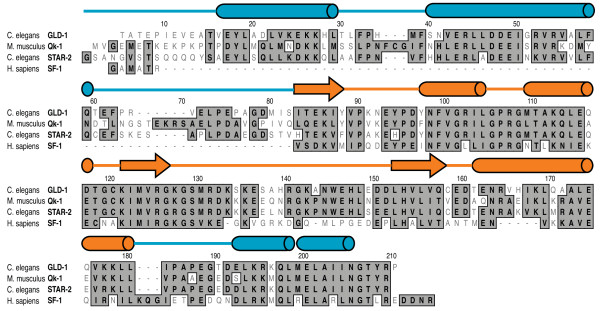
STAR/GSG proteins regulate gene expression in metazoans by binding consensus sites in the 5' or 3' UTRs of target mRNA transcripts. Owing to the high degree of homology across the STAR domain, most STAR proteins recognize similar RNA consensus sequences. Previously, the consensus for a number of well-characterized STAR proteins was defined as a hexameric sequence, referred to as the SBE, for STAR protein binding element. C. elegans GLD-1 and mouse Quaking (Qk-1) are two representative STAR proteins that bind similar consensus hexamers, which differ only in the preferred nucleotide identities at certain positions. Earlier reports also identified partial consensus elements located upstream or downstream of a canonical consensus hexamer in target RNAs, although the relative contribution of these sequences to the overall binding energy remains less well understood. Additionally, a recently identified STAR protein called STAR-2 from C. elegans is thought to bind target RNA consensus sites similar to that of GLD-1 and Qk-1.
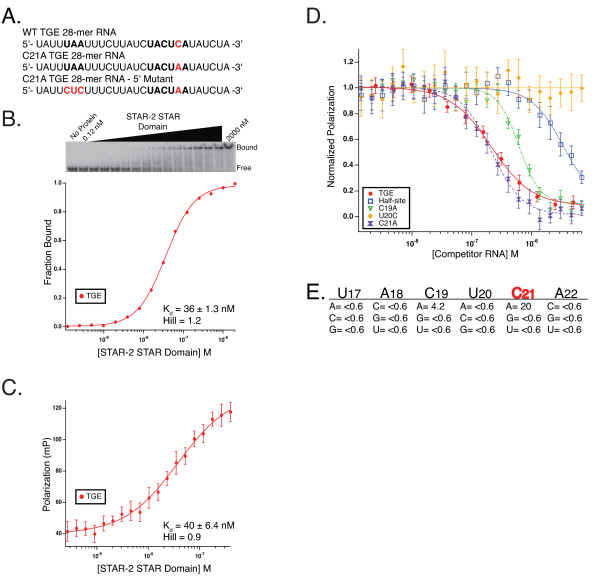
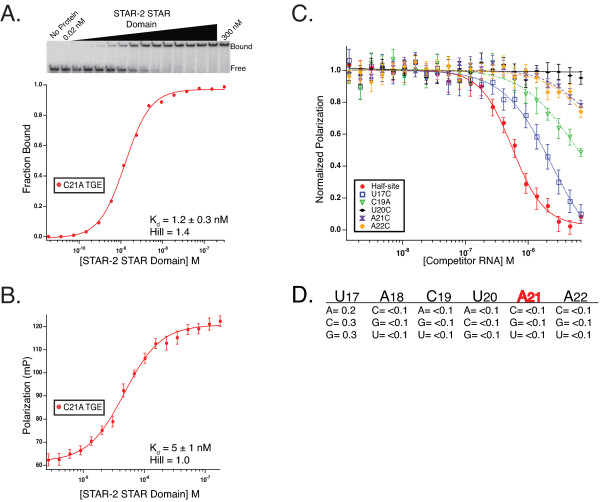
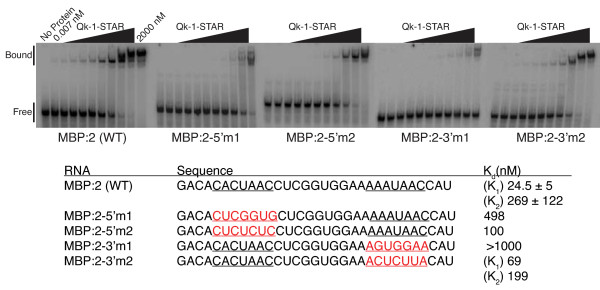
Here, a combination of fluorescence-polarization and gel mobility shift assays was used to demonstrate that STAR-2 binds to a similar RNA consensus as GLD-1 and Qk-1. These assays were also used to further delineate the contributions of each hexamer consensus nucleotide to high-affinity binding by GLD-1, Qk-1 and STAR-2 in a variety of RNA contexts. In addition, the effects of inserting additional full or partial consensus elements upstream or downstream of a canonical hexamer in target RNAs were also measured to better define the sequence elements and RNA architecture recognized by different STAR proteins.
The results presented here indicate that a single hexameric consensus is sufficient for high-affinity RNA binding by STAR proteins, and that upstream or downstream partial consensus elements may alter binding affinities depending on the sequence and spacing. The general requirements determined for high-affinity RNA binding by STAR proteins will help facilitate the identification of novel regulatory targets in vivo.
STAR/GSG 蛋白通过结合靶 mRNA 转录本 5'或 3'UTR 中的一致序列来调节真核生物中的基因表达。由于 STAR 结构域在跨物种中具有高度同源性,因此大多数 STAR 蛋白识别相似的 RNA 一致序列。以前,许多特征明确的 STAR 蛋白的一致序列被定义为六聚体序列,称为 STAR 蛋白结合元件(SBE)。秀丽隐杆线虫 GLD-1 和小鼠 Quaking(Qk-1)是两种代表性的 STAR 蛋白,它们结合相似的一致六聚体,但在某些位置的首选核苷酸身份上有所不同。早期的报道还确定了靶 RNA 中典型一致六聚体上游或下游的部分一致元件,尽管这些序列对整体结合能的相对贡献仍不太清楚。此外,最近从秀丽隐杆线虫中鉴定出一种名为 STAR-2 的 STAR 蛋白,据信它结合靶 RNA 一致序列类似于 GLD-1 和 Qk-1。
在这里,荧光偏振和凝胶迁移率变动分析的组合被用于证明 STAR-2 结合到与 GLD-1 和 Qk-1 相似的 RNA 一致序列。这些测定还用于进一步描绘 GLD-1、Qk-1 和 STAR-2 在各种 RNA 背景下高亲和力结合的每个六聚体一致核苷酸的贡献。此外,还测量了在靶 RNA 中插入一致六聚体上游或下游的额外全长或部分一致元件对结合亲和力的影响,以更好地定义不同 STAR 蛋白识别的序列元件和 RNA 结构。
这里呈现的结果表明,单个六聚体一致序列足以用于 STAR 蛋白的高亲和力 RNA 结合,并且上游或下游的部分一致元件可能会根据序列和间隔改变结合亲和力。确定的 STAR 蛋白高亲和力 RNA 结合的一般要求将有助于促进体内新的调节靶标的鉴定。