Department of Psychology, University of Milano-Bicocca, Milan, Italy.
PLoS One. 2010 Jun 21;5(6):e11242. doi: 10.1371/journal.pone.0011242.
It is currently believed that face processing predominantly activates the right hemisphere in humans, but available literature is very inconsistent.
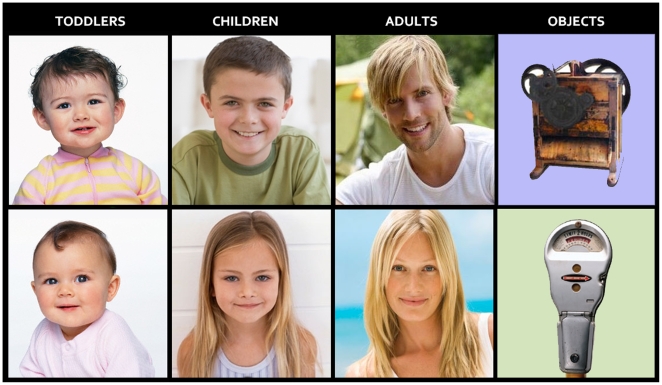
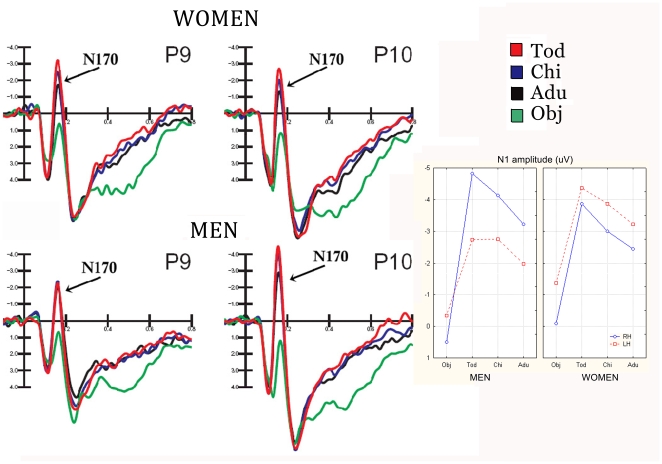
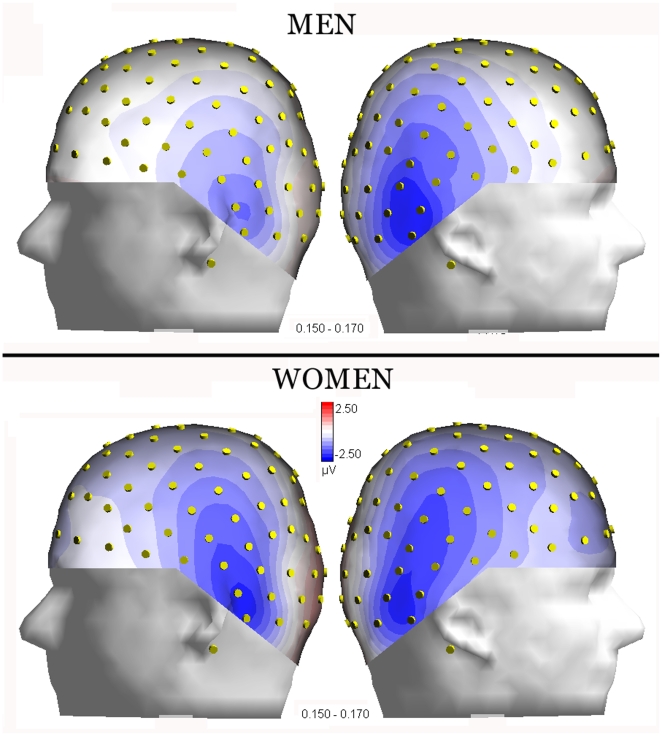
METHODOLOGY/PRINCIPAL FINDINGS: In this study, ERPs were recorded in 50 right-handed women and men in response to 390 faces (of different age and sex), and 130 technological objects. Results showed no sex difference in the amplitude of N170 to objects; a much larger face-specific response over the right hemisphere in men, and a bilateral response in women; a lack of face-age coding effect over the left hemisphere in men, with no differences in N170 to faces as a function of age; a significant bilateral face-age coding effect in women.
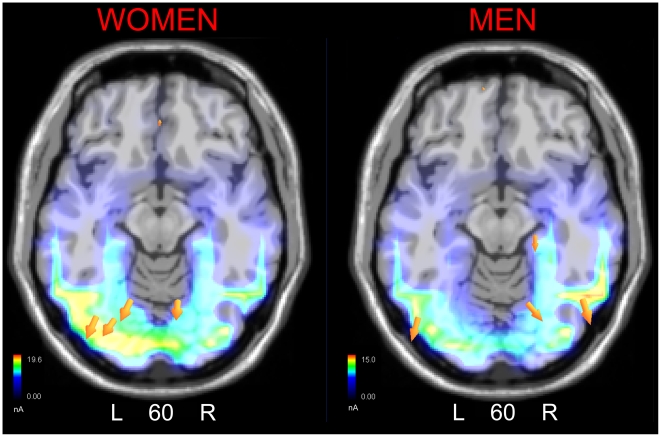
CONCLUSIONS/SIGNIFICANCE: LORETA reconstruction showed a significant left and right asymmetry in the activation of the fusiform gyrus (BA19), in women and men, respectively. The present data reveal a lesser degree of lateralization of brain functions related to face coding in women than men. In this light, they may provide an explanation of the inconsistencies in the available literature concerning the asymmetric activity of left and right occipito-temporal cortices devoted to face perception during processing of face identity, structure, familiarity or affective content.
目前人们认为,人类的面部处理主要激活右半球,但现有文献非常不一致。
方法/主要发现:在这项研究中,记录了 50 名右利手女性和男性对 390 张面孔(不同年龄和性别)和 130 个技术对象的反应。结果表明,男性对物体的 N170 振幅没有性别差异;男性的右半球有更大的面孔特异性反应,而女性的反应则是双侧的;男性左半球没有面孔年龄编码效应,面孔的 N170 与年龄无关;女性的 N170 对面孔年龄有显著的双侧编码效应。
结论/意义:LORETA 重建显示,梭状回(BA19)的激活存在显著的左右不对称,分别在女性和男性中。这些数据揭示了女性在与面孔编码相关的大脑功能的偏侧化程度低于男性。从这个角度来看,它们可能解释了现有文献中关于左、右枕颞叶皮质在处理面孔身份、结构、熟悉度或情感内容时不对称活动的不一致性。