Zhou Qiqi, Nicholas Verne G
Department of Medicine, University of Florida Colleges of Medicine, Gainesville, FL, USA.
Rev Analg. 2008 Nov 1;10(1):33-43. doi: 10.3727/154296108783994013.
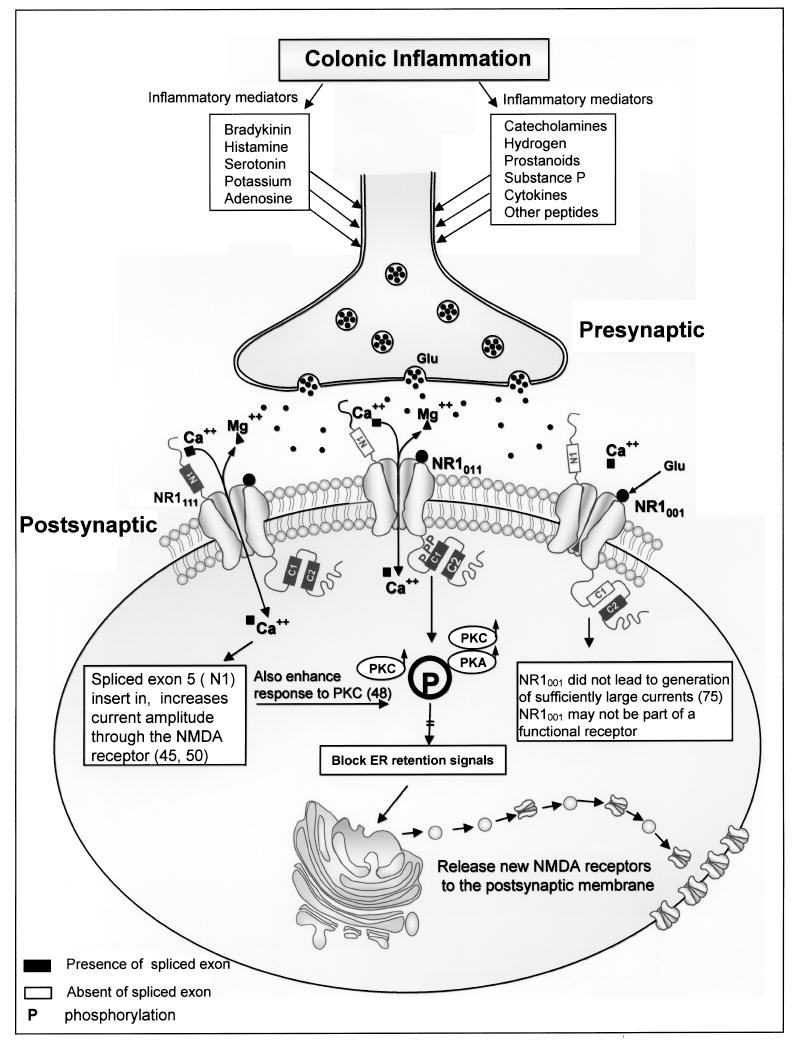
During the last decade, research focusing primarily on alterations in the peripheral and central nervous system has improved our understanding of the pathophysiological mechanisms of chronic visceral pain. These studies have demonstrated significant physiological changes following injury to the viscera in the firing patterns of both primary afferent neurons that transmit nociceptive information from the viscera and in central neurons that process the nociceptive information. A number of receptors, neurotransmitters, cytokines, and second messenger systems in these neurons have been implicated in the enhancement of visceral nociception. N-methyl-d-aspartic acid (NMDA) receptors play an important role in chronic visceral pain and hypersensitivity that is present in the setting of colonic inflammation. NMDA receptors are found in the peripheral nervous system as well as the central terminal of primary afferent neurons and have been shown to play an important role in regulating the release of nociceptive neurotransmitters. Recent work has demonstrated the presence of NMDA receptors in the enteric nervous system. In this article, we will discuss more recent evidence of the role of NMDA receptors in visceral pain associated with colitis.
在过去十年中,主要聚焦于外周和中枢神经系统变化的研究增进了我们对慢性内脏痛病理生理机制的理解。这些研究表明,在内脏受到损伤后,传递内脏伤害性信息的初级传入神经元以及处理伤害性信息的中枢神经元的放电模式发生了显著的生理变化。这些神经元中的多种受体、神经递质、细胞因子和第二信使系统都与内脏伤害感受的增强有关。N-甲基-D-天冬氨酸(NMDA)受体在慢性内脏痛以及结肠炎症时出现的超敏反应中起重要作用。NMDA受体存在于外周神经系统以及初级传入神经元的中枢终末,并且已被证明在调节伤害性神经递质的释放中起重要作用。最近的研究表明,肠神经系统中也存在NMDA受体。在本文中,我们将讨论NMDA受体在与结肠炎相关的内脏痛中作用的最新证据。