von der Emde Gerhard, Behr Katharina, Bouton Béatrice, Engelmann Jacob, Fetz Steffen, Folde Caroline
Neuroethology/Sensory Ecology, Institute of Zoology, University of Bonn Bonn, Germany.
Front Behav Neurosci. 2010 May 28;4:26. doi: 10.3389/fnbeh.2010.00026. eCollection 2010.
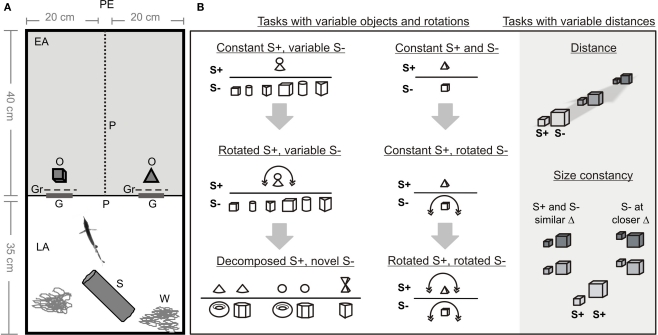
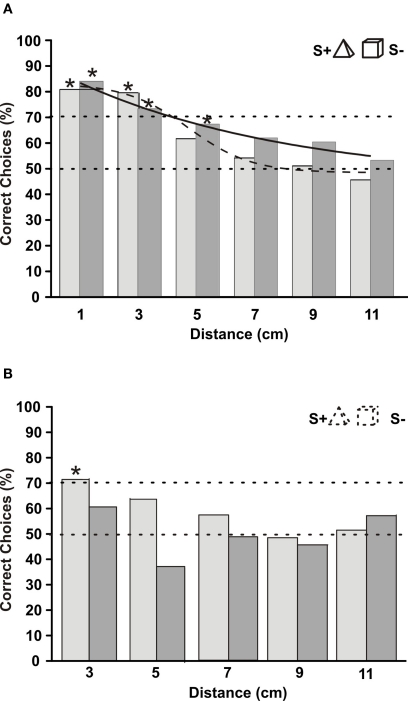
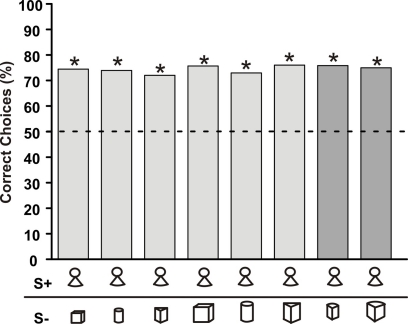
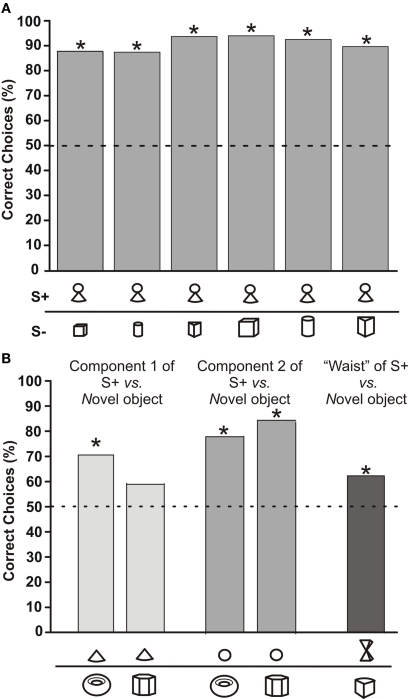
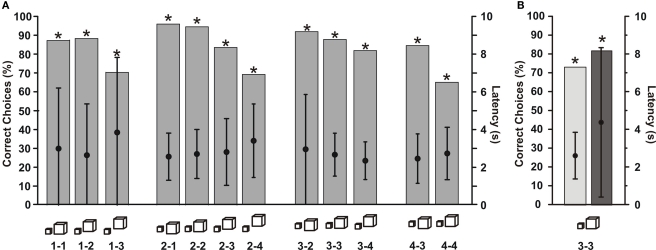
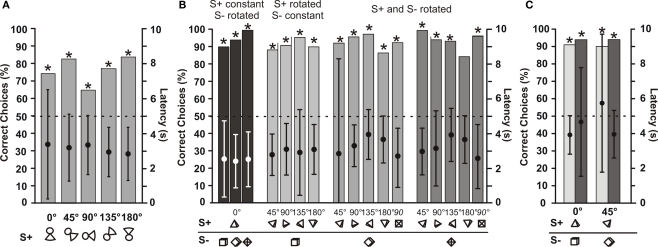
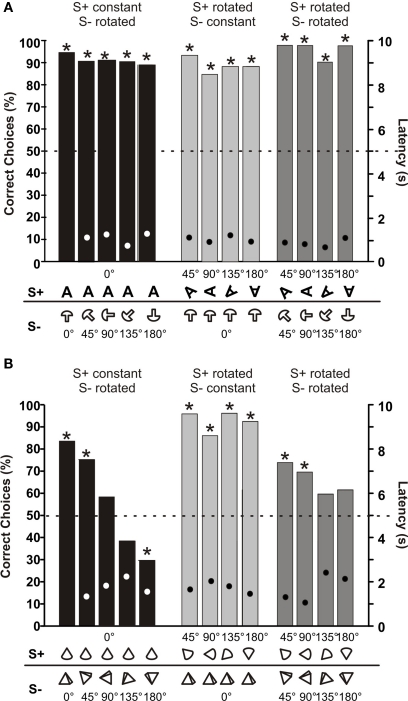
Weakly electric fish use active electrolocation for object detection and orientation in their environment even in complete darkness. The African mormyrid Gnathonemus petersii can detect object parameters, such as material, size, shape, and distance. Here, we tested whether individuals of this species can learn to identify 3-dimensional objects independently of the training conditions and independently of the object's position in space (rotation-invariance; size-constancy). Individual G. petersii were trained in a two-alternative forced-choice procedure to electrically discriminate between a 3-dimensional object (S+) and several alternative objects (S-). Fish were then tested whether they could identify the S+ among novel objects and whether single components of S+ were sufficient for recognition. Size-constancy was investigated by presenting the S+ together with a larger version at different distances. Rotation-invariance was tested by rotating S+ and/or S- in 3D. Our results show that electrolocating G. petersii could (1) recognize an object independently of the S- used during training. When only single components of a complex S+ were offered, recognition of S+ was more or less affected depending on which part was used. (2) Object-size was detected independently of object distance, i.e. fish showed size-constancy. (3) The majority of the fishes tested recognized their S+ even if it was rotated in space, i.e. these fishes showed rotation-invariance. (4) Object recognition was restricted to the near field around the fish and failed when objects were moved more than about 4 cm away from the animals. Our results indicate that even in complete darkness our G. petersii were capable of complex 3-dimensional scene perception using active electrolocation.
弱电鱼即使在完全黑暗的环境中,也会利用主动电定位来检测物体并确定自身方位。非洲长颌鱼Gnathonemus petersii能够检测物体的参数,如材质、大小、形状和距离。在此,我们测试了该物种的个体是否能够独立于训练条件以及物体在空间中的位置(旋转不变性;大小恒常性)来学习识别三维物体。对Gnathonemus petersii个体进行双选强制选择训练,使其通过电信号区分一个三维物体(S+)和几个替代物体(S-)。然后测试鱼是否能够在新物体中识别出S+,以及S+的单个组件是否足以用于识别。通过将S+与不同距离处的更大版本一起呈现来研究大小恒常性。通过在三维空间中旋转S+和/或S-来测试旋转不变性。我们的结果表明,进行电定位的Gnathonemus petersii能够:(1)独立于训练期间使用的S-识别物体。当只提供复杂S+的单个组件时,根据使用的是哪一部分,S+的识别或多或少会受到影响。(2)独立于物体距离检测物体大小,即鱼表现出大小恒常性。(3)大多数接受测试的鱼即使S+在空间中旋转也能识别,即这些鱼表现出旋转不变性。(4)物体识别仅限于鱼周围的近场,当物体移至距离动物约4厘米以上时,识别失败。我们的结果表明,即使在完全黑暗的环境中,我们的Gnathonemus petersii也能够利用主动电定位进行复杂的三维场景感知。