Branco Diogo Martins, Arduino Daniela M, Esteves A Raquel, Silva Diana F F, Cardoso Sandra M, Oliveira Catarina Resende
Center for Neuroscience and Cell Biology, University of Coimbra Coimbra, Portugal.
Front Aging Neurosci. 2010 May 21;2:17. doi: 10.3389/fnagi.2010.00017. eCollection 2010.
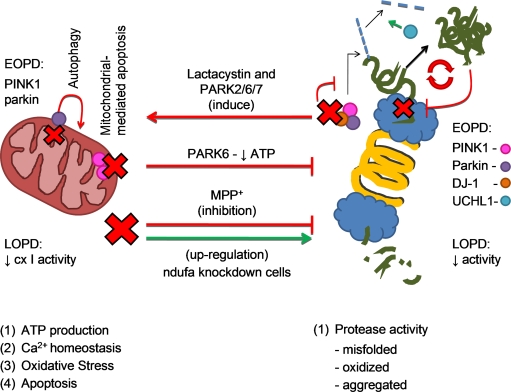
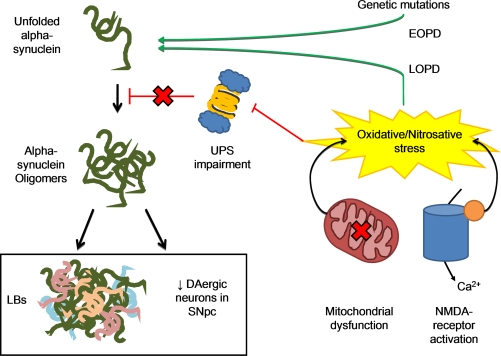
Parkinson's disease (PD) is the most common progressive neurodegenerative movement disorder, characterized by the selective loss of nigrostriatal dopaminergic neurons, and the presence of intracellular insoluble proteinaceous inclusions, known as Lewy Bodies. Although PD etiopathogenesis remains elusive, the leading hypothesis for the death of specific groups of neurons establishes that mitochondrial dysfunction, alterations in the ubiquitin-proteasomal system (UPS), and oxidative stress are major events that act synergistically causing this devastating disease. In this review we will focus on mitochondrial impairment and its implications on proteasomal function and alpha-synuclein aggregation. We will address the role of mitochondria and proteasome cross-talk in the neuronal loss that leads to PD and discuss how this knowledge might further improve patient therapy.
帕金森病(PD)是最常见的进行性神经退行性运动障碍,其特征是黑质纹状体多巴胺能神经元选择性丧失,以及存在细胞内不溶性蛋白质包涵体,即路易小体。尽管PD的病因发病机制仍不清楚,但关于特定神经元群死亡的主要假说是,线粒体功能障碍、泛素-蛋白酶体系统(UPS)改变和氧化应激是协同作用导致这种毁灭性疾病的主要事件。在本综述中,我们将重点关注线粒体损伤及其对蛋白酶体功能和α-突触核蛋白聚集的影响。我们将探讨线粒体和蛋白酶体相互作用在导致PD的神经元丧失中的作用,并讨论这些知识如何可能进一步改善患者治疗。