Wellcome Trust Centre for Neuroimaging, University College London, 12 Queen Square, London, United Kingdom.
Biol Psychol. 2010 Sep;85(1):163-70. doi: 10.1016/j.biopsycho.2010.06.007. Epub 2010 Jun 25.
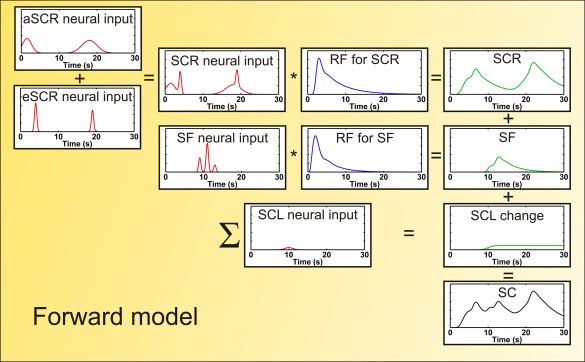
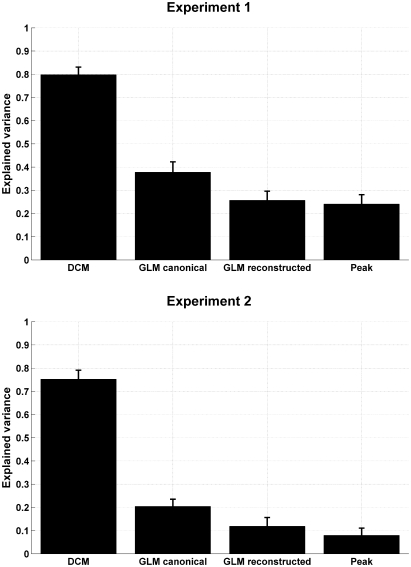
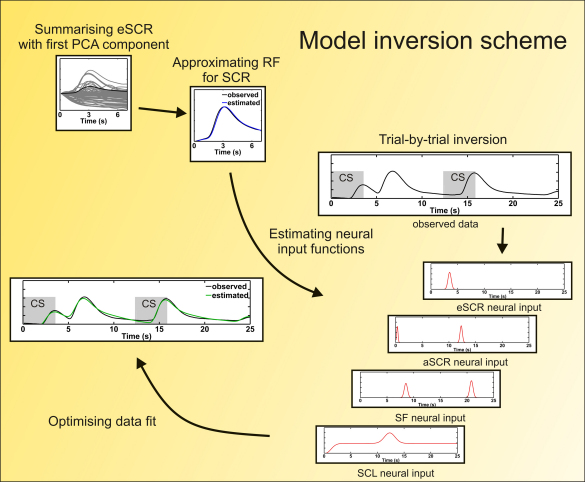
Anticipatory skin conductance responses [SCRs] are a widely used measure of aversive conditioning in humans. Here, we describe a dynamic causal model [DCM] of how anticipatory, evoked, and spontaneous skin conductance changes are generated by sudomotor nerve activity. Inversion of this model, using variational Bayes, provides a means of inferring the most likely sympathetic nerve activity, given observed skin conductance responses. In two fear conditioning experiments, we demonstrate the predictive validity of the DCM by showing it has greater sensitivity to the effects of conditioning, relative to alternative (conventional) response estimates. Furthermore, we establish face validity by showing that trial-by-trial estimates of anticipatory sudomotor activity are better predicted by formal learning models, relative to response estimates from peak-scoring approaches. The model furnishes a potentially powerful approach to characterising SCR that exploits knowledge about how these signals are generated.
预期皮肤电反应(SCR)是人类厌恶条件反射的一种广泛应用的测量方法。在这里,我们描述了一个动态因果模型(DCM),用于说明自主神经活动如何产生预期的、诱发的和自发的皮肤电导变化。通过变分贝叶斯对该模型进行反演,为根据观察到的皮肤电反应推断最有可能的交感神经活动提供了一种手段。在两项恐惧条件反射实验中,我们通过显示它相对于替代(传统)响应估计,对条件作用的影响具有更高的敏感性,从而证明了 DCM 的预测有效性。此外,我们通过显示预期的自主神经活动的逐次试验估计比基于峰值评分方法的响应估计更好地由正式学习模型预测,从而证明了其表面效度。该模型提供了一种潜在的强大方法来描述 SCR,它利用了有关这些信号如何产生的知识。