Pacific Biosciences Research Center, University of Hawaii, 1993 East-West Road, Honolulu, HI 96822, USA.
Behav Brain Res. 2010 Dec 25;214(2):443-9. doi: 10.1016/j.bbr.2010.06.025. Epub 2010 Jun 25.
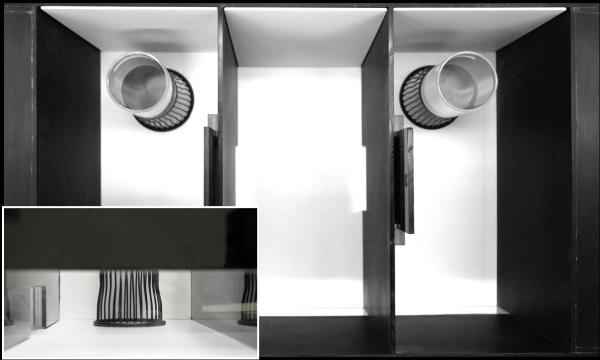
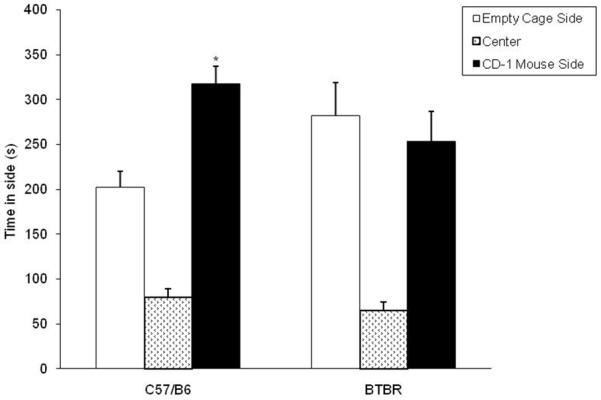
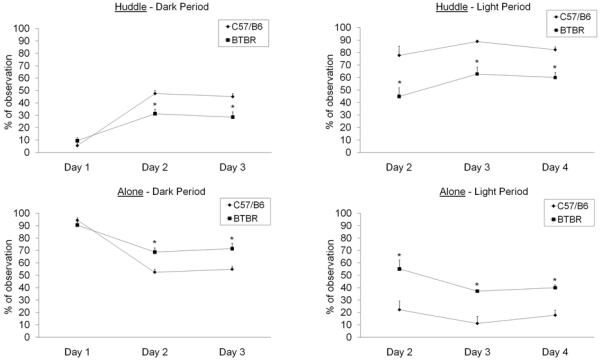
The core symptoms of autism spectrum disorder (ASD) include deficits in social interaction, impaired communication, and repetitive behaviors with restricted interests. Mouse models with behavioral phenotypes relevant to these core symptoms offer an experimental approach to advance the investigation of genes associated with ASD. Previous findings demonstrate that BTBR T+ tf/J (BTBR) is an inbred mouse strain that shows robust behavioral phenotypes with analogies to all three of the diagnostic symptoms of ASD. In the present study, we investigated the expression of social behaviors in a semi-natural visible burrow system (VBS), during colony formation and maintenance in groups comprising three adult male mice of the same strain, either C57BL/6J (B6) or BTBR. For comparative purposes, an extensively investigated three-chambered test was subsequently used to assess social approach in both strains. The effects of strain on these two situations were consistent and highly significant. In the VBS, BTBR mice showed reductions in all interactive behaviors: approach (front and back), flight, chase/follow, allo-grooming and huddling, along with increases in self-grooming and alone, as compared to B6. These results were corroborated in the three-chambered test: in contrast to B6, male BTBR mice failed to spend more time in the side of the test box containing the unfamiliar CD-1 mouse. Overall, the present data indicates that the strain profile for BTBR mice, including consistent social deficits and high levels of repetitive self-grooming, models multiple components of the ASD phenotype.
自闭症谱系障碍(ASD)的核心症状包括社交互动缺陷、沟通障碍以及兴趣受限的重复行为。具有与这些核心症状相关的行为表型的小鼠模型为研究与 ASD 相关的基因提供了一种实验方法。先前的研究结果表明,BTBR T+ tf/J(BTBR)是一种近交系小鼠,具有与 ASD 的所有三种诊断症状相似的强大行为表型。在本研究中,我们在一个半自然可见的洞穴系统(VBS)中研究了社会行为的表达,在该系统中,由三只成年雄性相同品系的小鼠(C57BL/6J(B6)或 BTBR)组成的群体中进行了群体形成和维持。为了进行比较,随后使用经过广泛研究的三腔测试来评估两种菌株的社交接近能力。在这两种情况下,品系对这些结果的影响是一致的且非常显著。在 VBS 中,与 B6 相比,BTBR 小鼠的所有互动行为(前向和后向接近、逃避、追逐/跟随、同种梳理和群居以及自我梳理和独处)均减少。这些结果在三腔测试中得到了证实:与 B6 相反,雄性 BTBR 小鼠不会花更多的时间在测试箱的一侧,该侧装有不熟悉的 CD-1 小鼠。总的来说,目前的数据表明,BTBR 小鼠的品系特征包括一致的社交缺陷和高水平的重复自我梳理,模拟了 ASD 表型的多个成分。