Howard Hughes Medical Institute, Department of Genetics, Harvard Medical School, and Brigham and Women's Hospital, Boston, MA 02115, USA.
Mol Cell. 2010 Jul 9;39(1):36-47. doi: 10.1016/j.molcel.2010.06.023.
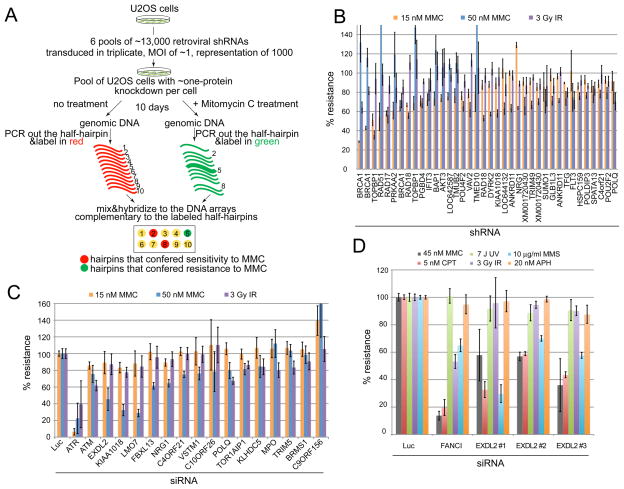
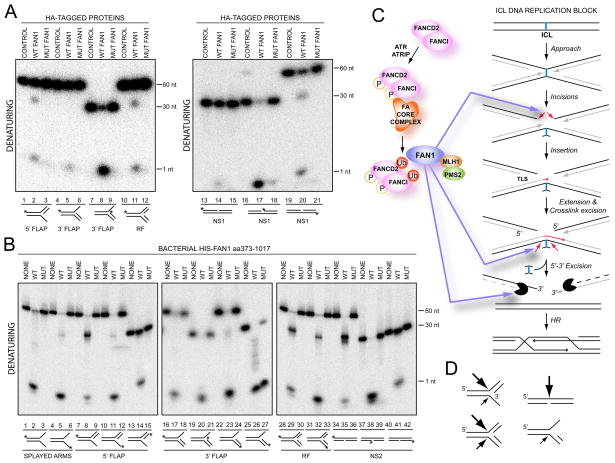
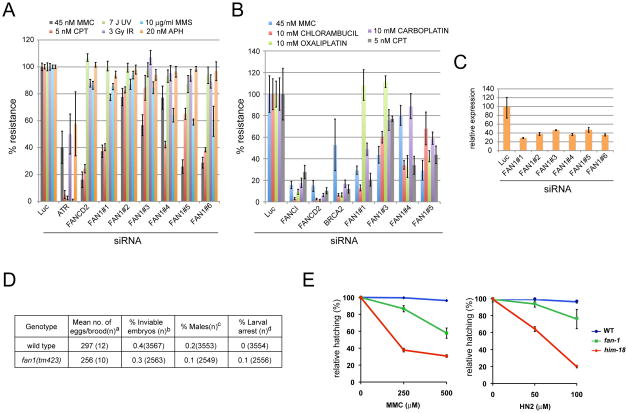
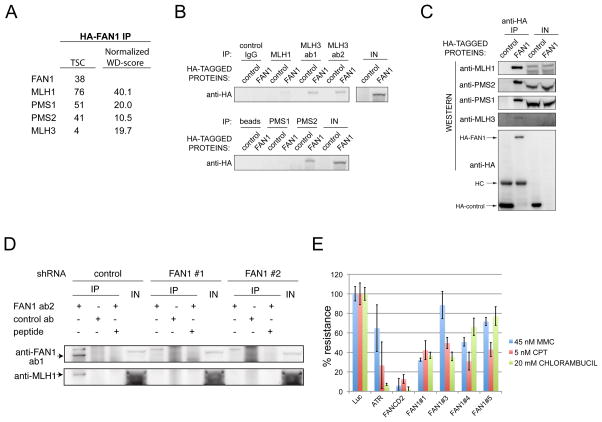
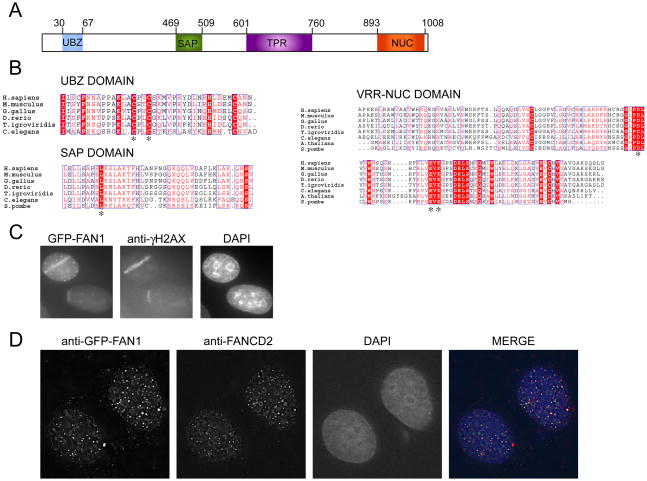
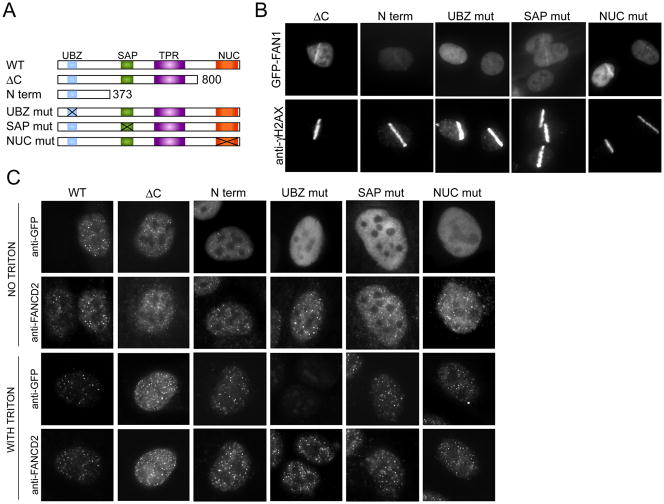
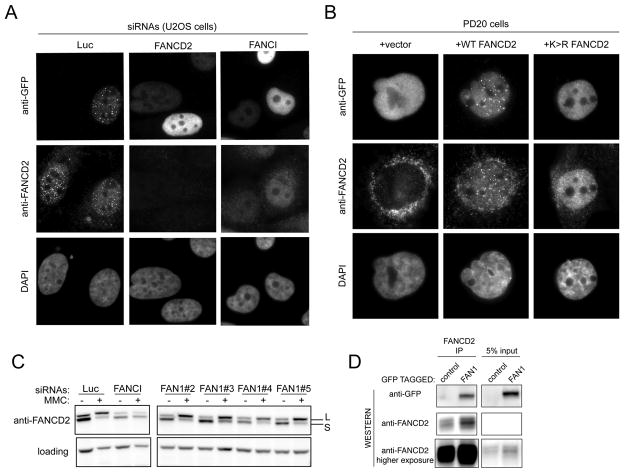
The Fanconi anemia (FA) pathway is responsible for interstrand crosslink repair. At the heart of this pathway is the FANCI-FAND2 (ID) complex, which, upon ubiquitination by the FA core complex, travels to sites of damage to coordinate repair that includes nucleolytic modification of the DNA surrounding the lesion and translesion synthesis. How the ID complex regulates these events is unknown. Here we describe a shRNA screen that led to the identification of two nucleases necessary for crosslink repair, FAN1 (KIAA1018) and EXDL2. FAN1 colocalizes at sites of DNA damage with the ID complex in a manner dependent on FAN1's ubiquitin-binding domain (UBZ), the ID complex, and monoubiquitination of FANCD2. FAN1 possesses intrinsic 5'-3' exonuclease activity and endonuclease activity that cleaves nicked and branched structures. We propose that FAN1 is a repair nuclease that is recruited to sites of crosslink damage in part through binding the ubiquitinated ID complex through its UBZ domain.
范可尼贫血(FA)途径负责链间交联修复。该途径的核心是 FANCI-FAND2(ID)复合物,它在 FA 核心复合物的泛素化作用下,会到达损伤部位,协调修复,包括对损伤周围 DNA 的核酶修饰和跨损伤合成。ID 复合物如何调节这些事件尚不清楚。在这里,我们描述了一个 shRNA 筛选,该筛选导致鉴定出两种对交联修复至关重要的核酶,FAN1(KIAA1018)和 EXDL2。FAN1 以依赖于 FAN1 的泛素结合结构域(UBZ)、ID 复合物和 FANCD2 的单泛素化的方式与 ID 复合物在 DNA 损伤部位共定位。FAN1 具有内在的 5'-3'外切核酸酶活性和内切核酸酶活性,可切割缺口和分支结构。我们提出,FAN1 是一种修复核酶,它通过其 UBZ 结构域与泛素化的 ID 复合物结合,部分被招募到交联损伤部位。