Biological Resource Center, Korea Research Institute of Bioscience & Biotechnology, Daejeon 305-806, Korea.
BMC Genomics. 2010 Jul 9;11:423. doi: 10.1186/1471-2164-11-423.
DNA barcoding uses a 650 bp segment of the mitochondrial cytochrome c oxidase I (COI) gene as the basis for an identification system for members of the animal kingdom and some other groups of eukaryotes. PCR amplification of the barcode region is a key step in the analytical chain, but it sometimes fails because of a lack of homology between the standard primer sets and target DNA.
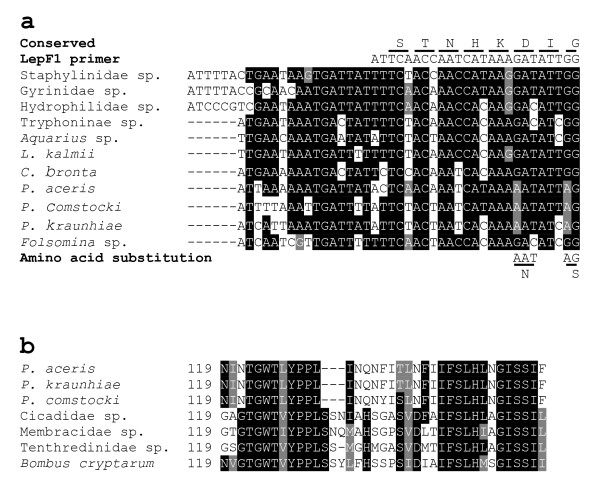
Two forward PCR primers were developed following analysis of all known arthropod mitochondrial genome arrangements and sequence alignment of the tRNA-W gene which was usually located within 200 bp upstream of the COI gene. These two primers were combined with a standard reverse primer (LepR1) to produce a cocktail which generated a barcode amplicon from 125 of 141 species that included representatives of 121 different families of Hexapoda. High quality sequences were recovered from 79% of the species including groups, such as scale insects, that invariably fail to amplify with standard primers.
A cocktail of two tRNA-W forward primers coupled with a standard reverse primer amplifies COI for most hexapods, allowing characterization of the standard barcode primer binding region in COI 5' as well as the barcode segment. The current results show that primers designed to bind to highly conserved gene regions upstream of COI will aid the amplification of this gene region in species where standard primers fail and provide valuable information to design a primer for problem groups.
DNA 条形码使用线粒体细胞色素 c 氧化酶 I(COI)基因的 650bp 片段作为动物王国成员和其他一些真核生物类群鉴定系统的基础。PCR 扩增条形码区域是分析链中的关键步骤,但由于标准引物与目标 DNA 之间缺乏同源性,有时会失败。
在分析所有已知节肢动物线粒体基因组排列和 tRNA-W 基因序列比对后,开发了两个正向 PCR 引物,该基因通常位于 COI 基因上游 200bp 内。这两个引物与标准反向引物(LepR1)结合,生成了一个混合物,从包括 121 个不同六足纲家族代表的 141 个物种中产生了一个条形码扩增子。从 79%的物种中回收了高质量的序列,包括那些通常无法用标准引物扩增的物种,如鳞片昆虫。
两个 tRNA-W 正向引物的混合物与一个标准反向引物相结合,可扩增大多数六足类动物的 COI,从而能够对 COI 5'上标准条形码引物结合区以及条形码片段进行特征描述。目前的结果表明,设计用于结合 COI 上游高度保守基因区域的引物将有助于在标准引物失败的物种中扩增该基因区域,并为设计针对问题群体的引物提供有价值的信息。