Southern Research Institute, Frederick, MD, USA.
AIDS Res Ther. 2010 Jul 9;7:22. doi: 10.1186/1742-6405-7-22.
At present, there is no effective vaccine or other approved product for the prevention of sexually transmitted human immunodeficiency virus type 1 (HIV-1) infection. It has been reported that women in resource-poor communities use vaginally applied citrus juices as topical microbicides. These easily accessible food products have historically been applied to prevent pregnancy and sexually transmitted diseases. The aim of this study was to evaluate the efficacy and cytotoxicity of these substances using an established topical microbicide testing algorithm. Freshly squeezed lemon and lime juice and household vinegar were tested in their original state or in pH neutralized form for efficacy and cytotoxicity in the CCR5-tropic cell-free entry and cell-associated transmission assays, CXCR4-tropic entry and fusion assays, and in a human PBMC-based anti-HIV-1 assay. These products were also tested for their effect on viability of cervico-vaginal cell lines, human cervical explant tissues, and beneficial Lactobacillus species.
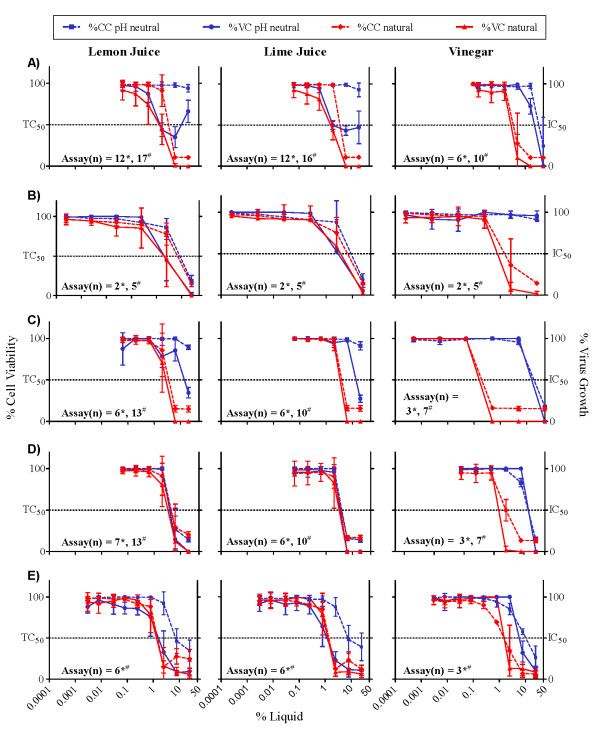
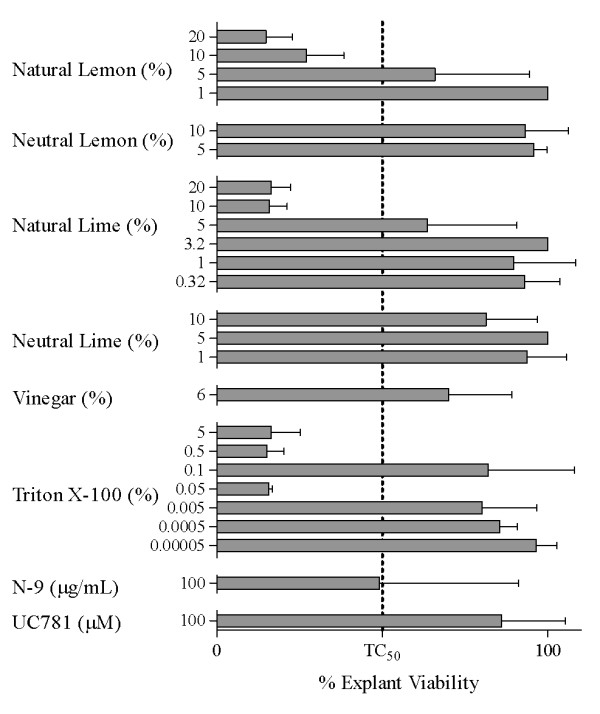
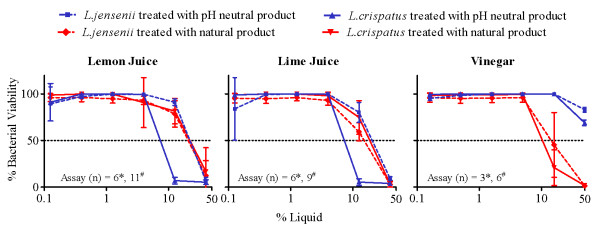
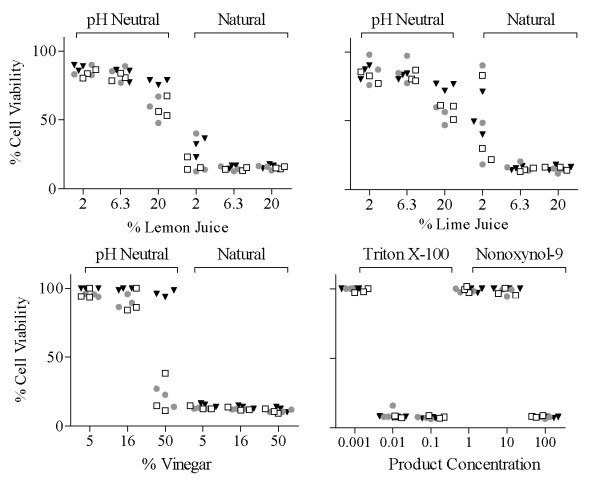
Natural lime and lemon juice and household vinegar demonstrated anti-HIV-1 activity and cytotoxicity in transformed cell lines. Neutralization of the products reduced both anti-HIV-1 activity and cytotoxicity, resulting in a low therapeutic window for both acidic and neutralized formulations. For the natural juices and vinegar, the IC50 was </= 3.5 (0.8-3.5)% and the TC50 </= 6.3 (1.0-6.3)%. All three liquid products inhibited viability of beneficial Lactobacillus species associated with vaginal health. Comparison of three different toxicity endpoints in the cervical HeLa cell line revealed that all three products affected membrane integrity, cytosolic enzyme release, and dehydrogenase enzyme activity in living cells. The juices and vinegar also exerted strong cytotoxicity in cervico-vaginal cell lines, mainly due to their acidic pH. In human cervical explant tissues, treatment with 5% lemon or lime juice or 6% vinegar induced toxicity similar to application of 100 mug/ml nonoxynol-9, and exposure to 10% lime juice caused tissue damage comparable to treatment with 5% Triton-X-100.
Lemon and lime juice and household vinegar do not fulfill the safety criteria mandated for a topical microbicide. As a result of their unphysiological formulation for the vaginal tract, they exhibit cytotoxicity to human cell lines, human vaginal tissues, and beneficial vaginal Lactobacillus species.
目前,尚无预防经性传播的人免疫缺陷病毒 1 型(HIV-1)感染的有效疫苗或其他经批准的产品。据报道,资源匮乏社区的妇女使用阴道应用的柑橘类果汁作为局部杀微生物剂。这些容易获得的食品产品在历史上一直被用于预防怀孕和性传播疾病。本研究的目的是使用既定的局部杀微生物剂测试算法评估这些物质的功效和细胞毒性。新鲜榨取的柠檬汁和酸橙汁以及家用醋以其原始状态或 pH 值中和形式进行测试,以评估其在 CCR5 嗜性无细胞进入和细胞相关传播试验、CXCR4 嗜性进入和融合试验以及基于人 PBMC 的抗 HIV-1 测定中的功效和细胞毒性。还测试了这些产品对宫颈阴道细胞系、人宫颈组织外植体和有益的乳杆菌种的生存能力的影响。
天然酸橙汁和柠檬汁以及家用醋在转化细胞系中表现出抗 HIV-1 活性和细胞毒性。产品的中和既降低了抗 HIV-1 活性,又降低了细胞毒性,导致酸性和中和制剂的治疗窗口均较低。对于天然果汁和醋,IC50 为</=3.5(0.8-3.5)%,TC50</=6.3(1.0-6.3)%。所有三种液体产品均抑制了与阴道健康相关的有益乳杆菌种的生存能力。在宫颈 HeLa 细胞系中比较三种不同的毒性终点,发现所有三种产品均影响活细胞的膜完整性、细胞质酶释放和脱氢酶活性。果汁和醋也对宫颈阴道细胞系表现出很强的细胞毒性,主要归因于其酸性 pH 值。在人宫颈组织外植体中,用 5%柠檬或酸橙汁或 6%醋处理会引起类似于应用 100ug/ml 壬苯醇醚-9 的毒性,而用 10%酸橙汁处理会引起与用 5%Triton-X-100 处理相当的组织损伤。
柠檬汁和酸橙汁以及家用醋不符合局部杀微生物剂所需的安全标准。由于其阴道部位的非生理配方,它们对人细胞系、人阴道组织和有益的阴道乳杆菌种表现出细胞毒性。