Department of Medicine and Therapeutics, Ninewells Hospital and Medical School, Dundee, UK.
Diabetes. 2010 Nov;59(11):2945-8. doi: 10.2337/db09-1690. Epub 2010 Jul 9.
We have previously observed that genetic profiles determined by the combination of five functionally significant single nucleotide polymorphisms (SNPs) (rs1800795, rs5498, rs5361, rs1024611, and rs679620) of genes encoding prototypical inflammatory molecules are associated with history of ischemic stroke. Here we tested the ability of this multigenic model to predict stroke risk in a large population-based prospective cohort of subjects with type 2 diabetes.
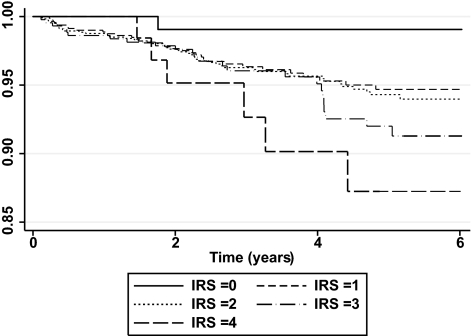
This study was conducted using a prospective cohort of individuals with type 2 diabetes participating in the Go-DARTS (Genetics of Diabetes Audit and Research in Tayside Scotland) study, which includes genetic and clinical information of patients with diabetes within the Tayside region of Scotland, U.K. The above-mentioned inflammatory SNPs were investigated in 2,182 Go-DARTS participants. We created an inflammatory risk score (IRS), ranging from 0 to 5, according to the number of "at-risk" genotypes concomitantly carried by a given individual. The primary outcome was the occurrence of fatal or nonfatal stroke of any kind. Mean follow-up time was 6.2 ± 1.1 years.
The incidence of stroke increased according to the IRS. The IRS was significantly and independently associated with increased stroke risk after adjustment for other conventional risk factors (hazard ratio 1.34 [95% CI 1.1-1.7]; P = 0.009). The highest hazard ratio for stroke was found in subjects concomitantly carrying > 3 proinflammatory variations and in subjects without previous cardiovascular diseases.
This large prospective cohort study provides evidence that SNPs of genes encoding prototypical inflammatory molecules may be used to create multigenic models that predict stroke risk in subjects with type 2 diabetes.
我们之前观察到,由编码典型炎症分子的五个功能显著单核苷酸多态性(SNP)(rs1800795、rs5498、rs5361、rs1024611 和 rs679620)组合确定的遗传特征与缺血性中风病史相关。在这里,我们在一个大型基于人群的 2 型糖尿病患者前瞻性队列中测试了该多基因模型预测中风风险的能力。
本研究使用参与 Go-DARTS(苏格兰泰赛德遗传学糖尿病审计和研究)研究的 2 型糖尿病患者前瞻性队列进行,该研究包括英国苏格兰泰赛德地区糖尿病患者的遗传和临床信息。在 2182 名 Go-DARTS 参与者中研究了上述炎症 SNPs。根据个体同时携带的“风险”基因型数量,我们创建了炎症风险评分(IRS),范围为 0 到 5。主要结局是任何类型的致命或非致命性中风的发生。平均随访时间为 6.2±1.1 年。
根据 IRS,中风的发病率增加。在调整其他传统危险因素后,IRS 与中风风险增加显著相关(危险比 1.34[95%CI1.1-1.7];P=0.009)。在同时携带>3 种促炎变异体的受试者和无先前心血管疾病的受试者中,中风的最高危险比。
这项大型前瞻性队列研究提供了证据,表明编码典型炎症分子的 SNP 可用于创建多基因模型,以预测 2 型糖尿病患者的中风风险。