Department of Biology, University of Alabama at Birmingham, Birmingham, Alabama, United States of America.
PLoS One. 2010 Jul 6;5(7):e11457. doi: 10.1371/journal.pone.0011457.
Sulforaphane (SFN), an isothiocyanate found in cruciferous vegetables, is a common dietary component that has histone deacetylase inhibition activity and exciting potential in cancer prevention. The mechanisms by which SFN imparts its chemopreventive properties are of considerable interest and little is known of its preventive potential for breast cancer.
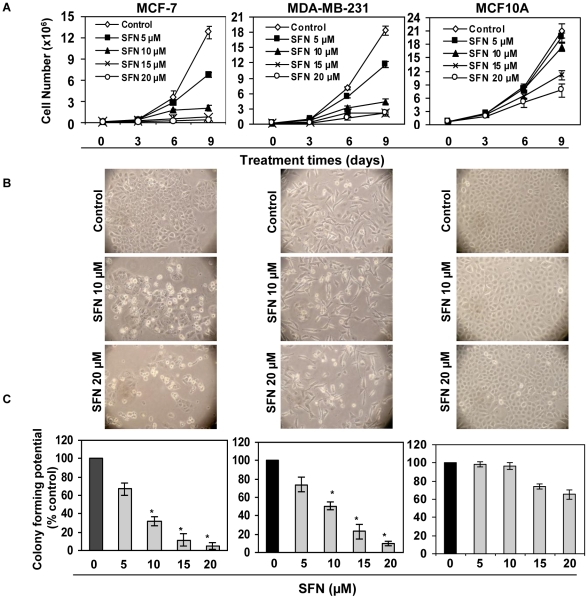
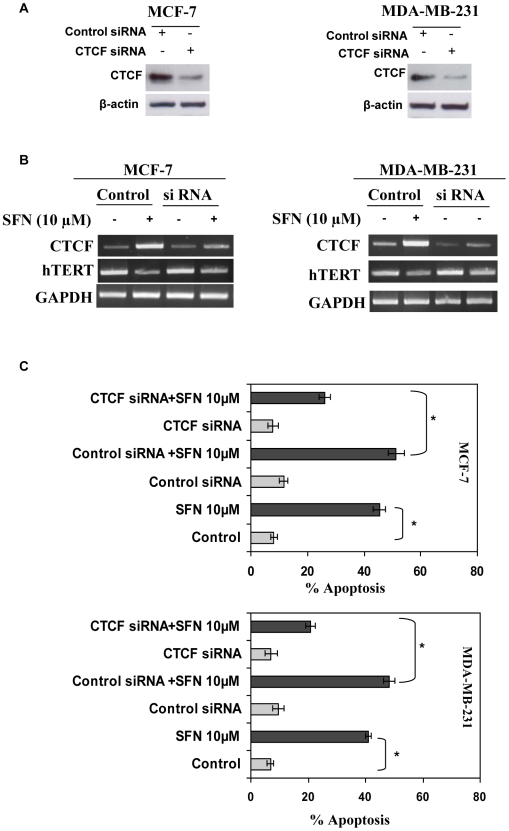
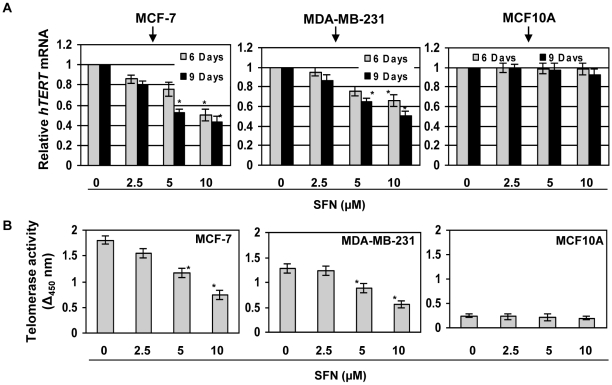
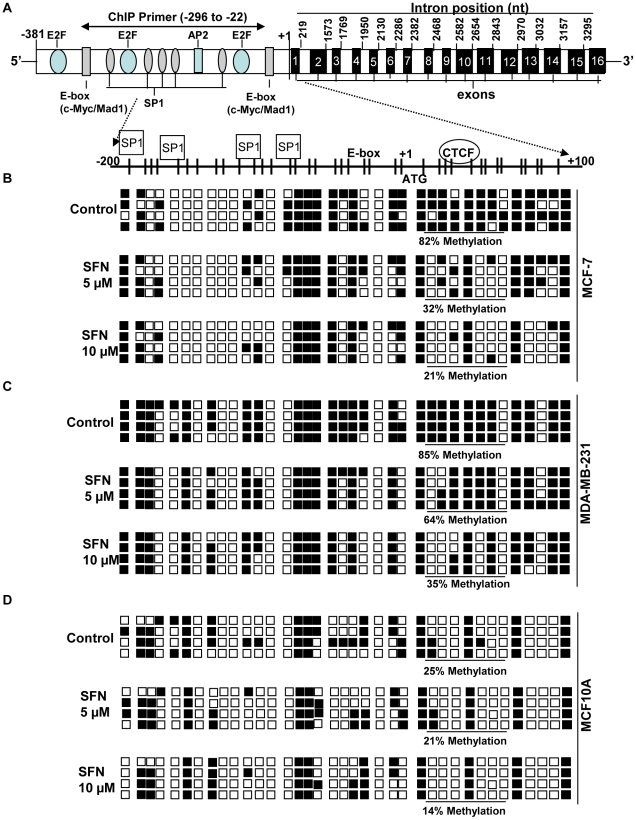
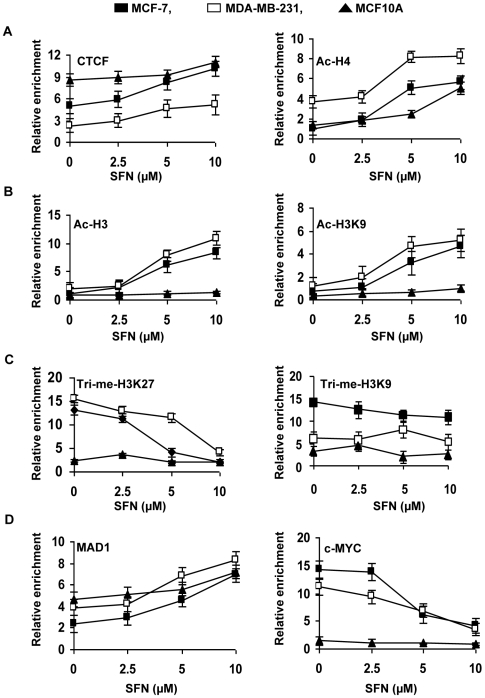
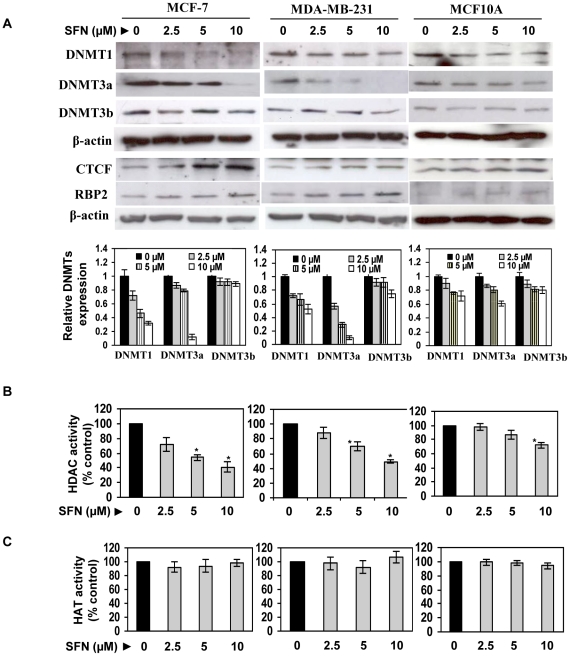
We found that SFN significantly inhibits the viability and proliferation of breast cancer cells in vitro while it has negligible effects on normal breast cells. Inhibition of telomerase has received considerable attention because of its high expression in cancer cells and extremely low level of expression in normal cells. SFN treatment dose- and time-dependently inhibited human telomerase reverse transcriptase (hTERT), the catalytic regulatory subunit of telomerase, in both MCF-7 and MDA-MB-231 human breast cancer cells. DNA methyltransferases (DNMTs), especially DNMT1 and DNMT3a, were also decreased in SFN-treated breast cancer cells suggesting that SFN may repress hTERT by impacting epigenetic pathways. Down-regulation of DNMTs in response to SFN induced site-specific CpG demethylation occurring primarily in the first exon of the hTERT gene thereby facilitating CTCF binding associated with hTERT repression. Chromatin immunoprecipitation (ChIP) analysis of the hTERT promoter revealed that SFN increased the level of active chromatin markers acetyl-H3, acetyl-H3K9 and acetyl-H4, whereas the trimethyl-H3K9 and trimethyl-H3K27 inactive chromatin markers were decreased in a dose-dependent manner. SFN-induced hyperacetylation facilitated the binding of many hTERT repressor proteins such as MAD1 and CTCF to the hTERT regulatory region. Depletion of CTCF using siRNA reduced the SFN-induced down-regulation of hTERT mRNA transcription in these breast cancer cells. In addition, down-regulation of hTERT expression facilitated the induction of cellular apoptosis in human breast cancer cells.
Collectively, our results provide novel insights into SFN-mediated epigenetic down-regulation of telomerase in breast cancer prevention and may open new avenues for approaches to SFN-mediated cancer prevention.
萝卜硫素(SFN)是十字花科蔬菜中发现的一种异硫氰酸盐,是一种常见的膳食成分,具有组蛋白去乙酰化酶抑制活性,在癌症预防方面具有令人兴奋的潜力。SFN 赋予其化学预防特性的机制引起了相当大的兴趣,而其对乳腺癌的预防潜力知之甚少。
我们发现 SFN 可显著抑制乳腺癌细胞在体外的活力和增殖,而对正常乳腺细胞几乎没有影响。由于端粒酶在癌细胞中的高表达和在正常细胞中的极低水平表达,端粒酶的抑制受到了相当多的关注。SFN 处理剂量和时间依赖性地抑制了 MCF-7 和 MDA-MB-231 人乳腺癌细胞中的人端粒酶逆转录酶(hTERT),即端粒酶的催化调节亚基。SFN 处理的乳腺癌细胞中的 DNA 甲基转移酶(DNMTs),特别是 DNMT1 和 DNMT3a,也减少了,这表明 SFN 可能通过影响表观遗传途径来抑制 hTERT。SFN 诱导的 DNMTs 下调导致 hTERT 基因第一外显子中发生特定于 CpG 的去甲基化,从而促进与 hTERT 抑制相关的 CTCF 结合。hTERT 启动子的染色质免疫沉淀(ChIP)分析显示,SFN 增加了活性染色质标记物乙酰-H3、乙酰-H3K9 和乙酰-H4 的水平,而三甲基-H3K9 和三甲基-H3K27 非活性染色质标记物则呈剂量依赖性降低。SFN 诱导的乙酰化促进了许多 hTERT 阻遏蛋白如 MAD1 和 CTCF 与 hTERT 调节区的结合。用 siRNA 耗尽 CTCF 会降低 SFN 诱导的这些乳腺癌细胞中 hTERT mRNA 转录的下调。此外,hTERT 表达的下调促进了人乳腺癌细胞的细胞凋亡诱导。
总的来说,我们的结果为 SFN 介导的乳腺癌预防中端粒酶的表观遗传下调提供了新的见解,并可能为 SFN 介导的癌症预防开辟新的途径。