Urban J F, Katona I M, Paul W E, Finkelman F D
Helminthic Diseases Laboratory, U.S. Department of Agriculture, Beltsville, MD 20705-2350.
Proc Natl Acad Sci U S A. 1991 Jul 1;88(13):5513-7. doi: 10.1073/pnas.88.13.5513.
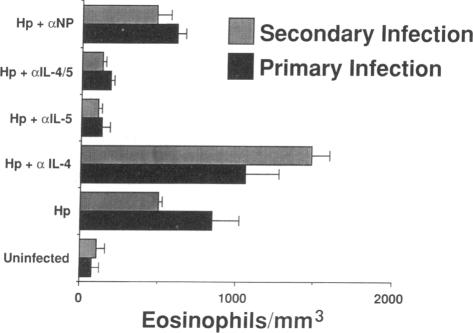
Parasitic helminths typically induce components of immediate-type hypersensitivity, including elevated serum IgE, eosinophilia, and mucosal mast cells. These responses are T-cell-dependent and associated with rapid expulsion of parasitic worms from a sensitized host; existing experimental systems have failed to define the precise role of cytokines in these responses. We report here that anti-interleukin 4 or anti-interleukin 4 receptor antibodies block the polyclonal IgE response to a parasitic nematode, Heligmosomoides polygyrus, and abrogate protective immunity to the infection. In contrast, anti-interleukin 5 antibody prevented H. polygyrus-induced eosinophilia but did not prevent protection. These data provide evidence that a specific cytokine affects the physiology and survival of a parasitic nematode in the host.
寄生性蠕虫通常会引发速发型超敏反应的一些成分,包括血清IgE升高、嗜酸性粒细胞增多以及黏膜肥大细胞。这些反应依赖于T细胞,并且与致敏宿主快速排出寄生蠕虫有关;现有的实验系统未能明确细胞因子在这些反应中的精确作用。我们在此报告,抗白细胞介素4或抗白细胞介素4受体抗体可阻断对寄生线虫多房棘球绦虫的多克隆IgE反应,并消除对该感染的保护性免疫。相比之下,抗白细胞介素5抗体可预防多房棘球绦虫诱导的嗜酸性粒细胞增多,但不能预防保护作用。这些数据证明,一种特定的细胞因子会影响寄生线虫在宿主体内的生理状态和存活。