Department of Psychology, University of Minnesota, Minneapolis, USA.
Am J Psychiatry. 2010 Sep;167(9):1066-74. doi: 10.1176/appi.ajp.2010.09091272. Epub 2010 Jul 15.
There is substantial evidence of a link between parental substance use disorders and antisocial behavior and childhood disruptive disorders in offspring, but it is unclear whether this transmission is specific to particular disorders or if a general liability accounts for familial resemblance. The authors examined whether the association between parental externalizing disorders and childhood disruptive disorders in preadolescent offspring is a result of the transmission of general or disorder-specific liabilities and estimated the genetic and environmental contributions to variation in these general and specific liability indicators.
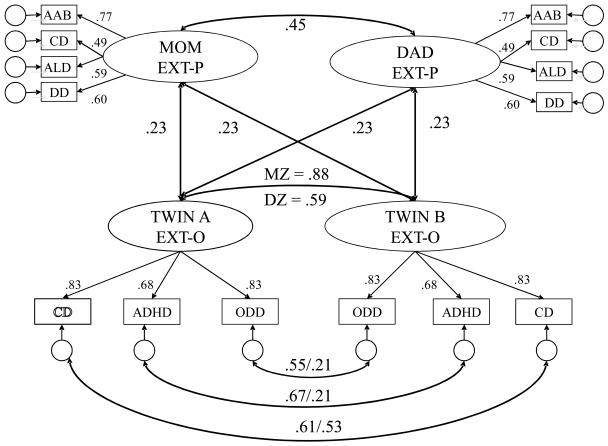
Participants were 1,069 families consisting of 11-year-old twins and their biological mother and father. Structural equation modeling was used to simultaneously estimate the general and specific transmission effects of four parental externalizing disorders (conduct disorder, adult antisocial behavior, alcohol dependence, and drug dependence) on childhood disruptive disorders (attention deficit hyperactivity disorder, conduct disorder, and oppositional defiant disorder).
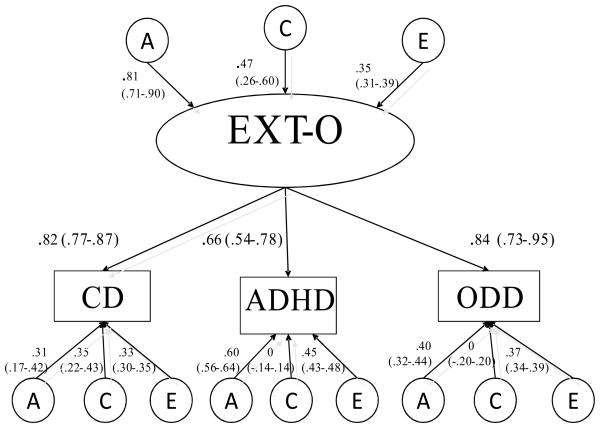
Parent-child resemblance was accounted for by the transmission of a general liability to externalizing disorders, and this general liability was highly heritable. Specific effects were also detected, but for sibling rather than parental transmission. Specific genetic and nonshared environmental effects were detected for each childhood disruptive disorder, but only conduct disorder exhibited a significant shared environmental effect.
A highly heritable general liability accounts for the parent-child transmission of externalizing psychopathology from parents to their preadolescent offspring. This general liability should be a focus of research for both etiology and intervention.
大量证据表明,父母的物质使用障碍和反社会行为与子女的童年破坏性行为障碍之间存在关联,但尚不清楚这种传递是特定于特定障碍,还是普遍倾向可以解释家族相似性。作者研究了父母的外在障碍与青春期前子女的童年破坏性行为障碍之间的关联是否是一般或特定障碍倾向传递的结果,并估计了这些一般和特定倾向指标变化的遗传和环境贡献。
参与者包括 1069 个家庭,由 11 岁的双胞胎及其亲生母亲和父亲组成。结构方程模型用于同时估计四种父母外在障碍(品行障碍、成年反社会行为、酒精依赖和药物依赖)对童年破坏性行为障碍(注意缺陷多动障碍、品行障碍和对立违抗性障碍)的一般和特定传递效应。
亲子相似性是由外在障碍的普遍倾向传递引起的,这种普遍倾向具有高度遗传性。还检测到特定效应,但仅限于兄弟姐妹之间的传递,而不是父母之间的传递。每种童年破坏性行为障碍都检测到特定的遗传和非共享环境效应,但只有品行障碍表现出显著的共享环境效应。
高度遗传性的普遍倾向解释了父母从外向型精神病理学到青春期前子女的亲子传递。这种普遍倾向应该是病因学和干预研究的重点。