Center for Neuroscience Research, Children's National Medical Center, Washington, DC, USA.
Nat Neurosci. 2010 Aug;13(8):927-34. doi: 10.1038/nn.2600. Epub 2010 Jul 18.
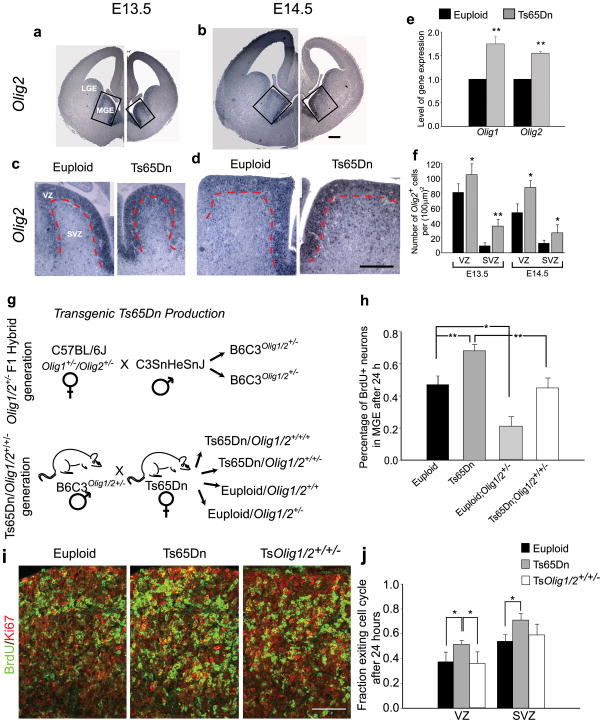
Over-inhibition is thought to be one of the underlying causes of the cognitive deficits in Ts65Dn mice, the most widely used model of Down syndrome. We found a direct link between gene triplication and defects in neuron production during embryonic development. These neurogenesis defects led to an imbalance between excitatory and inhibitory neurons and to increased inhibitory drive in the Ts65Dn forebrain. We discovered that Olig1 and Olig2, two genes that are triplicated in Down syndrome and in Ts65Dn mice, were overexpressed in the Ts65Dn forebrain. To test the hypothesis that Olig triplication causes the neurological phenotype, we used a genetic approach to normalize the dosage of these two genes and thereby rescued the inhibitory neuron phenotype in the Ts65Dn brain. These data identify seminal alterations during brain development and suggest a mechanistic relationship between triplicated genes and these brain abnormalities in the Ts65Dn mouse.
过度抑制被认为是 Ts65Dn 小鼠(唐氏综合征最广泛使用的模型)认知缺陷的潜在原因之一。我们发现基因三倍体与胚胎发育过程中神经元产生缺陷之间存在直接联系。这些神经发生缺陷导致兴奋性和抑制性神经元之间失衡,并增加了 Ts65Dn 前脑的抑制性驱动。我们发现,在唐氏综合征和 Ts65Dn 小鼠中三倍体的两个基因 Olig1 和 Olig2 在 Ts65Dn 前脑中过度表达。为了验证 Olig 三倍体导致神经表型的假说,我们使用遗传方法使这两个基因的剂量正常化,从而挽救了 Ts65Dn 大脑中的抑制性神经元表型。这些数据确定了大脑发育过程中的重要改变,并表明在 Ts65Dn 小鼠中,三倍体基因与这些大脑异常之间存在机制关系。