Cape Breton University, 1250 Grand Lake Road, Sydney, NS B1P 6L2, Canada.
BMC Genomics. 2010 Jul 19;11:440. doi: 10.1186/1471-2164-11-440.
Widespread sampling of vertebrates, which comprise the majority of published animal mitochondrial genomes, has led to the view that mitochondrial gene rearrangements are relatively rare, and that gene orders are typically stable across major taxonomic groups. In contrast, more limited sampling within the Phylum Mollusca has revealed an unusually high number of gene order arrangements. Here we provide evidence that the lability of the molluscan mitochondrial genome extends to the family level by describing extensive gene order changes that have occurred within the Vermetidae, a family of sessile marine gastropods that radiated from a basal caenogastropod stock during the Cenozoic Era.
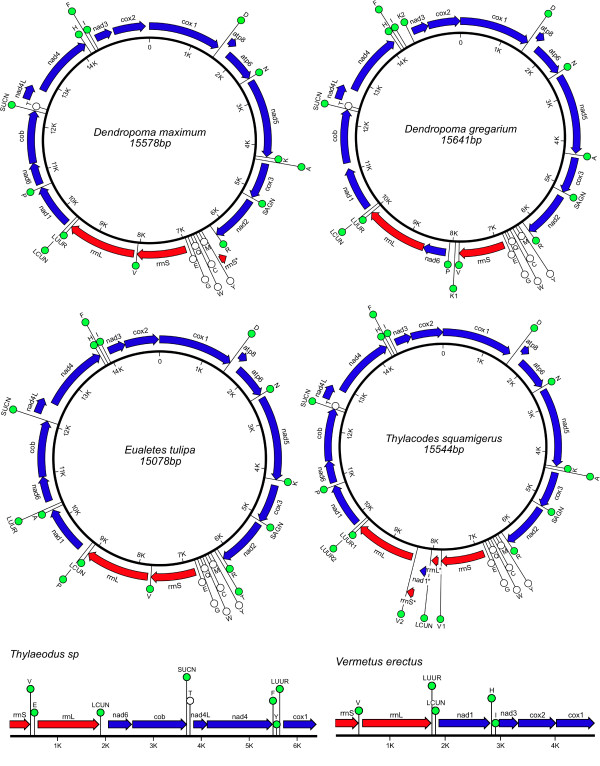
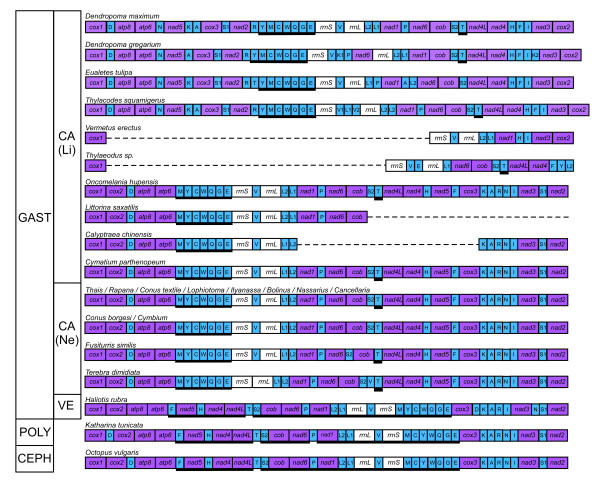
Major mitochondrial gene rearrangements have occurred within this family at a scale unexpected for such an evolutionarily young group and unprecedented for any caenogastropod examined to date. We determined the complete mitochondrial genomes of four species (Dendropoma maximum, D. gregarium, Eualetes tulipa, and Thylacodes squamigerus) and the partial mitochondrial genomes of two others (Vermetus erectus and Thylaeodus sp.). Each of the six vermetid gastropods assayed possessed a unique gene order. In addition to the typical mitochondrial genome complement of 37 genes, additional tRNA genes were evident in D. gregarium (trnK) and Thylacodes squamigerus (trnV, trnLUUR). Three pseudogenes and additional tRNAs found within the genome of Thylacodes squamigerus provide evidence of a past duplication event in this taxon. Likewise, high sequence similarities between isoaccepting leucine tRNAs in Thylacodes, Eualetes, and Thylaeodus suggest that tRNA remolding has been rife within this family. While vermetids exhibit gene arrangements diagnostic of this family, they also share arrangements with littorinimorph caenogastropods, with which they have been linked based on sperm morphology and primary sequence-based phylogenies.
We have uncovered major changes in gene order within a family of caenogastropod molluscs that are indicative of a highly dynamic mitochondrial genome. Studies of mitochondrial genomes at such low taxonomic levels should help to illuminate the dynamics of gene order change, since the telltale vestiges of gene duplication, translocation, and remolding have not yet been erased entirely. Likewise, gene order characters may improve phylogenetic hypotheses at finer taxonomic levels than once anticipated and aid in investigating the conditions under which sequence-based phylogenies lack resolution or prove misleading.
广泛采样脊椎动物(构成已发表动物线粒体基因组的大多数)导致了这样一种观点,即线粒体基因重排相对较少,并且基因顺序在主要分类群中通常是稳定的。相比之下,在门 Mollusca 内的有限采样揭示了异常高数量的基因顺序排列。在这里,我们通过描述在 Vermetidae 中发生的广泛的基因顺序变化,提供了软体动物线粒体基因组不稳定性延伸到家族水平的证据,Vermetidae 是一种固着的海洋腹足纲动物,在新生代从基础的腹足纲动物中辐射而来。
在这个家族中发生了主要的线粒体基因重排,其规模对于这样一个进化年轻的群体来说是出乎意料的,而且对于迄今为止检查过的任何腹足纲动物来说都是前所未有的。我们测定了四个物种(Dendropoma maximum、D. gregarium、Eualetes tulipa 和 Thylacodes squamigerus)的完整线粒体基因组和另外两个物种(Vermetus erectus 和 Thylaeodus sp.)的部分线粒体基因组。所测定的六种 vermetid 腹足纲动物都具有独特的基因顺序。除了典型的线粒体基因组 37 个基因外,D. gregarium(trnK)和 Thylacodes squamigerus(trnV、trnLUUR)中还存在额外的 tRNA 基因。在 Thylacodes squamigerus 基因组中发现的三个假基因和额外的 tRNA 提供了该分类单元过去发生复制事件的证据。同样,Thylacodes、Eualetes 和 Thylaeodus 中同工接受的亮氨酸 tRNA 之间的高序列相似性表明,在这个家族中 tRNA 重塑非常普遍。虽然 vermetids 表现出与这个家族一致的基因排列,但它们也与 littorinimorph 腹足纲动物共享排列,这两者基于精子形态和基于初级序列的系统发育关系有关。
我们在腹足纲软体动物的一个家族中发现了基因顺序的重大变化,这表明线粒体基因组具有高度的动态性。在如此低的分类水平上研究线粒体基因组应该有助于阐明基因顺序变化的动态,因为基因复制、易位和重塑的明显痕迹尚未完全消除。同样,基因顺序特征可能比以前预期的更能改善精细分类水平的系统发育假设,并有助于研究序列为基础的系统发育缺乏分辨率或证明具有误导性的条件。