J Psychopharmacol. 2011 Apr;25(4):439-52. doi: 10.1177/0269881110378371. Epub 2010 Jul 19.
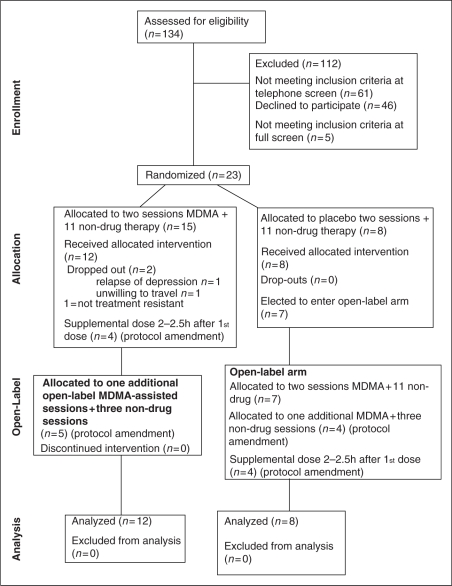
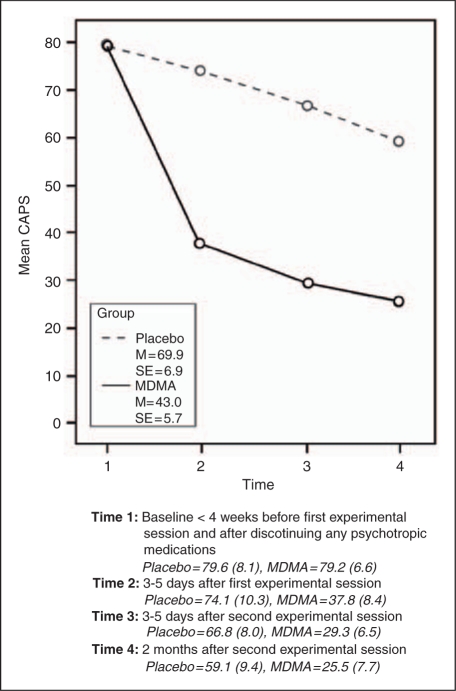
Case reports indicate that psychiatrists administered ±3,4-methylenedioxymethamphetamine (MDMA) as a catalyst to psychotherapy before recreational use of MDMA as 'Ecstasy' resulted in its criminalization in 1985. Over two decades later, this study is the first completed clinical trial evaluating MDMA as a therapeutic adjunct. Twenty patients with chronic posttraumatic stress disorder, refractory to both psychotherapy and psychopharmacology, were randomly assigned to psychotherapy with concomitant active drug (n = 12) or inactive placebo (n = 8) administered during two 8-h experimental psychotherapy sessions. Both groups received preparatory and follow-up non-drug psychotherapy. The primary outcome measure was the Clinician-Administered PTSD Scale, administered at baseline, 4 days after each experimental session, and 2 months after the second session. Neurocognitive testing, blood pressure, and temperature monitoring were performed. After 2-month follow-up, placebo subjects were offered the option to re-enroll in the experimental procedure with open-label MDMA. Decrease in Clinician-Administered PTSD Scale scores from baseline was significantly greater for the group that received MDMA than for the placebo group at all three time points after baseline. The rate of clinical response was 10/12 (83%) in the active treatment group versus 2/8 (25%) in the placebo group. There were no drug-related serious adverse events, adverse neurocognitive effects or clinically significant blood pressure increases. MDMA-assisted psychotherapy can be administered to posttraumatic stress disorder patients without evidence of harm, and it may be useful in patients refractory to other treatments.
病例报告表明,在 MDMA 被滥用为“摇头丸”并于 1985 年被定罪之前,精神科医生曾将其作为一种催化剂用于心理治疗。二十多年后,这项研究是第一个评估 MDMA 作为治疗辅助药物的临床试验。20 名患有慢性创伤后应激障碍的患者,对心理治疗和精神药理学都没有反应,他们被随机分配到接受心理治疗并同时使用活性药物(n=12)或安慰剂(n=8)的组中,药物在两次 8 小时的实验性心理治疗会议期间给予。两组均接受预备性和后续非药物心理治疗。主要结局指标是临床医生管理的创伤后应激障碍量表,在基线、每次实验会议后 4 天和第二次会议后 2 个月进行评估。进行了神经认知测试、血压和体温监测。在 2 个月的随访后,安慰剂组的患者可以选择重新参加开放标签 MDMA 的实验程序。与安慰剂组相比,接受 MDMA 治疗的组从基线开始,在所有三个时间点上,临床医生管理的创伤后应激障碍量表评分的下降均显著更大。在活性治疗组中,临床反应率为 10/12(83%),而在安慰剂组中为 2/8(25%)。没有与药物相关的严重不良事件、不良神经认知影响或临床显著的血压升高。MDMA 辅助心理治疗可以在没有伤害证据的情况下用于创伤后应激障碍患者,并且对于其他治疗方法无效的患者可能有用。