Microbiology, Immunology and Pathology Department, Colorado State University, Fort Collins, Colorado, United States of America.
PLoS Negl Trop Dis. 2010 Jul 13;4(7):e739. doi: 10.1371/journal.pntd.0000739.
Venezuelan equine encephalitis virus (VEEV) is responsible for VEE epidemics that occur in South and Central America and the U.S. The VEEV envelope contains two glycoproteins E1 (mediates cell membrane fusion) and E2 (binds receptor and elicits virus neutralizing antibodies). Previously we constructed E1 and E2 epitope maps using murine monoclonal antibodies (mMAbs). Six E2 epitopes (E2(c,d,e,f,g,h)) bound VEEV-neutralizing antibody and mapped to amino acids (aa) 182-207. Nothing is known about the human antibody repertoire to VEEV or epitopes that engage human virus-neutralizing antibodies. There is no specific treatment for VEE; however virus-neutralizing mMAbs are potent protective and therapeutic agents for mice challenged with VEEV by either peripheral or aerosol routes. Therefore, fully human MAbs (hMAbs) with virus-neutralizing activity should be useful for prevention or clinical treatment of human VEE.
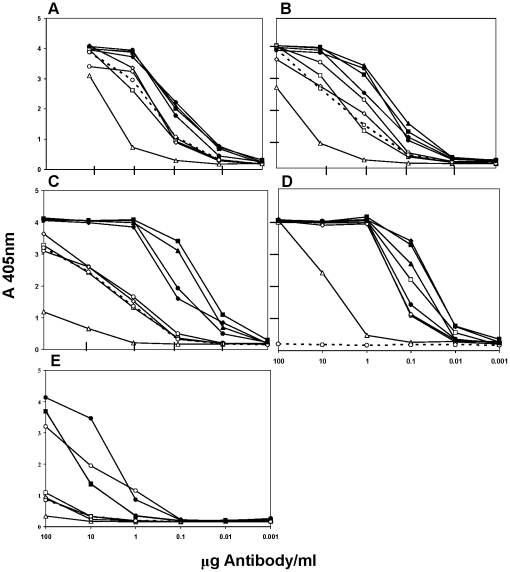
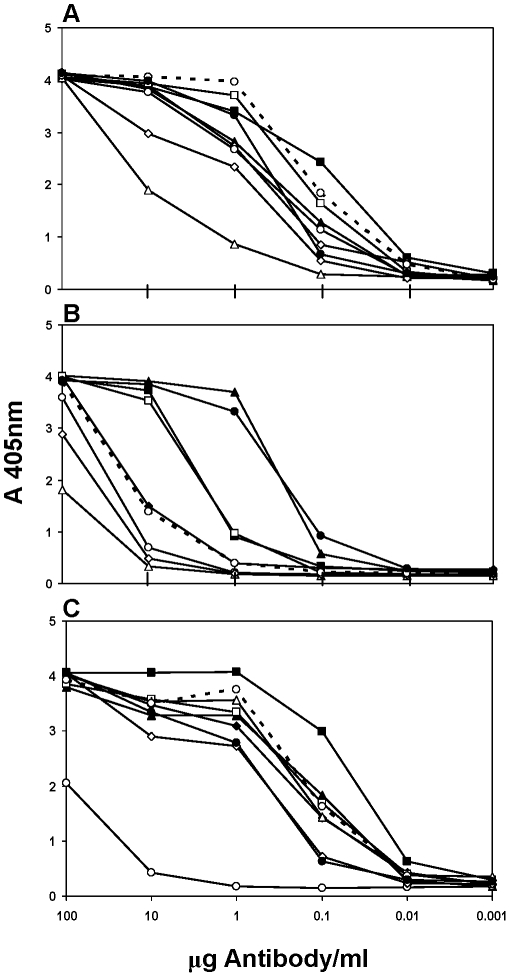
We used phage-display to isolate VEEV-specific hFabs from human bone marrow donors. These hFabs were characterized by sequencing, specificity testing, VEEV subtype cross-reactivity using indirect ELISA, and in vitro virus neutralization capacity. One E2-specific neutralizing hFAb, F5n, was converted into IgG, and its binding site was identified using competitive ELISA with mMAbs and by preparing and sequencing antibody neutralization-escape variants.
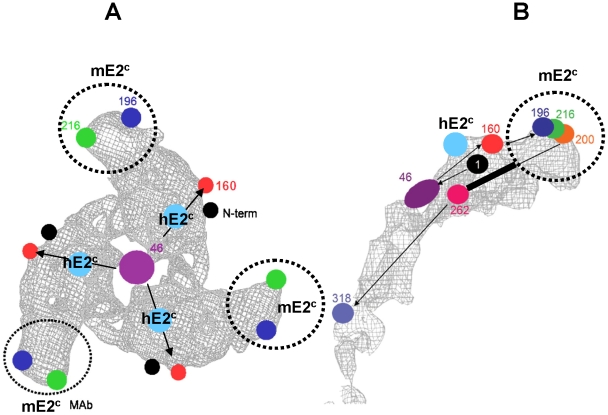
Using 11 VEEV-reactive hFabs we constructed the first human epitope map for the alphaviral surface proteins E1 and E2. We identified an important neutralization-associated epitope unique to the human immune response, E2 aa115-119. Using a 9 A resolution cryo-electron microscopy map of the Sindbis virus E2 protein, we showed the probable surface location of this human VEEV epitope.
The VEEV-neutralizing capacity of the hMAb F5 nIgG is similar to that exhibited by the humanized mMAb Hy4 IgG. The Hy4 IgG has been shown to limit VEEV infection in mice both prophylactically and therapeutically. Administration of a cocktail of F5n and Hy4 IgGs, which bind to different E2 epitopes, could provide enhanced prophylaxis or immunotherapy for VEEV, while reducing the possibility of generating possibly harmful virus neutralization-escape variants in vivo.
委内瑞拉马脑炎病毒(VEEV)是导致南、中美洲和美国发生 VEE 流行的罪魁祸首。VEEV 包膜包含两种糖蛋白 E1(介导细胞膜融合)和 E2(结合受体并引发病毒中和抗体)。先前,我们使用鼠单克隆抗体(mMAb)构建了 E1 和 E2 表位图谱。六个 E2 表位(E2(c、d、e、f、g、h))结合 VEEV 中和抗体,并映射到氨基酸(aa)182-207。目前尚不清楚人类对 VEEV 的抗体库或与人类病毒中和抗体结合的表位。目前尚无针对 VEE 的特效治疗方法;然而,病毒中和 mMAb 是通过外周或气溶胶途径用 VEEV 攻击的小鼠的有效保护和治疗药物。因此,具有病毒中和活性的完全人单克隆抗体(hMAb)应该可用于预防或临床治疗人类 VEE。
我们使用噬菌体展示技术从人类骨髓供体中分离 VEEV 特异性 hFab。通过测序、特异性测试、间接 ELISA 检测 VEEV 亚型交叉反应性以及体外病毒中和能力对这些 hFab 进行了表征。一种针对 E2 的中和性 hFab,F5n,被转化为 IgG,并用 mMAb 进行竞争 ELISA 以及制备和测序抗体中和逃逸变体来确定其结合位点。
使用 11 种 VEEV 反应性 hFab,我们构建了用于甲型病毒表面蛋白 E1 和 E2 的第一个人类表位图谱。我们鉴定了一个重要的中和相关表位,该表位是人类免疫反应所特有的,E2 aa115-119。使用辛德毕斯病毒 E2 蛋白的 9A 分辨率冷冻电镜图谱,我们展示了该人类 VEEV 表位的可能表面位置。
hMAb F5nIgG 的 VEEV 中和能力与人类化 mMAb Hy4 IgG 相当。Hy4 IgG 已被证明可在预防性和治疗性方面限制 VEEV 在小鼠中的感染。施用 F5n 和 Hy4 IgGs 的混合物,它们结合到不同的 E2 表位,可提供针对 VEEV 的增强预防或免疫治疗,同时降低体内产生可能有害的病毒中和逃逸变体的可能性。