Fürtbauer Ines, Schülke Oliver, Heistermann Michael, Ostner Julia
Int J Primatol. 2010 Aug;31(4):501-517. doi: 10.1007/s10764-010-9409-3. Epub 2010 May 14.
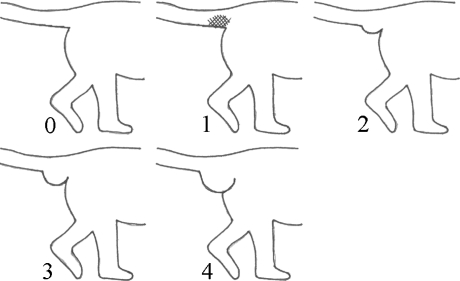
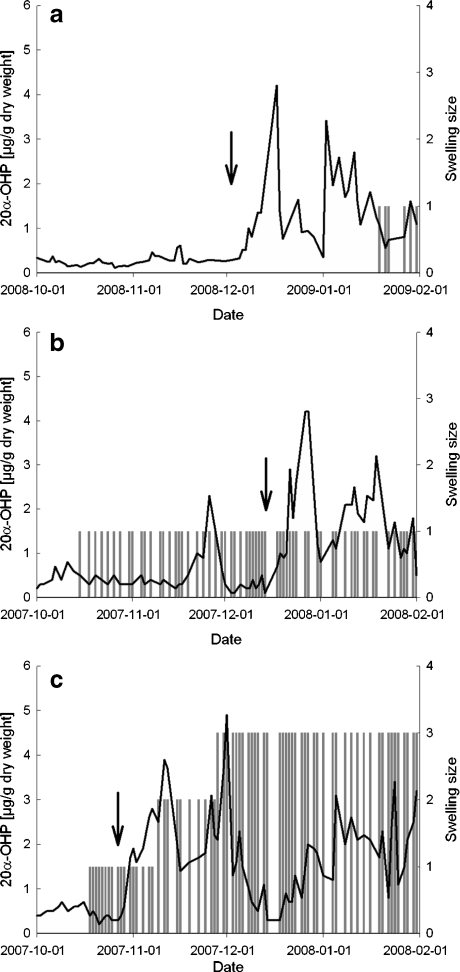
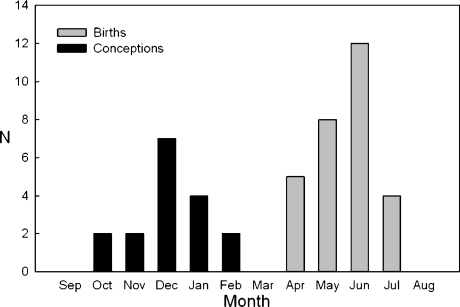
Information on basic reproductive parameters and life-history traits is crucial for the understanding of primate evolution, ecology, social behavior, and reproductive strategies. Here, we report 4 yr of data on reproductive and life-history traits for wild female Assamese macaques (Macaca assamensis) at Phu Khieo Wildlife Sanctuary, northeastern Thailand. During 2 consecutive reproductive seasons, we investigated reproductive behavior and sexual swelling size in 16 females and collected 1832 fecal samples. Using enzyme immunoassays, we measured fecal estrogen and progesterone metabolites to assess ovarian activity and timing of ovulation and to ascertain conceptions and pregnancies. Timing of reproduction was strictly seasonal (births: April-July, 86% in April-June, 4 yr, n = 29; conceptions: October-February, 65% in December-January, 2 yr, n = 17). Females showed no cyclic ovarian activity outside the mating season and conceived in their first or second cycle (mean: 1.2 cycles to conception, n = 13). Gestation length was on average 164.2 d (range: 158-170, n = 10), and females had their first infant at an age of 5 yr (n = 4). Interbirth intervals were bimodally distributed, with females giving birth on average every 13.9 or 23.2 mo. Shorter interbirth intervals were linked to early parturition within the birth season. Most females displayed subcaudal sexual swellings which, however, did not reliably indicate female reproductive status or fertility. Overall, our results fall within the range of findings reported for other macaque species. These results thus add to the growing body of information available for wild macaques, facilitating comparative studies for a better understanding of interspecific differences in social and reproductive patterns.
基本生殖参数和生活史特征的信息对于理解灵长类动物的进化、生态、社会行为和生殖策略至关重要。在此,我们报告了泰国东北部普希约野生动物保护区野生雌性阿萨姆猕猴(Macaca assamensis)4年的生殖和生活史特征数据。在连续两个生殖季节中,我们调查了16只雌性猕猴的生殖行为和性肿胀大小,并收集了1832份粪便样本。我们使用酶免疫分析法测量粪便中的雌激素和孕酮代谢物,以评估卵巢活动、排卵时间,并确定受孕和妊娠情况。繁殖时间严格遵循季节性(出生时间:4月至7月,4年中86%在4月至6月,n = 29;受孕时间:10月至2月,2年中65%在12月至1月,n = 17)。雌性在交配季节之外没有周期性的卵巢活动,且在第一个或第二个周期受孕(平均:受孕需1.2个周期,n = 13)。妊娠期平均为164.2天(范围:158 - 170天,n = 10),雌性在5岁时产下第一胎(n = 4)。产仔间隔呈双峰分布,雌性平均每13.9个月或23.2个月产仔一次。较短的产仔间隔与出生季节内的早产有关。大多数雌性表现出尾下性肿胀,然而,这并不能可靠地表明雌性的生殖状态或生育能力。总体而言,我们的结果在其他猕猴物种报告的研究结果范围内。因此,这些结果增加了现有的关于野生猕猴的信息,有助于进行比较研究,以更好地理解社会和生殖模式的种间差异。