Department of Medical Oncology, Erasmus University Medical Center, Room HE-118, 's Gravendijkwal 230, 3015 CE Rotterdam, The Netherlands.
Cancer Chemother Pharmacol. 2011 May;67(5):1055-62. doi: 10.1007/s00280-010-1400-3. Epub 2010 Jul 23.
Response to anticancer therapy is believed to be directly related to the concentration of the anticancer drug in the tumor itself. Assessment of intra-tumor drug pharmacokinetics can be helpful to gain more insight into mechanisms involved in the (in)sensitivity of tumors to anticancer therapy. We explored the pharmacokinetics of 5-fluorouracil in both plasma and tumor tissue during a 5-day continuous infusion of 5-fluorouracil in patients with cancer. Sampling for measurement of 5-fluorouracil in tumor tissue was performed using microdialysis.
In seven patients with an accessible (sub)cutaneous tumor treated with a continuous 5-fluorouracil infusion, plasma and microdialysate samples from tumor and normal adipose tissue were collected over a period of 5 days.
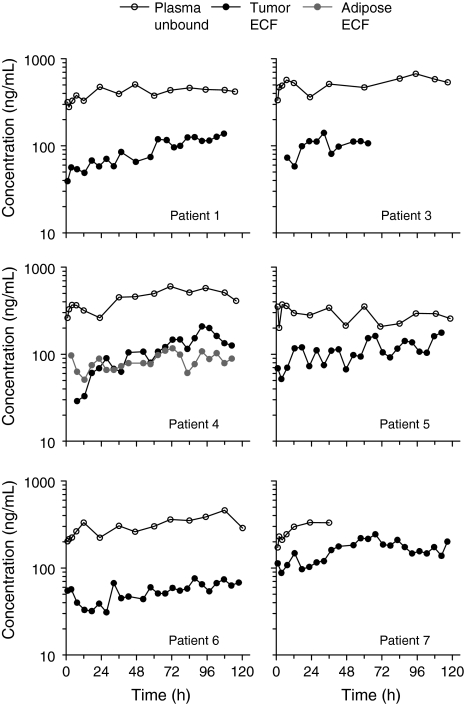
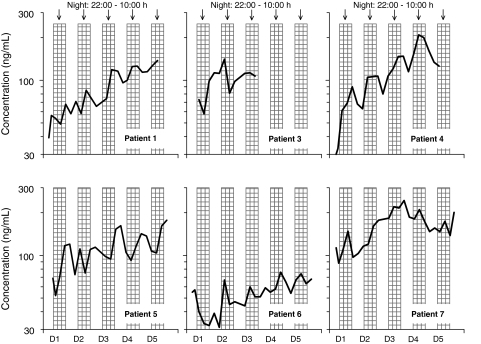
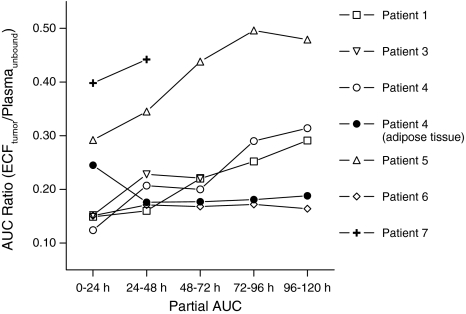
For six patients, drug concentrations in both tumor tissue and plasma were available. Concentration-time curves of unbound 5-fluorouracil were lower in tumor tissue compared to the curves in plasma, but exposure ratios of tumor tissue versus plasma increased during the 5-day infusion period. The presence of circadian rhythmicity of 5-fluorouracil pharmacokinetics in the tumor itself was demonstrated as 5-fluorouracil concentrations in tumor extracellular fluid were higher during the night than during daytime.
Microdialysis was successfully employed in patients with cancer during a continuous 5-day 5-fluorouracil infusion. Plasma and tumor pharmacokinetics of 5-fluorouracil differed substantially with increasing 5-fluorouracil concentrations in tumor over time, possibly resulting from a lowered interstitial fluid pressure by 5-fluorouracil itself. This microdialysis 5-fluorouracil model might be useful to monitor the effect of drug delivery modulating strategies in future studies.
人们认为抗癌治疗的反应与肿瘤内抗癌药物的浓度直接相关。评估肿瘤内药物药代动力学有助于更深入地了解肿瘤对抗癌治疗的(不)敏感性相关的机制。我们在癌症患者中连续 5 天输注氟尿嘧啶时,探索了氟尿嘧啶在血浆和肿瘤组织中的药代动力学。使用微透析法对肿瘤组织中的氟尿嘧啶进行采样以进行测量。
在 7 名可触及(皮下)肿瘤的患者中,连续输注氟尿嘧啶,在 5 天的时间内,从肿瘤和正常脂肪组织中采集血浆和微透析样本。
对于 6 名患者,肿瘤组织和血浆中均有药物浓度可用。与血浆相比,未结合的氟尿嘧啶在肿瘤组织中的浓度-时间曲线较低,但在 5 天输注期间,肿瘤组织与血浆的暴露比增加。证明了肿瘤本身氟尿嘧啶药代动力学存在昼夜节律性,因为肿瘤细胞外液中的氟尿嘧啶浓度在夜间高于白天。
在连续 5 天氟尿嘧啶输注期间,成功地在癌症患者中使用了微透析法。氟尿嘧啶的血浆和肿瘤药代动力学存在显著差异,随着时间的推移肿瘤内氟尿嘧啶浓度增加,这可能是由于氟尿嘧啶本身降低了间质液压力。这种微透析氟尿嘧啶模型可能有助于在未来的研究中监测药物输送调节策略的效果。