Department of Epidemiology, Harvard School of Public Health, Boston, MA 02115, USA.
Pediatrics. 2010 Aug;126(2):e442-50. doi: 10.1542/peds.2009-2814. Epub 2010 Jul 26.
To compare the incidence of wasting, stunting, and mortality among children aged 6 to 36 months who are receiving preventive supplementation with either ready-to-use supplementary foods (RUSFs) or ready-to-use therapeutic foods (RUTFs).
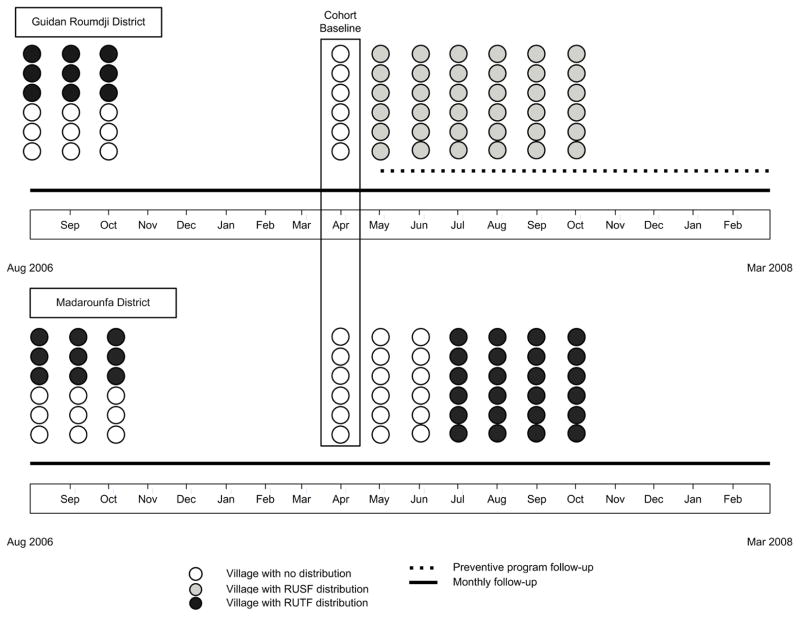
Children aged 6 to 36 months in 12 villages of Maradi, Niger, (n = 1645) received a monthly distribution of RUSFs (247 kcal [3 spoons] per day) for 6 months or RUTFs (500-kcal sachet per day) for 4 months. We compared the incidence of wasting, stunting, and mortality among children who received preventive supplementation with RUSFs versus RUTFs.
The effectiveness of RUSF supplementation depended on receipt of a previous preventive intervention. In villages in which a preventive supplementation program was previously implemented, the RUSF strategy was associated with a 46% (95% confidence interval [CI]: 6%-69%) and 59% (95% CI: 17%-80%) reduction in wasting and severe wasting, respectively. In contrast, in villages in which the previous intervention was not implemented, we found no difference in the incidence of wasting or severe wasting according to type of supplementation. Compared with the RUTF strategy, the RUSF strategy was associated with a 19% (95% CI: 0%-34%) reduction in stunting overall.
We found that the relative performance of a 6-month RUSF supplementation strategy versus a 4-month RUTF strategy varied with receipt of a previous nutritional intervention. Contextual factors will continue to be important in determining the dose and duration of supplementation that will be most effective, acceptable, and sustainable for a given setting.
比较接受即食补充食品(RUSF)或即食治疗食品(RUTF)预防补充的 6 至 36 个月儿童中消瘦、发育迟缓及死亡率的发生率。
在尼日尔马里迪的 12 个村庄中,6 至 36 个月大的儿童(n=1645)每月接受 RUSF(每天 247 千卡[3 勺])分配 6 个月或 RUTF(每天 500 千卡小袋)4 个月。我们比较了接受 RUSF 与 RUTF 预防补充的儿童中消瘦、发育迟缓及死亡率的发生率。
RUSF 补充的效果取决于是否接受过先前的预防干预。在之前实施预防补充方案的村庄中,RUSF 策略与消瘦和严重消瘦的发生率分别降低 46%(95%置信区间[CI]:6%-69%)和 59%(95% CI:17%-80%)相关。相比之下,在未实施先前干预的村庄中,根据补充类型,我们发现消瘦或严重消瘦的发生率没有差异。与 RUTF 策略相比,RUSF 策略与总发育迟缓发生率降低 19%(95% CI:0%-34%)相关。
我们发现,6 个月 RUSF 补充策略与 4 个月 RUTF 策略的相对表现因先前营养干预的接受情况而异。在确定对于给定环境最有效、可接受和可持续的补充剂量和持续时间时,背景因素将继续发挥重要作用。