Junk Anna K, Goel Manik, Mundorf Tom, Rockwood Edward J, Bhattacharya Sanjoy K
Bascom Palmer Eye Institute, University of Miami Miller School of Medicine, Miami, FL, USA.
Mol Vis. 2010 Jul 10;16:1286-91.
To determine whether activity of carbohydrate metabolism enzymes (aldolase, pyruvate kinase, isocitrate dehydrogenase, and malate dehydrogenase) are altered in the glaucomatous trabecular meshwork (TM) compared to controls.
Tissue specimens were obtained from trabeculectomy (n=45 open angle glaucoma; Caucasian, average age 61+/-8 years of age of both genders) and from cadaver eyes (n=15 control and n=5 glaucoma; Caucasian, average age 63+/-4 years of both genders). Protein extracts from TM tissue were prepared in a non-denaturing buffer containing 0.1% genapol. Aldolase activity was measured spectrophotometrically at 240 nm absorbance using reaction of 3-phosphoglycerate with hydrazine to form hydrazone. Pyruvate kinase activity was measured by coupling lactate dehydrogenase with NADPH and pyruvate absorbance was measured at 340 nm. Isocitrate dehydrogenase activity was measured using reduction of NADP to NADPH at the characteristic absorbance at 340 nm. Malate dehydrogenase catalyzes the interconversion of L-malate and oxaloacetate using NADP as a coenzyme, quantified by its absorbance at 340 nm.
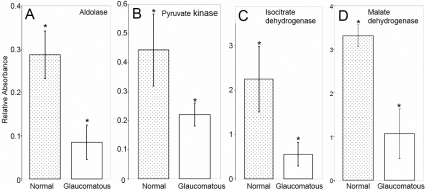
Aldolase, pyruvate kinase, isocitrate dehydrogenase, and malate dehyrogenase activities in the glaucomatous TM tissue were found to be reduced 70, 50, 25, and 69 percent, respectively. SDS-PAGE analysis suggests the presence of 4-hydorxynonenal (HNE) modified isocitrate dehydrogenase protein in the glaucomatous TM tissue compared to controls.
Several Krebs cycle enzyme activities are considerably reduced in glaucomatous TM. HNE modified isocitrate dehydrogenase activity is consistent with reduced inactivated form of the protein. Lipid peroxidation product modification of aldolase, pyruvate kinase, and isocitrate dehydrogenase serves as a likely reason for the reduction of enzyme activity.
确定与对照组相比,青光眼小梁网(TM)中碳水化合物代谢酶(醛缩酶、丙酮酸激酶、异柠檬酸脱氢酶和苹果酸脱氢酶)的活性是否发生改变。
组织标本取自小梁切除术(n = 45例开角型青光眼;白种人,平均年龄61±8岁,男女皆有)以及尸体眼(n = 15例对照和n = 5例青光眼;白种人,平均年龄63±4岁,男女皆有)。TM组织的蛋白质提取物在含有0.1%杰纳波尔的非变性缓冲液中制备。醛缩酶活性通过3 - 磷酸甘油酸与肼反应形成腙,在240 nm吸光度下用分光光度法测量。丙酮酸激酶活性通过将乳酸脱氢酶与NADPH偶联来测量,丙酮酸吸光度在340 nm处测量。异柠檬酸脱氢酶活性通过在340 nm特征吸光度下将NADP还原为NADPH来测量。苹果酸脱氢酶以NADP为辅酶催化L - 苹果酸和草酰乙酸的相互转化,通过其在340 nm处的吸光度进行定量。
发现青光眼TM组织中醛缩酶、丙酮酸激酶、异柠檬酸脱氢酶和苹果酸脱氢酶的活性分别降低了70%、50%、25%和69%。SDS - PAGE分析表明,与对照组相比,青光眼TM组织中存在4 - 羟基壬烯醛(HNE)修饰的异柠檬酸脱氢酶蛋白。
青光眼TM中几种三羧酸循环酶的活性显著降低。HNE修饰的异柠檬酸脱氢酶活性与蛋白质失活形式的减少一致。醛缩酶、丙酮酸激酶和异柠檬酸脱氢酶的脂质过氧化产物修饰可能是酶活性降低的原因。