Neag Comprehensive Cancer Center and Center for Molecular Medicine, University of Connecticut Health Center, Farmington, Connecticut 06030-3101, USA.
Hum Mutat. 2010 Oct;31(10):E1699-708. doi: 10.1002/humu.21333.
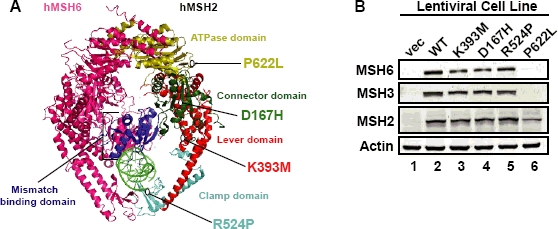
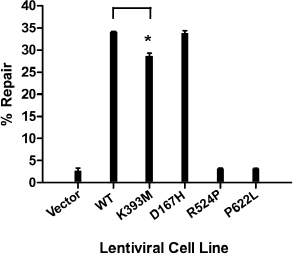
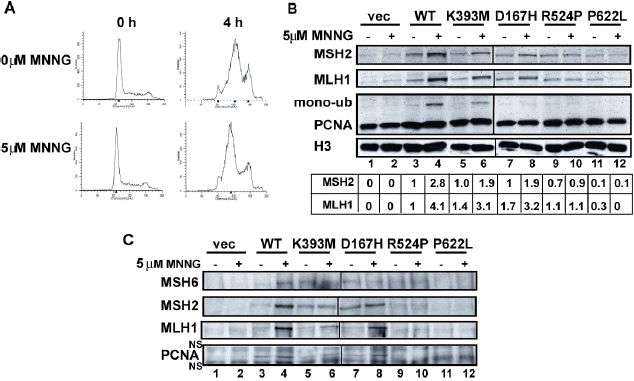
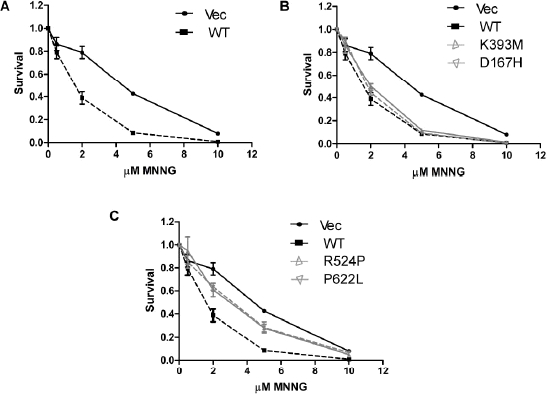
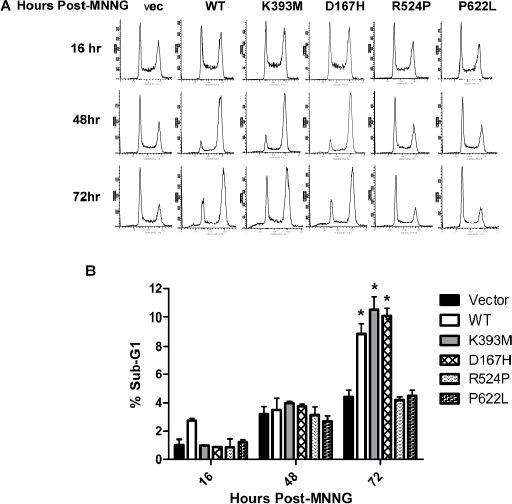
The DNA mismatch repair (MMR) pathway is essential in maintaining genomic stability through its role in DNA repair and the checkpoint response. Loss of DNA MMR underlies the hereditary cancer disease Lynch Syndrome (LS). Germline mutations in MSH2 account for approximately 40% of LS patients and of these, 18% are missense variants. One important clinical challenge has been discriminating between missense variants that are pathogenic and those that are not. Current analysis of missense mutations in MSH2 is performed using a combination of clinical, biochemical, and functional data; however, suitable cell culture models to test the various functions of the DNA MMR proteins are lacking. Here, we have generated human cell lines stably expressing a subset of MSH2 missense mutants and tested their effect on DNA repair and checkpoint response functions. We have expanded on previous biochemical and functional analyses performed in non-human systems to further understand defects conferred by this subset of single amino acid alterations. The functional characterization of MSH2 missense mutants combined with clinical and biochemical data is essential for appropriate patient management and genetic counseling decisions.
DNA 错配修复 (MMR) 途径在 DNA 修复和检查点反应中发挥作用,对于维持基因组稳定性至关重要。Lynch 综合征 (LS) 的遗传性癌症疾病的基础是 DNA MMR 的缺失。MSH2 的种系突变约占 LS 患者的 40%,其中 18%为错义变异。一个重要的临床挑战是区分致病性和非致病性错义变异。目前对 MSH2 中的错义突变的分析使用了临床、生化和功能数据的组合;然而,缺乏用于测试 DNA MMR 蛋白各种功能的合适细胞培养模型。在这里,我们生成了稳定表达 MSH2 错义突变体亚集的人类细胞系,并测试了它们对 DNA 修复和检查点反应功能的影响。我们扩展了以前在非人类系统中进行的生化和功能分析,以进一步了解这组单一氨基酸改变所带来的缺陷。对 MSH2 错义突变体的功能特征与临床和生化数据相结合,对于适当的患者管理和遗传咨询决策至关重要。