Bacterial Diseases Branch, Division of Vector-Borne Diseases, Centers for Disease Control and Prevention, Fort Collins, CO, USA.
BMC Infect Dis. 2010 Jul 30;10:229. doi: 10.1186/1471-2334-10-229.
Bartonella tamiae, a newly described bacterial species, was isolated from the blood of three hospitalized patients in Thailand. These patients presented with headache, myalgia, anemia, and mild liver function abnormalities. Since B. tamiae was presumed to be the cause of their illness, these isolates were inoculated into immunocompetent mice to determine their relative pathogenicity in inducing manifestations of disease and pathology similar to that observed in humans.
Three groups of four Swiss Webster female mice aged 15-18 months were each inoculated with 10(6-7) colony forming units of one of three B. tamiae isolates [Th239, Th307, and Th339]. A mouse from each experimental group was sampled at 3, 4, 5 and 6 weeks post-inoculation. Two saline inoculated age-matched controls were included in the study. Samples collected at necropsy were evaluated for the presence of B. tamiae DNA, and tissues were formalin-fixed, stained with hematoxylin and eosin, and examined for histopathology.
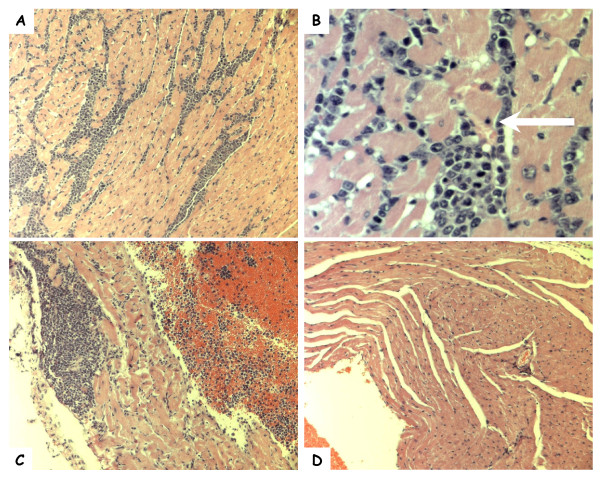
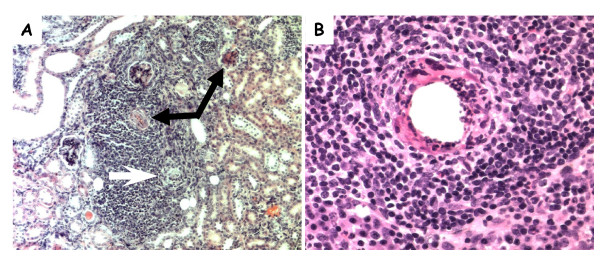
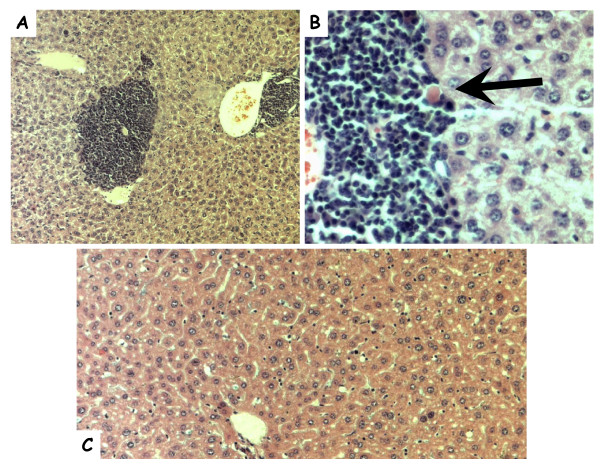
Following inoculation with B. tamiae, mice developed ulcerative skin lesions and subcutaneous masses on the lateral thorax, as well as axillary and inguinal lymphadenopathy. B. tamiae DNA was found in subcutaneous masses, lymph node, and liver of inoculated mice. Histopathological changes were observed in tissues of inoculated mice, and severity of lesions correlated with the isolate inoculated, with the most severe pathology induced by B. tamiae Th239. Mice inoculated with Th239 and Th339 demonstrated myocarditis, lymphadenitis with associated vascular necrosis, and granulomatous hepatitis and nephritis with associated hepatocellular and renal necrosis. Mice inoculated with Th307 developed a deep dermatitis and granulomas within the kidneys.
The three isolates of B. tamiae evaluated in this study induce disease in immunocompetent Swiss Webster mice up to 6 weeks after inoculation. The human patients from whom these isolates were obtained had clinical presentations consistent with the multi-organ pathology observed in mice in this study. This mouse model for B. tamiae induced disease not only strengthens the causal link between this pathogen and clinical illness in humans, but provides a model to further study the pathological processes induced by these bacteria.
Bartonella tamiae 是一种新描述的细菌物种,从泰国的 3 名住院患者的血液中分离出来。这些患者表现为头痛、肌痛、贫血和轻度肝功能异常。由于推测 B. tamiae 是导致他们患病的原因,因此将这些分离株接种到免疫功能正常的小鼠中,以确定它们在诱导类似于人类观察到的疾病表现和病理学方面的相对致病性。
将三组每组四只 15-18 月龄的瑞士 Webster 雌性小鼠分别接种三种 B. tamiae 分离株[Th239、Th307 和 Th339]的 10(6-7)个集落形成单位。每组实验的一只小鼠在接种后 3、4、5 和 6 周进行采样。研究中还包括两个用生理盐水接种的年龄匹配的对照。尸检时采集的样本用于评估 B. tamiae DNA 的存在,组织用福尔马林固定、用苏木精和曙红染色,并检查组织病理学变化。
接种 B. tamiae 后,小鼠出现溃疡性皮肤病变和侧胸、腋窝和腹股沟淋巴结肿大。在接种小鼠的皮下肿块、淋巴结和肝脏中发现了 B. tamiae DNA。接种小鼠的组织中观察到组织病理学变化,病变的严重程度与接种的分离株相关,最严重的病理学是由 B. tamiae Th239 引起的。接种 Th239 和 Th339 的小鼠出现心肌炎、伴血管坏死的淋巴结炎、肉芽肿性肝炎和肾炎伴肝实质和肾实质坏死。接种 Th307 的小鼠出现深部性皮炎和肾脏内的肉芽肿。
在这项研究中评估的三种 B. tamiae 分离株在接种后长达 6 周内可诱导免疫功能正常的瑞士 Webster 小鼠发病。从这些分离株中获得的人类患者具有与本研究中观察到的小鼠多器官病理学一致的临床表现。这种 B. tamiae 诱导疾病的小鼠模型不仅加强了这种病原体与人类临床疾病之间的因果关系,而且为进一步研究这些细菌引起的病理过程提供了模型。