GSF Helmholtz Zentrum München-German Research Center for Environment Health, 85764 Neuherberg, Germany.
Mol Genet Genomics. 2010 Oct;284(4):231-42. doi: 10.1007/s00438-010-0561-4. Epub 2010 Jul 31.
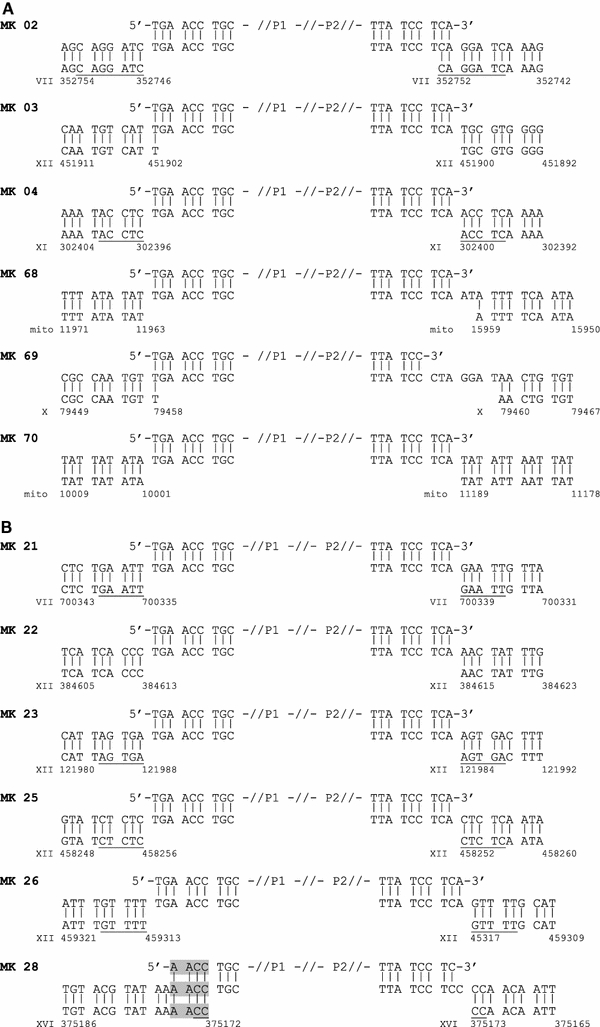
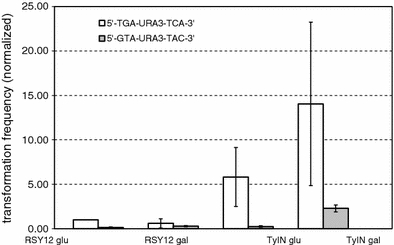
The integrase of the Saccharomyces cerevisiae retrotransposon Ty1 integrates Ty1 cDNA into genomic DNA likely via a transesterification reaction. Little is known about the mechanisms ensuring that integrase does not integrate non-Ty DNA fragments. In an effort to elucidate the conditions under which Ty1 integrase accepts non-Ty DNA as substrate, PCR fragments encompassing a selectable marker gene were transformed into yeast strains overexpressing Ty1 integrase. These fragments do not exhibit similarity to Ty1 cDNA except for the presence of the conserved terminal dinucleotide 5'-TG-CA-3'. The frequency of fragment insertion events increased upon integrase overexpression. Characterization of insertion events by genomic sequencing revealed that most insertion events exhibited clear hallmarks of integrase-mediated reactions, such as 5 bp target site duplication and target site preferences. Alteration of the terminal dinucleotide abolished the suitability of the PCR fragments to serve as substrates. We hypothesize that substrate specificity under normal conditions is mainly due to compartmentalization of integrase and Ty cDNA, which meet in virus-like particles. In contrast, recombinant integrase, which is not confined to virus-like particles, is able to accept non-Ty DNA, provided that it terminates in the proper dinucleotide sequence.
酿酒酵母 retrotransposon Ty1 的整合酶通过转酯化反应将 Ty1 cDNA 整合到基因组 DNA 中。关于确保整合酶不会整合非 Ty DNA 片段的机制知之甚少。为了阐明 Ty1 整合酶接受非 Ty DNA 作为底物的条件,我们将包含可选择标记基因的 PCR 片段转化到过表达 Ty1 整合酶的酵母菌株中。这些片段除了存在保守的末端二核苷酸 5'-TG-CA-3' 外,与 Ty1 cDNA 没有相似性。整合酶过表达后,片段插入事件的频率增加。通过基因组测序对插入事件进行的特征分析表明,大多数插入事件表现出明显的整合酶介导反应特征,例如 5 bp 靶位点重复和靶位点偏好。末端二核苷酸的改变使 PCR 片段不再适合作为底物。我们假设在正常条件下,底物特异性主要归因于整合酶和 Ty cDNA 的区室化,它们在病毒样颗粒中相遇。相比之下,不受病毒样颗粒限制的重组整合酶能够接受非 Ty DNA,前提是它以适当的二核苷酸序列结尾。