Centre for Biomolecular Sciences, University of Nottingham, University Park, Nottingham NG7 2RD, UK.
BMC Microbiol. 2010 Aug 6;10:210. doi: 10.1186/1471-2180-10-210.
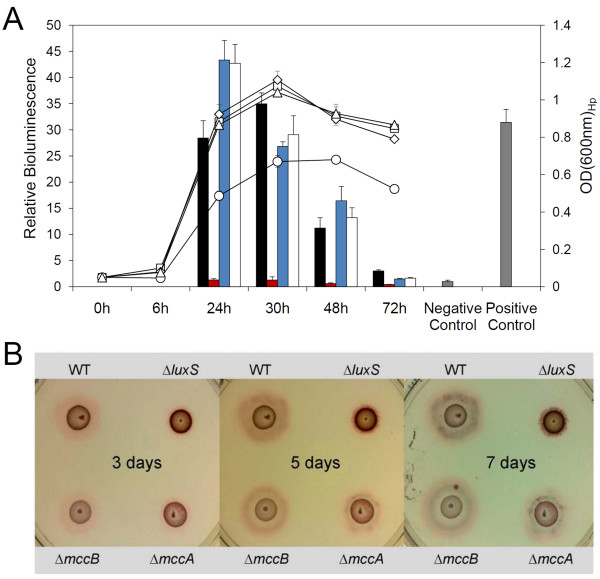
LuxS may function as a metabolic enzyme or as the synthase of a quorum sensing signalling molecule, auto-inducer-2 (AI-2); hence, the mechanism underlying phenotypic changes upon luxS inactivation is not always clear. In Helicobacter pylori, we have recently shown that, rather than functioning in recycling methionine as in most bacteria, LuxS (along with newly-characterised MccA and MccB), synthesises cysteine via reverse transsulphuration. In this study, we investigated whether and how LuxS controls motility of H. pylori, specifically if it has its effects via luxS-required cysteine metabolism or via AI-2 synthesis only.
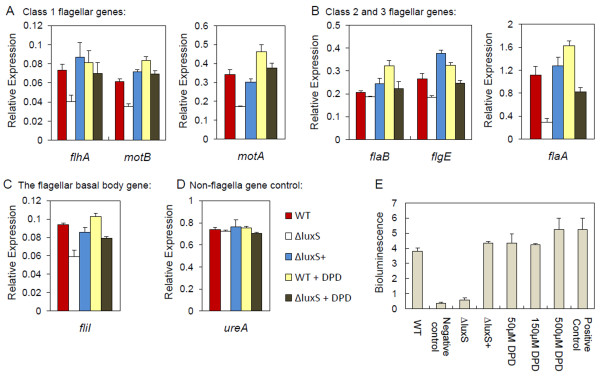
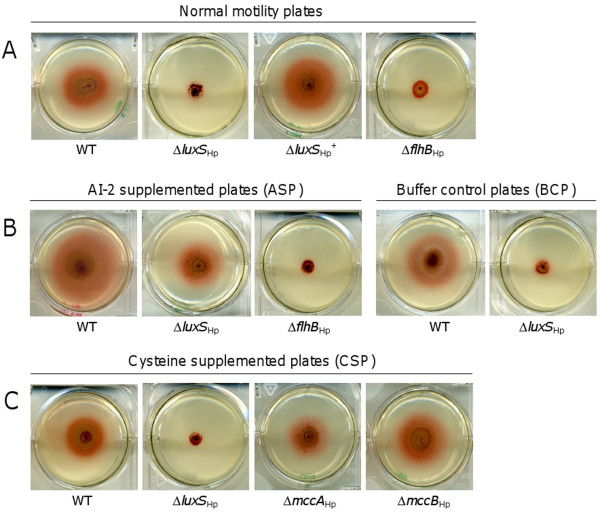
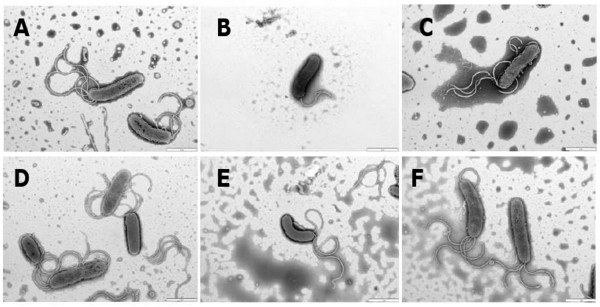
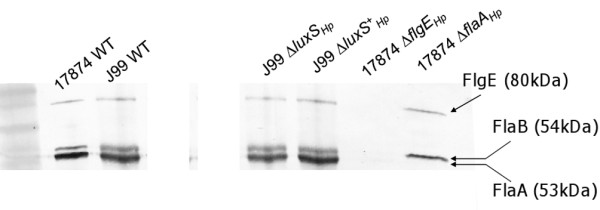
We report that disruption of luxS renders H. pylori non-motile in soft agar and by microscopy, whereas disruption of mccAHp or mccBHp (other genes in the cysteine provision pathway) does not, implying that the lost phenotype is not due to disrupted cysteine provision. The motility defect of the DeltaluxSHp mutant was complemented genetically by luxSHp and also by addition of in vitro synthesised AI-2 or 4, 5-dihydroxy-2, 3-pentanedione (DPD, the precursor of AI-2). In contrast, exogenously added cysteine could not restore motility to the DeltaluxSHp mutant, confirming that AI-2 synthesis, but not the metabolic effect of LuxS was important. Microscopy showed reduced number and length of flagella in the DeltaluxSHp mutant. Immunoblotting identified decreased levels of FlaA and FlgE but not FlaB in the DeltaluxSHp mutant, and RT-PCR showed that the expression of flaA, flgE, motA, motB, flhA and fliI but not flaB was reduced. Addition of DPD but not cysteine to the DeltaluxSHp mutant restored flagellar gene transcription, and the number and length of flagella.
Our data show that as well as being a metabolic enzyme, H. pylori LuxS has an alternative role in regulation of motility by modulating flagellar transcripts and flagellar biosynthesis through production of the signalling molecule AI-2.
LuxS 可能作为代谢酶或群体感应信号分子自动诱导物-2(AI-2)的合成酶发挥作用;因此,LuxS 失活后表型变化的机制并不总是清楚。在幽门螺杆菌中,我们最近表明,与大多数细菌中回收蛋氨酸的作用不同,LuxS(与新表征的 McCa 和 McCb 一起)通过反硫化作用合成半胱氨酸。在这项研究中,我们研究了 LuxS 是否以及如何控制幽门螺杆菌的运动,特别是它是否通过 luxS 所需的半胱氨酸代谢或仅通过 AI-2 合成发挥作用。
我们报告说,LuxS 的破坏使幽门螺杆菌在软琼脂和显微镜下失去运动能力,而 mccAHp 或 mccBHp(半胱氨酸供应途径中的其他基因)的破坏则不会,这意味着失去的表型不是由于半胱氨酸供应中断引起的。DeltaluxSHp 突变体的运动缺陷可以通过 luxSHp 的遗传互补以及体外合成的 AI-2 或 4,5-二羟基-2,3-戊二酮(DPD,AI-2 的前体)来弥补。相比之下,外源性添加半胱氨酸不能恢复 DeltaluxSHp 突变体的运动能力,这证实了 AI-2 合成而不是 LuxS 的代谢作用很重要。显微镜观察显示,DeltaluxSHp 突变体中 flagella 的数量和长度减少。免疫印迹分析表明,DeltaluxSHp 突变体中 FlaA 和 FlgE 的水平降低,但 FlaB 没有,RT-PCR 显示 flaA、flgE、motA、motB、flhA 和 fliI 的表达减少,但 flaB 没有。向 DeltaluxSHp 突变体中添加 DPD 而不是半胱氨酸可以恢复鞭毛基因转录和 flagella 的数量和长度。
我们的数据表明,幽门螺杆菌 LuxS 不仅作为一种代谢酶,而且还通过产生信号分子 AI-2 来调节 flagellar 转录物和 flagellar 生物合成,从而在调节运动方面发挥替代作用。