Department of Environmental and Occupational Health Sciences, School of Public Health, University of Washington, Seattle, Washington 98105-6099, USA.
Comp Biochem Physiol C Toxicol Pharmacol. 2011 Jan;153(1):9-16. doi: 10.1016/j.cbpc.2010.07.008. Epub 2010 Aug 6.
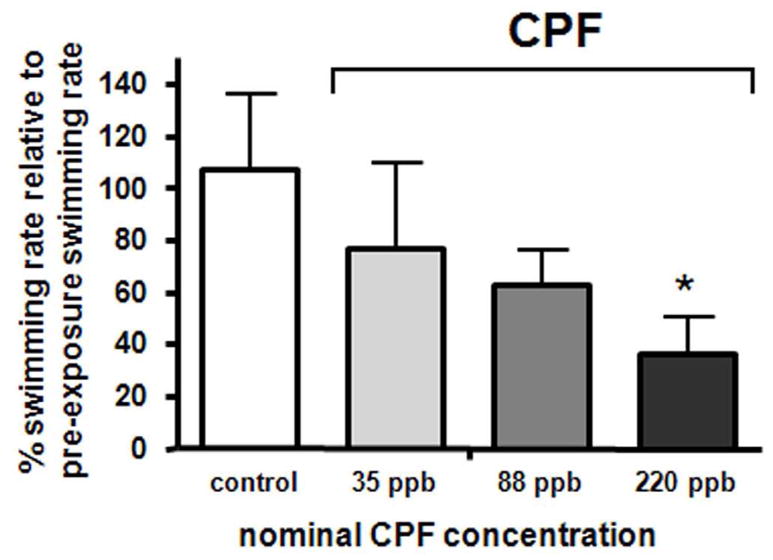
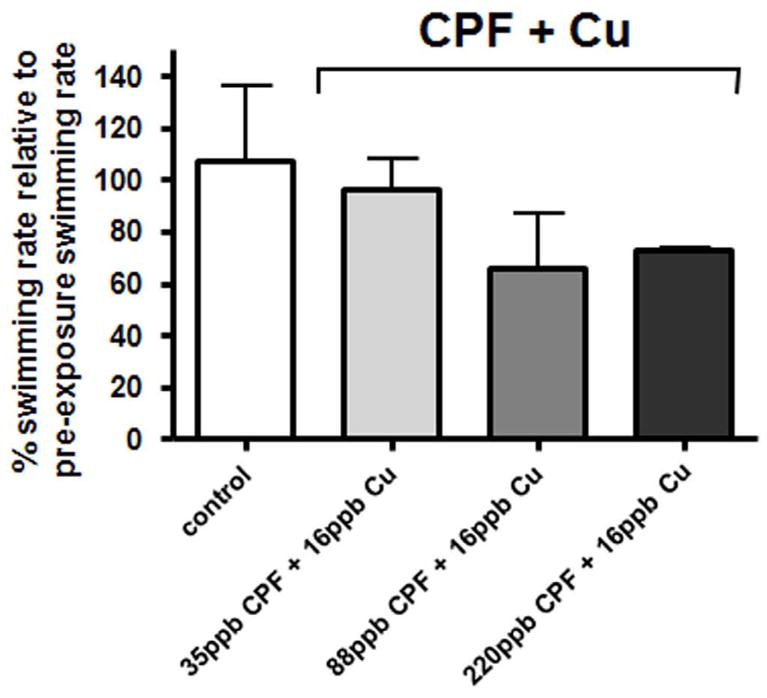
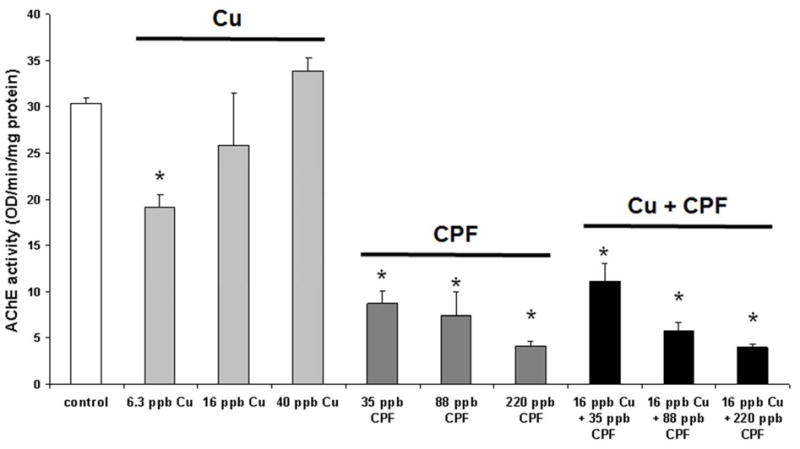
Pesticides such as chlorpyrifos (CPF) and metals such as copper can impair swimming behavior in fish. However, the impact to swimming behavior from exposure to mixtures of neurotoxicants has received little attention. In the current study, we analyzed spontaneous swimming rates of adult zebrafish (Danio rerio) to investigate in vivo mixture interactions involving two chemical classes. Zebrafish were exposed to the neurotoxicants copper chloride (CuCl, 0.1 μM, 0.25 μM, 0.6 μM, or 6.3, 16, 40 ppb), chlorpyrifos (CPF, 0.1 μM, 0.25 μM, 0.6 μM, or 35, 88, 220 ppb) and binary mixtures for 24h to better understand the effects of Cu on CPF neurotoxicity. Exposure to CPF increased the number of animals undergoing freeze responses (an anti-predator behavior) and, at the highest CPF dose (0.6 μM), elicited a decrease in zebrafish swimming rates. Interestingly, the addition of Cu caused a reduction in the number of zebrafish in the CPF exposure groups undergoing freeze responses. There was no evidence of additive or synergistic toxicity between Cu and CPF. Although muscle AChE activity was significantly reduced by CPF, there was a relatively poor relationship among muscle AChE concentrations and swimming behavior, suggesting non-muscle AChE mechanisms in the loss of swimming behavior. In summary, we have observed a modulating effect of Cu on CPF swimming impairment that appears to involve both AChE and non-AChE mechanisms. Our study supports the utility of zebrafish in understanding chemical mixture interactions and neurobehavioral injury.
杀虫剂如毒死蜱(CPF)和金属如铜会损害鱼类的游泳行为。然而,暴露于神经毒物混合物对游泳行为的影响却很少受到关注。在目前的研究中,我们分析了成年斑马鱼(Danio rerio)的自发游泳速度,以研究涉及两类化学物质的体内混合物相互作用。斑马鱼暴露于神经毒物氯化铜(CuCl,0.1 μM、0.25 μM、0.6 μM 或 6.3、16、40 ppb)、毒死蜱(CPF,0.1 μM、0.25 μM、0.6 μM 或 35、88、220 ppb)和二元混合物中 24 小时,以更好地了解 Cu 对 CPF 神经毒性的影响。CPF 的暴露增加了经历冻结反应(一种抗捕食行为)的动物数量,并且在最高 CPF 剂量(0.6 μM)下,斑马鱼的游泳速度降低。有趣的是,Cu 的添加导致 CPF 暴露组中经历冻结反应的斑马鱼数量减少。Cu 和 CPF 之间没有表现出相加或协同毒性。尽管 CPF 显著降低了肌肉 AChE 活性,但肌肉 AChE 浓度与游泳行为之间的相关性较差,这表明在游泳行为丧失中存在非肌肉 AChE 机制。总之,我们观察到 Cu 对 CPF 游泳障碍的调节作用,这似乎涉及 AChE 和非 AChE 机制。我们的研究支持利用斑马鱼来理解化学混合物相互作用和神经行为损伤。