Laboratory of Psychiatry and Exp Alzheimers Research, Department of Psychiatry and Psychotherapy, Innsbruck Medical University, Austria.
Mol Cell Neurosci. 2010 Dec;45(4):408-17. doi: 10.1016/j.mcn.2010.08.001. Epub 2010 Aug 6.
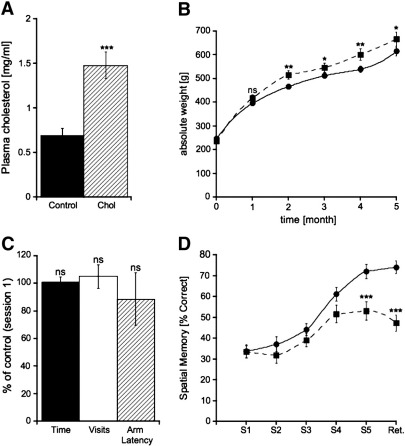
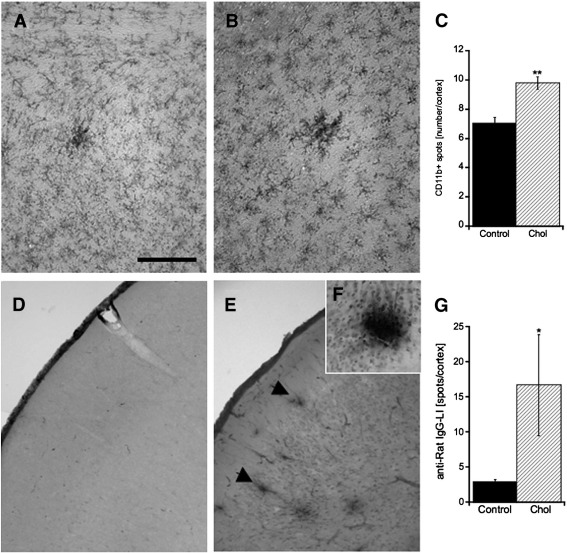
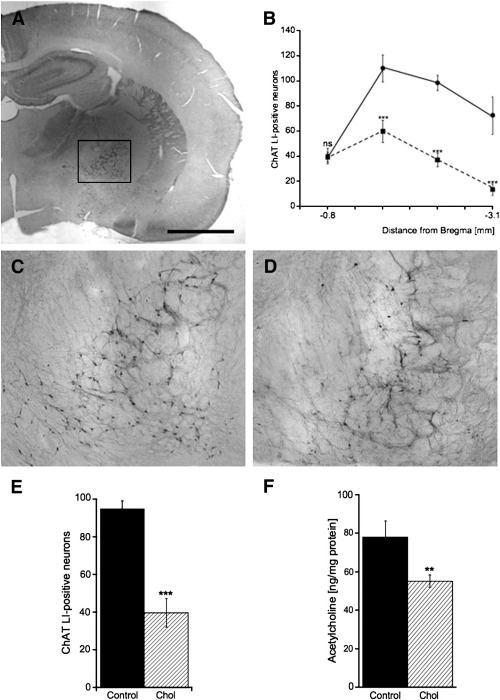
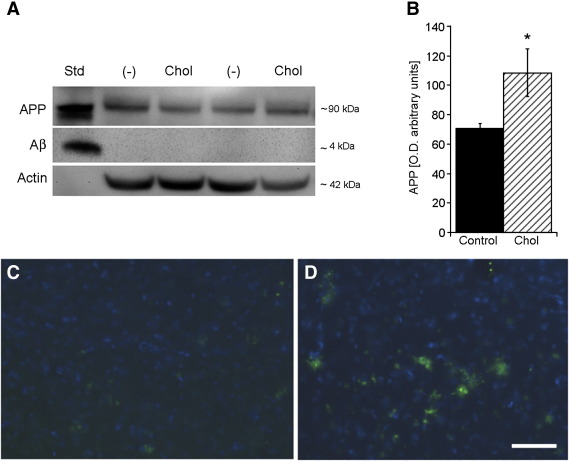
Alzheimer's disease (AD) is a chronic brain disorder characterized by cognitive impairment, cholinergic dysfunction, inflammation, tau and beta-amyloid pathology and vascular damage. Recent studies have shown, that high cholesterol levels are linked to the pathology of AD. The aim of our present work was to study the effects of hypercholesterolemia in adult rats. Five months after 5% cholesterol-enriched diet plasma cholesterol levels and total weight were significantly enhanced compared to controls. Spatial memory was studied in an 8-arm radial maze and cholesterol-treated rats showed an impaired learning and long-term memory. Hypercholesterolemia significantly reduced the number of cholinergic neurons in the basal nucleus of Meynert and decreased acetylcholine levels in the cortex. Nerve growth factor was only slightly enhanced in the cortex of cholesterol-treated animals. Levels of amyloid precursor protein, beta-amyloid(1-42), as well as tau and phospho-tau 181 were significantly enhanced in the cortex of cholesterol-fed rats. Hypercholesterolemia markedly increased several cerebral inflammatory markers and enhanced microglial CD11b-like immunoreactivity. Vascular density, stained by RECA-1 was not changed. However, cholesterol induced cortical microbleedings illustrated by intensive anti-rat IgG-positive spots in the cortex. In conclusion, our data demonstrate that hypercholesterolemia in rats caused memory impairment, cholinergic dysfunction, inflammation, enhanced cortical beta-amyloid and tau and microbleedings, all indications, which resemble an AD-like pathology.
阿尔茨海默病(AD)是一种慢性脑障碍,其特征是认知障碍、胆碱能功能障碍、炎症、tau 和 β-淀粉样蛋白病理和血管损伤。最近的研究表明,高胆固醇水平与 AD 的病理有关。我们目前工作的目的是研究高胆固醇血症对成年大鼠的影响。与对照组相比,5%胆固醇饮食 5 个月后,大鼠的血浆胆固醇水平和总体重显著升高。在 8 臂放射状迷宫中研究空间记忆,胆固醇处理的大鼠表现出学习和长期记忆受损。高胆固醇血症显著减少了梅内尔特基底核中的胆碱能神经元数量,并降低了皮质中的乙酰胆碱水平。神经生长因子在胆固醇处理动物的皮质中仅略有增强。胆固醇喂养大鼠皮质中的淀粉样前体蛋白、β-淀粉样蛋白(1-42)、tau 和磷酸化 tau 181 的水平显著升高。高胆固醇血症显著增加了几种脑炎症标志物,并增强了小胶质细胞 CD11b 样免疫反应性。用 RECA-1 染色的血管密度没有改变。然而,胆固醇诱导了皮质微出血,在皮质中可见密集的抗大鼠 IgG 阳性点。总之,我们的数据表明,大鼠的高胆固醇血症导致记忆障碍、胆碱能功能障碍、炎症、增强的皮质β-淀粉样蛋白和 tau 以及微出血,所有这些迹象都类似于 AD 样病理。