Queen Mary University of London, Blizard Institute of Cell and Molecular Science, Barts and The London School of Medicine and Dentistry, Centre for Paediatrics, London, UK.
Oncogene. 2010 Nov 18;29(46):6102-14. doi: 10.1038/onc.2010.351. Epub 2010 Aug 9.
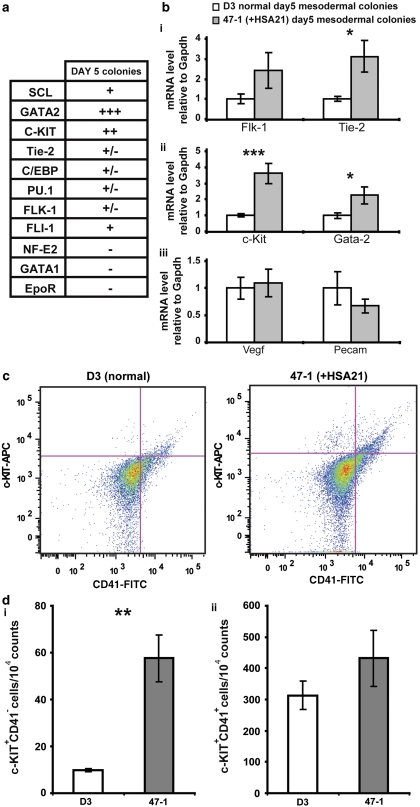
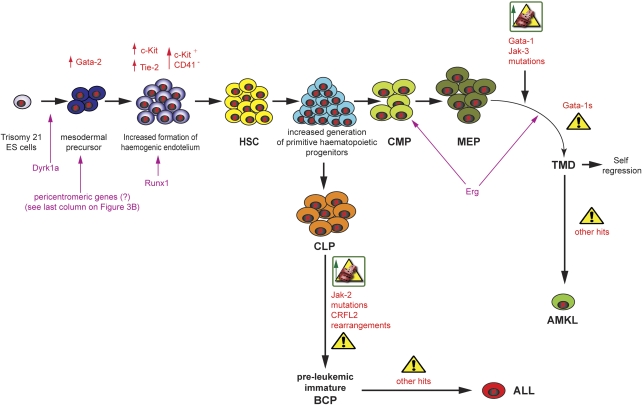
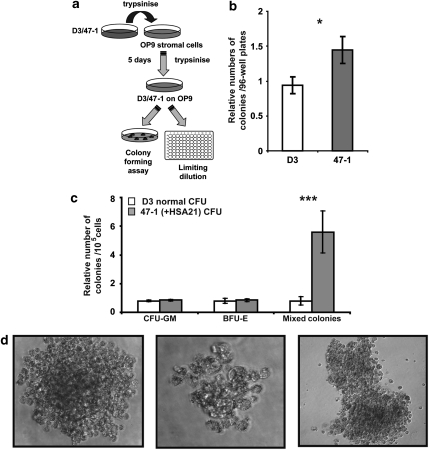
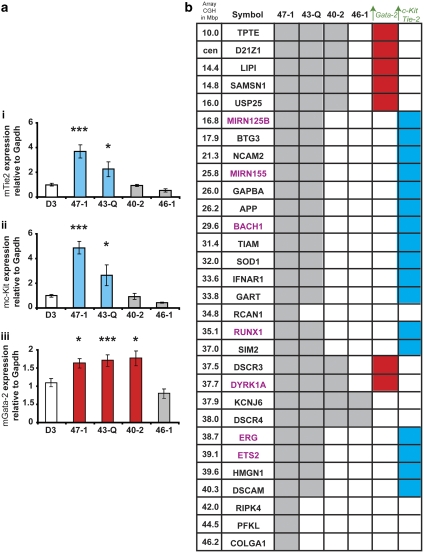
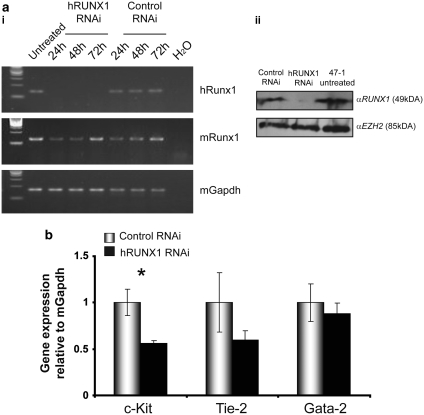
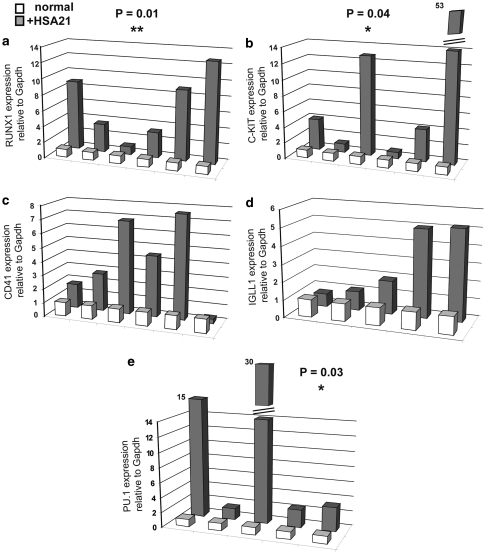
Children with Down's syndrome (DS) have 20-50-fold higher incidence of all leukaemias (lymphoid and myeloid), for reasons not understood. As incidence of many solid tumours is much lower in DS, we speculated that disturbed early haematopoietic differentiation could be the cause of increased leukaemia risk. If a common mechanism is behind the risk of both major leukaemia types, it would have to arise before the bifurcation to myeloid and lymphoid lineages. Using the transchromosomic system (mouse embryonic stem cells (ESCs)) bearing an extra human chromosome 21 (HSA21)) we analyzed the early stages of haematopoietic commitment (mesodermal colony formation) in vitro. We observed that trisomy 21 (T21) causes increased production of haemogenic endothelial cells, haematopoietic stem cell precursors and increased colony forming potential, with significantly increased immature progenitors. Transchromosomic colonies showed increased expression of Gata-2, c-Kit and Tie-2. A panel of partial T21 ESCs allowed us to assign these effects to HSA21 sub-regions, mapped by 3.5 kbp-resolution tiling arrays. The Gata-2 increase on one side, and c-Kit and Tie-2 increases on the other, could be attributed to two different, non-overlapping HSA21 regions. Using human-specific small interfering RNA silencing, we could demonstrate that an extra copy of RUNX1, but not ETS-2 or ERG, causes an increase in Tie-2/c-Kit levels. Finally, we detected significantly increased levels of RUNX1, C-KIT and PU.1 in human foetal livers with T21. We conclude that overdose of more than one HSA21 gene contributes to the disturbance of early haematopoiesis in DS, and that one of the contributors is RUNX1. As the observed T21-driven hyperproduction of multipotential immature precursors precedes the bifurcation to lymphoid and myeloid lineages, we speculate that this could create conditions of increased chance for acquisition of pre-leukaemogenic rearrangements/mutations in both lymphoid and myeloid lineages during foetal haematopoiesis, contributing to the increased risk of both leukaemia types in DS.
唐氏综合征(DS)患儿所有白血病(淋巴和髓系)的发病率高出 20-50 倍,但原因尚不清楚。由于 DS 中许多实体瘤的发病率要低得多,我们推测早期造血分化紊乱可能是白血病风险增加的原因。如果两种主要白血病类型的风险背后存在共同的机制,那么这种机制必须在向髓系和淋巴系分支之前就存在。我们使用携带额外人类染色体 21(HSA21)的转染色体系统(小鼠胚胎干细胞(ESCs))分析了体外造血定向的早期阶段(中胚层集落形成)。我们观察到,21 三体(T21)导致造血前体细胞和造血干细胞前体的血生成内皮细胞产生增加,集落形成潜能增加,不成熟祖细胞显著增加。转染色体集落表现出 Gata-2、c-Kit 和 Tie-2 的表达增加。一组部分 T21 ESCs 使我们能够通过分辨率为 3.5kbp 的平铺阵列将这些效应分配给 HSA21 亚区。Gata-2 的增加在一侧,而 c-Kit 和 Tie-2 的增加在另一侧,可以归因于两个不同的、不重叠的 HSA21 区域。使用人类特异性小干扰 RNA 沉默,我们可以证明额外的 RUNX1 拷贝,但不是 ETS-2 或 ERG,会导致 Tie-2/c-Kit 水平升高。最后,我们在 T21 人类胎肝中检测到 RUNX1、C-KIT 和 PU.1 的水平显著升高。我们得出结论,超过一个 HSA21 基因的过量表达导致 DS 中早期造血紊乱,其中一个贡献者是 RUNX1。由于观察到的 T21 驱动的多能不成熟前体的过度产生先于向淋巴和髓系分支,我们推测这可能在胎儿造血过程中为淋巴和髓系谱系中获得前白血病重排/突变创造了更高的机会条件,从而导致 DS 中两种白血病类型的风险增加。