Eppley Institute for Research in Cancer and Allied Diseases, University of Nebraska Medical Center, Omaha, NE 68198-5950, USA.
Oncogene. 2010 Oct 21;29(42):5667-77. doi: 10.1038/onc.2010.327. Epub 2010 Aug 9.
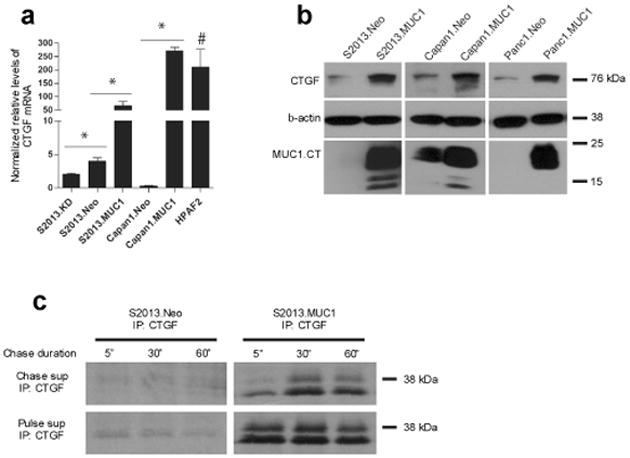
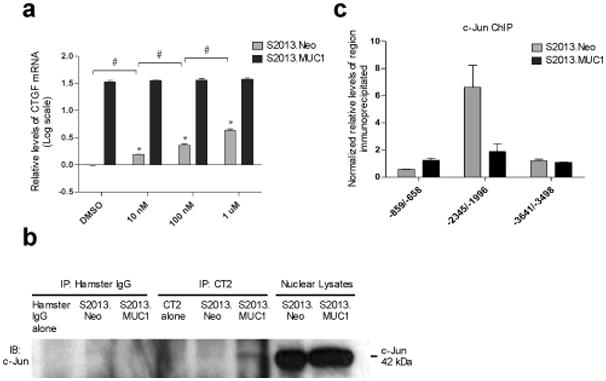
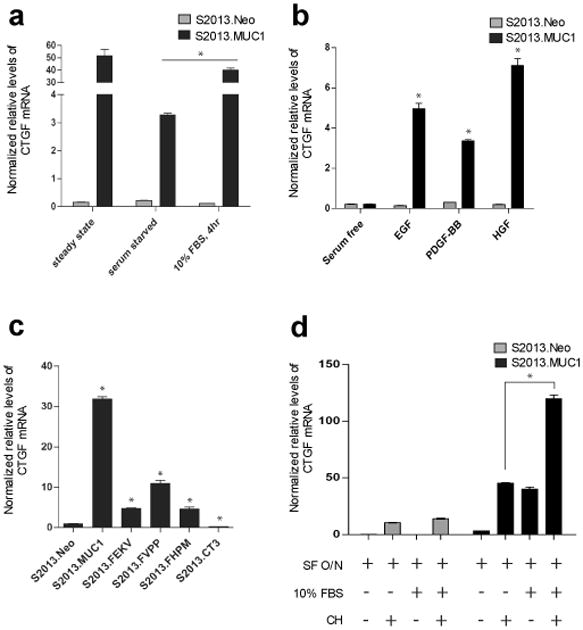
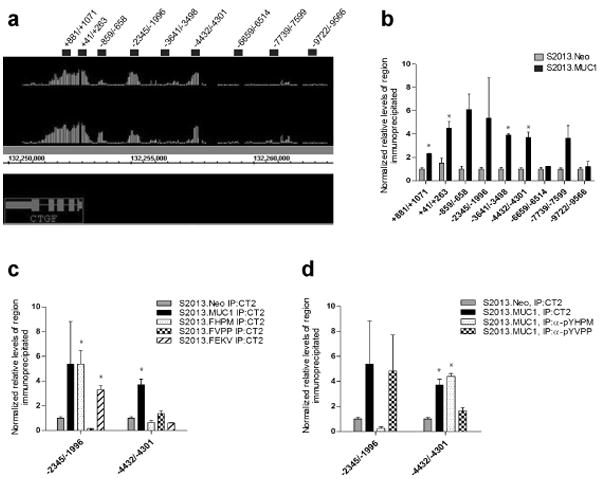
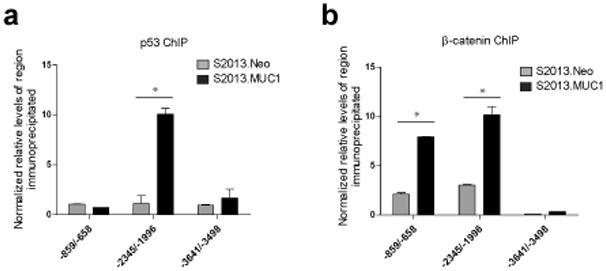
The MUC1 cytoplasmic tail (MUC1.CT) conducts signals from spatial and extracellular cues (growth factor and cytokine stimulation) to evoke a reprogramming of the cellular transcriptional profile. Specific phosphorylated forms of the MUC1.CT achieve this function by differentially associating with transcription factors and redirecting their transcriptional regulatory capabilities at specific gene regulatory elements. The specificity of interaction between MUC1.CT and several transcription factors is dictated by the phosphorylation pattern of the 18 potential phosphorylation motifs within the MUC1.CT. To better appreciate the scope of differential gene expression triggered by MUC1.CT activation, we performed microarray gene expression analysis and chromatin immunoprecipitation (ChIP)-chip promoter analysis and identified the genome-wide transcriptional targets of MUC1.CT signaling in pancreatic cancer. On a global scale, MUC1.CT preferentially targets genes related to invasion, angiogenesis and metastasis, suggesting that MUC1.CT signaling contributes to establishing a reactive tumor microenvironment during tumor progression to metastatic disease. We examined in detail the molecular mechanisms of MUC1.CT signaling that induces the expression of connective tissue growth factor (CTGF/CCN2), a potent mediator of ECM remodeling and angiogenesis. We demonstrate a robust induction of CTGF synthesis and secretion in response to serum factors that is enabled only when MUC1 is highly expressed. We demonstrate the requirement of phosphorylation at distinct tyrosine motifs within the MUC1.CT for MUC1-induced CTGF expression and demonstrate a phosphorylation-specific localization of MUC1.CT to the CTGF promoter. We found that MUC1 reorganizes transcription factor occupancy of genomic regions upstream of the CTGF gene, directing β-catenin and mutant p53 to CTGF gene regulatory elements to promote CTGF expression and destabilizing the interaction at these regions of the transcriptional repressor, c-Jun. With this example we illustrate the capacity of MUC1.CT to mediate transcription factor activity in a context-dependent manner to achieve wide spread and robust changes in gene expression and facilitate creation of the reactive tumor microenvironment.
MUC1 细胞质尾(MUC1.CT)从空间和细胞外线索(生长因子和细胞因子刺激)传导信号,引发细胞转录谱的重新编程。MUC1.CT 的特定磷酸化形式通过与转录因子的不同结合并在特定基因调控元件处重新定向其转录调控能力来实现此功能。MUC1.CT 与几种转录因子之间的相互作用特异性由 MUC1.CT 内的 18 个潜在磷酸化基序的磷酸化模式决定。为了更好地理解 MUC1.CT 激活引发的差异基因表达的范围,我们进行了微阵列基因表达分析和染色质免疫沉淀(ChIP)-芯片启动子分析,并鉴定了胰腺癌细胞中 MUC1.CT 信号的全基因组转录靶标。在全局范围内,MUC1.CT 优先靶向与侵袭、血管生成和转移相关的基因,表明 MUC1.CT 信号有助于在肿瘤进展为转移性疾病期间建立反应性肿瘤微环境。我们详细研究了 MUC1.CT 信号诱导结缔组织生长因子(CTGF/CCN2)表达的分子机制,CTGF 是 ECM 重塑和血管生成的有力介质。我们证明了 CTGF 合成和分泌的强烈诱导对血清因子的反应,只有当 MUC1 高表达时才能实现。我们证明了 MUC1.CT 内特定酪氨酸基序的磷酸化对于 MUC1 诱导的 CTGF 表达是必需的,并证明了 MUC1.CT 的磷酸化特异性定位到 CTGF 启动子。我们发现 MUC1 重新组织了 CTGF 基因上游基因组区域的转录因子占据,指导 β-连环蛋白和突变型 p53 到 CTGF 基因调控元件,以促进 CTGF 表达并破坏转录抑制剂 c-Jun 这些区域的相互作用。通过这个例子,我们说明了 MUC1.CT 以依赖于上下文的方式介导转录因子活性的能力,以实现广泛而强大的基因表达变化,并促进反应性肿瘤微环境的形成。