Chagan-Yasutan Haorile, Shiratori Beata, Siddiqi Umme Ruman, Saitoh Hiroki, Ashino Yugo, Arikawa Tomohiro, Hirashima Mitsuomi, Hattori Toshio
Department of Emerging Infectious Diseases, Graduate School of Medicine, Tohoku University, Sendai, Japan.
Clin Mol Allergy. 2010 Aug 11;8:12. doi: 10.1186/1476-7961-8-12.
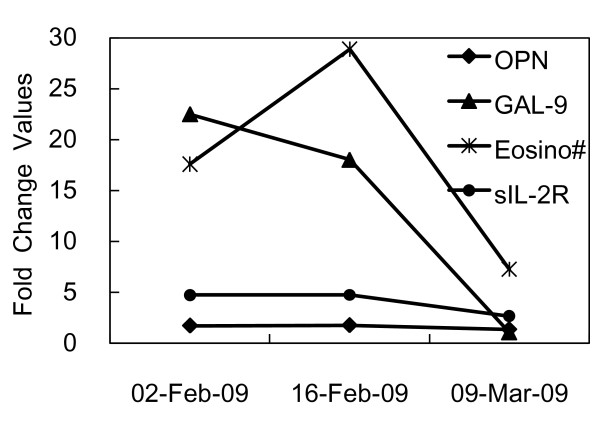
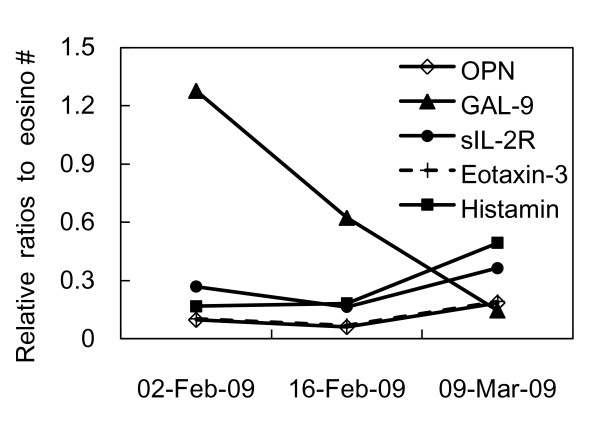
Allergic reaction to insulin is known to be associated with eosinophilia and hyper IgE. Recent report showed that eosinophilia is related with the increased synthesis of galectin-9 (GAL-9) and osteopontin (OPN). Here, we examined plasma levels of GAL-9 and OPN first time in a case of 65-year old patient with insulin allergy. Insulin aspart & insulin aspart 30 mix were given to the patient and an elevation of the eosinophil count (8440/mul, 17.6 fold) and a moderate increase of IgE (501 U/ml, reference range: 10-350 U/ml), eotaxin-3 (168 pg/ml, 2 fold), histamine (0.95 ng/ml, 5.3 fold) were found 33 days later. The plasma levels of GAL-9 and OPN were 22.5 and 1.7 fold higher than the cut-off point, respectively. After one month cessation of insulin therapy, elevations of the eosinophil count (3,480/mul; 7.3 fold), and OPN (1.4 fold) still occurred but the GAL-9 levels became normal. Therefore, we noted the increases of GAL-9 and OPN in plasma for the first time in a patient with insulin allergy and propose that GAL-9 reflects the conditions of allergy more accurately.
已知对胰岛素的过敏反应与嗜酸性粒细胞增多和高IgE相关。最近的报告显示,嗜酸性粒细胞增多与半乳糖凝集素-9(GAL-9)和骨桥蛋白(OPN)合成增加有关。在此,我们首次检测了一名65岁胰岛素过敏患者的血浆GAL-9和OPN水平。给该患者注射门冬胰岛素和门冬胰岛素30混合注射液,33天后发现嗜酸性粒细胞计数升高(8440/μl,17.6倍),IgE适度增加(501 U/ml,参考范围:10 - 350 U/ml),嗜酸性粒细胞趋化因子-3(168 pg/ml,2倍),组胺(0.95 ng/ml,5.3倍)。血浆GAL-9和OPN水平分别比临界值高22.5倍和1.7倍。胰岛素治疗停止一个月后,嗜酸性粒细胞计数(3480/μl;7.3倍)和OPN(1.4倍)仍有升高,但GAL-9水平恢复正常。因此,我们首次在胰岛素过敏患者中发现血浆GAL-9和OPN升高,并提出GAL-9能更准确地反映过敏状况。