Division of Plant Sciences and National Center for Soybean Biotechnology, University of Missouri, Columbia, MO 65211, USA.
BMC Genomics. 2010 Aug 11;11:469. doi: 10.1186/1471-2164-11-469.
With the advance of new massively parallel genotyping technologies, quantitative trait loci (QTL) fine mapping and map-based cloning become more achievable in identifying genes for important and complex traits. Development of high-density genetic markers in the QTL regions of specific mapping populations is essential for fine-mapping and map-based cloning of economically important genes. Single nucleotide polymorphisms (SNPs) are the most abundant form of genetic variation existing between any diverse genotypes that are usually used for QTL mapping studies. The massively parallel sequencing technologies (Roche GS/454, Illumina GA/Solexa, and ABI/SOLiD), have been widely applied to identify genome-wide sequence variations. However, it is still remains unclear whether sequence data at a low sequencing depth are enough to detect the variations existing in any QTL regions of interest in a crop genome, and how to prepare sequencing samples for a complex genome such as soybean. Therefore, with the aims of identifying SNP markers in a cost effective way for fine-mapping several QTL regions, and testing the validation rate of the putative SNPs predicted with Solexa short sequence reads at a low sequencing depth, we evaluated a pooled DNA fragment reduced representation library and SNP detection methods applied to short read sequences generated by Solexa high-throughput sequencing technology.
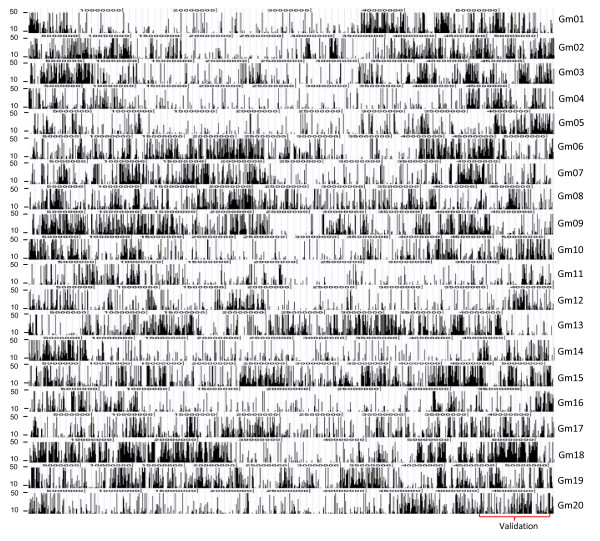
A total of 39,022 putative SNPs were identified by the Illumina/Solexa sequencing system using a reduced representation DNA library of two parental lines of a mapping population. The validation rates of these putative SNPs predicted with low and high stringency were 72% and 85%, respectively. One hundred sixty four SNP markers resulted from the validation of putative SNPs and have been selectively chosen to target a known QTL, thereby increasing the marker density of the targeted region to one marker per 42 K bp.
We have demonstrated how to quickly identify large numbers of SNPs for fine mapping of QTL regions by applying massively parallel sequencing combined with genome complexity reduction techniques. This SNP discovery approach is more efficient for targeting multiple QTL regions in a same genetic population, which can be applied to other crops.
随着新型大规模并行基因分型技术的进步,在鉴定重要复杂性状的基因方面,数量性状基因座(QTL)精细定位和基于图谱的克隆变得更加可行。在特定作图群体的 QTL 区域中开发高密度遗传标记对于经济重要基因的精细定位和基于图谱的克隆至关重要。单核苷酸多态性(SNP)是在任何不同基因型之间存在的最丰富的遗传变异形式,通常用于 QTL 作图研究。大规模并行测序技术(罗氏 GS/454、Illumina GA/Solexa 和 ABI/SOLiD)已广泛应用于识别全基因组序列变异。然而,目前尚不清楚在作物基因组的任何感兴趣的 QTL 区域中,低测序深度的序列数据是否足以检测到存在的变异,以及如何为大豆等复杂基因组准备测序样本。因此,我们的目标是通过经济有效的方法鉴定用于精细定位几个 QTL 区域的 SNP 标记,并测试在低测序深度下使用 Solexa 短序列读取预测的假定 SNP 的验证率,我们评估了一种用于短读序列生成的 pooled DNA 片段简化表示文库和 SNP 检测方法。Solexa 高通量测序技术。
使用作图群体两个亲本系的简化表示 DNA 文库,通过 Illumina/Solexa 测序系统共鉴定出 39022 个假定 SNP。使用低严格性和高严格性预测这些假定 SNP 的验证率分别为 72%和 85%。从假定 SNP 的验证中得到 164 个 SNP 标记,并已选择性地选择用于靶向已知 QTL,从而将目标区域的标记密度提高到每 42 Kbp 一个标记。
我们通过应用大规模并行测序结合基因组复杂性降低技术,展示了如何快速鉴定 QTL 区域精细定位的大量 SNP。这种 SNP 发现方法更有效地针对同一遗传群体中的多个 QTL 区域,可应用于其他作物。